






Manila Bulletin
 Philippines
National
Marcos cites technology, science in addressing plastic pollution
Philippines
National
Marcos cites technology, science in addressing plastic pollution
Philippines
National
Marcos cites technology, science in addressing plastic pollution
Marcos cites technology, science in addressing plastic pollution
Published Nov 25, 2025 01:09 pm


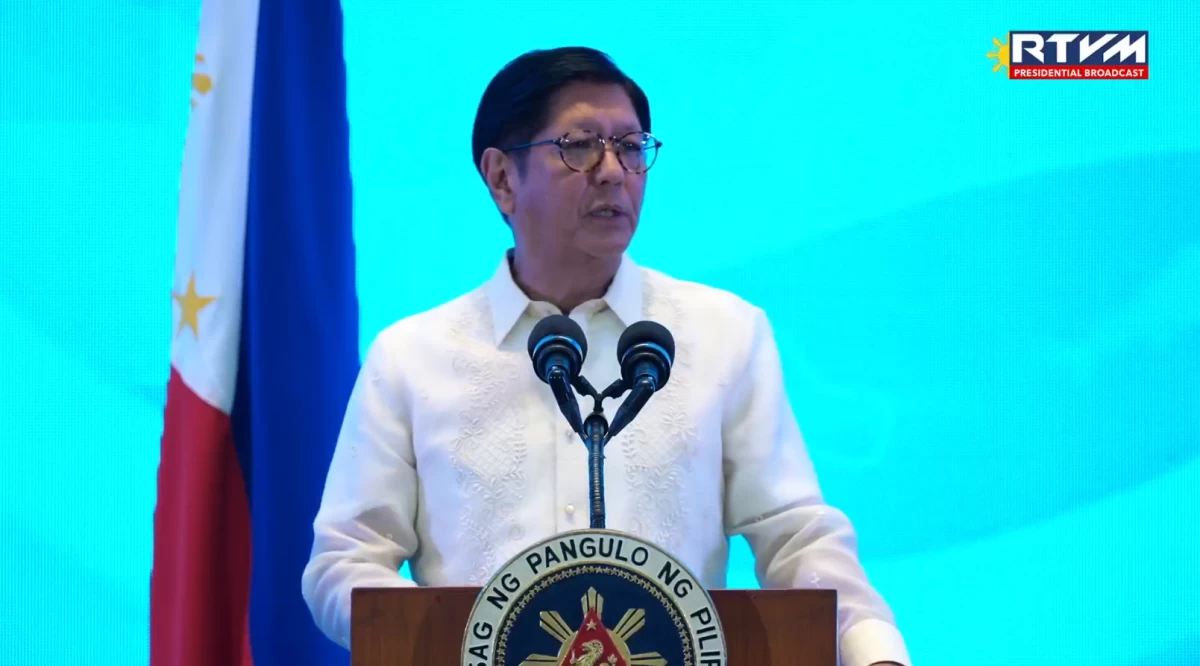
President Ferdinand R. Marcos Jr. speaks during the opening ceremony of the International Atomic Energy Agency (IAEA) International High-Level Forum on Nuclear Technology for Controlling Plastic Pollution (NUTEC Plastics) on Nov. 25, 2025. (RTVM)
Addressing plastic pollution requires not only regulation and advocacy, but credible technology, President Marcos said.
During the opening ceremony of the International Atomic Energy Agency (IAEA) International High-Level Forum on Nuclear Technology for Controlling Plastic Pollution (NUTEC Plastics) on Tuesday, Nov. 25, Marcos emphasized that plastic pollution affects biodiversity, public health, supply chains, and lives. Thus, the need to address it using modern technologies.
"Plastic pollution is emblematic of this new era of challenges: global in scale, persistent in impact, and deeply entangled with the way economies grow. It affects biodiversity, public health, supply chains, and the lives of our coastal and urban communities," Marcos said in his speech.
"Addressing it requires going beyond regulation and advocacy. It requires technology that is credible, scalable, and grounded in rigorous science," he added.
The President also stressed that "leadership today demands not only political will, but an ability to integrate scientific evidence, cutting-edge research, and strategic foresight into national and global decision-making."
He stated that the world is undergoing a technological shift as consequential as the Industrial Revolution.
Leaders, he added, must ensure that these technologies are aligned with human well-being and with environmental integrity.
"The leaders of this century must not only adopt new technologies — they must ensure that these technologies are aligned with human well-being, with ethical standards, with environmental integrity, and with sustainable growth," he said.
The Chief Executive also underscored that plastic pollution not only posed a major problem that has now become global in scale, but also deeply entangled with the way economies grow.
“That is why the Philippines is proud to champion the NUTEC Plastics Initiative of the IAEA. NUTEC Plastics embodies the kind of innovation we need — solutions that merge advanced nuclear applications with environmental protection, to translate scientific progress into tangible benefits for industry and for society,” Marcos told the forum attendees.
Scientific institutions in the Philippines have embraced this challenge, building on the strength of international scientific cooperation, Marcos noted.
Waste to value
Under the Post-Radiation Reactive Extrusion of Plastic Wastes Project, or PREx, the Philippine Nuclear Research Institute of the Department of Science and Technology (DOST), together with the Industrial Technology Development Institute and its industry partner, Envirotech, have developed a breakthrough process that transforms low-value plastic wastes into durable, commercially viable materials.
He cited that the PREx Prototype House stands today as a tangible output of the initiative.
"It shows how radiation technology can enhance polymer properties, reduce material degradation, create new industrial uses for plastics where there were none before," Marcos said.
"And this is how innovation reshapes a sector: by converting to what we once called 'waste' into new value," Marcos added.
The President also mentioned the marine microplastics monitoring laboratory established with the IAEA at the University of the Philippines – Marine Science Institute that equips Filipino researchers with the tools to quantify microplastic pollution with scientific precision.
Data generated from the facility informs global models, strengthens policy interventions, and helps experts track the real-time impacts of plastics on marine ecosystems, the President added.
Marcos also highlighted the launch of the NUTEC Plastics Investment and Partnership Brochure, which outlines opportunities for governments, industries, and research agencies to scale up investment in nuclear science for environmental protection and industry growth.
The President said the Philippines is committed to building networks with regulators, scientists, investors and community stakeholders, as manifested by his signing of Republic Act No. 12305 or the Philippine Nuclear Law last September.
"It gives our scientists now and industries as well a stable, predictable environment to innovate responsibly. It also signals that the Philippines is ready for deeper, science-driven cooperation with global partners," he said.
Under the Philippines’ Chairship of the Association of Southeast Asian Nations (ASEAN) in 2026, the President said the region will expand the work of the ASEAN Network of Regulatory Bodies on Atomic Energy (ASEANTOM) in enhancing nuclear science literacy, laboratory networks, and regulatory harmonization.
He cited NUTEC Plastics as a model for ASEAN collaboration on science-based solutions to transboundary problems, adding that technology and sustainability will form a central part of the Philippines' ASEAN chairship.
“Our engagement with the IAEA and our support for science-based responses to plastic pollution reflect that same conviction: that durable progress comes not from acting alone, but from strengthening the international system that makes such cooperation possible,” Marcos said.
“This Forum is part of that commitment. It reflects a belief that the peaceful uses of nuclear science can uplift communities, support green industries, and strengthen the resilience of nations,” he added.
In Malacañan, Marcos received Director General Rafael Mariano Grossi of the International Atomic Energy Agency (IAEA) during a courtesy call on Tuesday afternoon.
Grossi, who assumed office in 2019, is on his first official visit to the Philippines for the International High-Level Forum on Nuclear Technology for Controlling Plastic Pollution (NUTEC Plastics): Scaling Solutions and Partnerships for Global Impact.
The Philippines is hosting the forum from Nov. 25 to 26.
With headquarters in Vienna, Austria, the IAEA was established in 1957 within the United Nations system to promote the safe, secure, and peaceful use of nuclear technologies.
The Philippines has been a member state of the IAEA since 1958.
Through its participation in various IAEA technical cooperation projects, the country has strengthened its capabilities and expertise in nuclear science and technology and contributed to the global exchange of knowledge and best practices on the peaceful applications of nuclear energy, nuclear safety, safeguards and security.