






Manila Bulletin
 Lifestyle
Health and Wellness
How this Filipina became a world-class infectious diseases expert
Lifestyle
Health and Wellness
How this Filipina became a world-class infectious diseases expert
Lifestyle
Health and Wellness
How this Filipina became a world-class infectious diseases expert
How this Filipina became a world-class infectious diseases expert
Cementing Dr. Thelma Tupasi's legacy as a pioneer for modern tuberculosis treatment
Published Nov 24, 2025 07:04 pm


At A Glance
- Dr. Thelma's interest in infectious diseases, specifically tuberculosis, was ignited when she herself was diagnosed with tuberculosis during medical school.
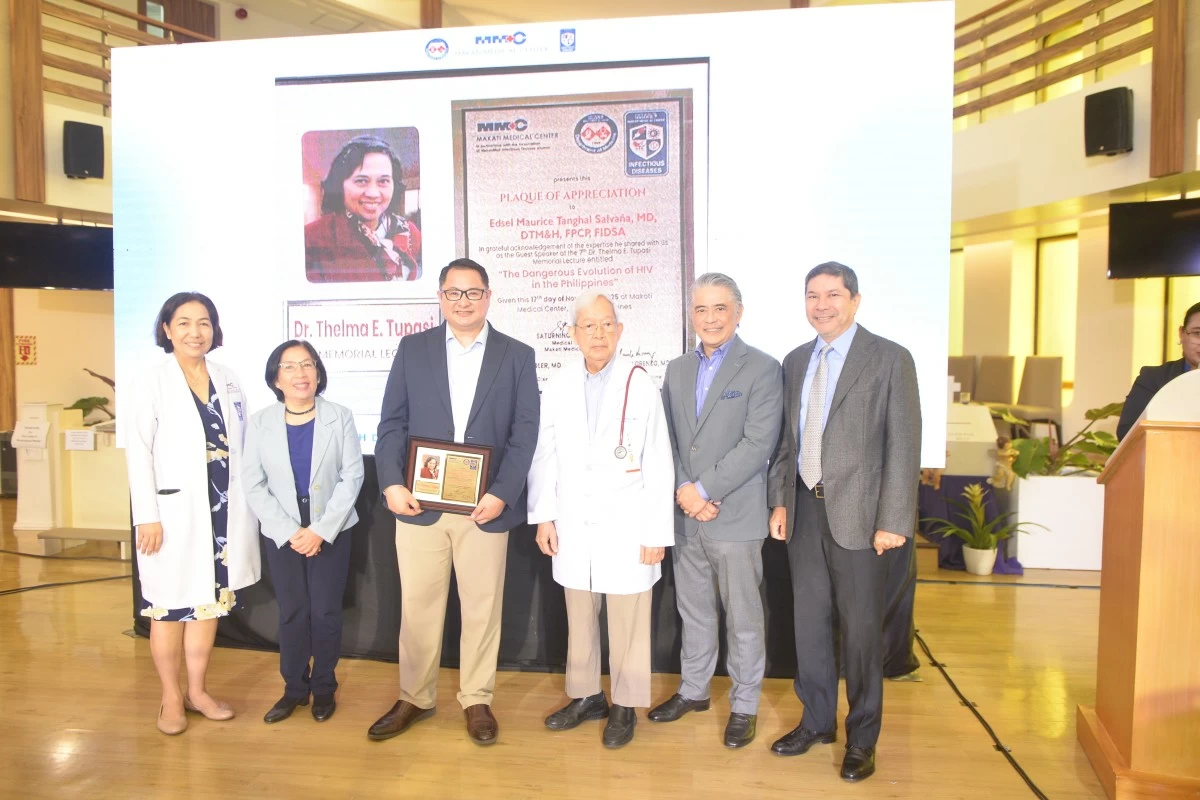
REMEMBERING HER LEGACY From left: Philippine Society for Microbiology and Infectious Diseases president Dr. Janice Campos-Caoili, Association of Makati Med Infectious Diseases Alumni president Dr. Evelyn Alesna, the author, Dr. Claver Ramos, Makati Medical Center medical director Dr. Saturnino Javier, and Makati Medical Center Department of Medicine chair Dr. Jose Paulo P. Lorenzo at the Dr. Thelma Tupasi Memorial Lecture. (Photo courtesy of AMIDA and ID Section, Makati Medical Center).
Last Nov. 17, 2025, I had the distinct honor of delivering the seventh Dr. Thelma Tupasi Memorial Lecture at the Makati Medical Center. Dr. Thelma Tupasi was one of the pillars of infectious diseases in the Philippines, and her contributions to the proper treatment of tuberculosis are acknowledged worldwide. If you or someone you know has ever been diagnosed with tuberculosis, the ubiquitous TB DOTS (Directly Observed Treatment Strategy) clinics from where free treatment can be obtained were first set up by her and her team. She pioneered the use of an intensified TB DOTS setup for the successful treatment of drug-resistant tuberculosis, and this served as a model for the rest of the world after the World Health Organization (WHO) determined that her interventions were more successful than other approaches. Her studies on drug-resistant tuberculosis are still quoted in scientific literature and remain relevant even in this age of molecular diagnostics and artificial intelligence. The research institutions she set up, particularly the Tropical Disease Foundation (TDF) at the Makati Medical Center, which was the original country recipient of the Global Fund to Fight AIDS, Tuberculosis, and Malaria, are still going strong. TDF was responsible for setting up the provision of free antiretroviral treatment for people with HIV in our country. In addition, tuberculosis remains the biggest killer of people with HIV in our part of the world. I believe these are the two reasons why the organizers invited me to give the memorial lecture, since my research and advocacy work are on HIV and AIDS.
As a disclosure, I have many personal connections with Dr. Thelma. Her daughter, Gina, was my classmate in college. My wife Angela and I asked her to be our ninang at our wedding. Her husband, Dr. Claver Ramos, was the best man at the wedding of my father-in-law, Dr. Ernesto Domingo. Organizers, however, reassured me that this did not play a role in my selection as the speaker for the memorial lecture when I brought it up. They weren’t even aware of our personal connections since Dr. Thelma is a very private person.
The event kicked off with a retelling of her life and accomplishments. Dr. Thelma’s interest in infectious diseases, specifically tuberculosis, was ignited when she herself was diagnosed with tuberculosis during medical school. Her experience with the disease and treatment drove her to become a lifelong tuberculosis advocate. She graduated from the University of the Philippines College of Medicine and went on to do further training in the US at the National Communicable Disease Center in Atlanta, at the University of Washington in Seattle, and at the University of Virginia in Charlottesville. She spearheaded the national survey of tuberculosis prevalence in the Philippines in the 1990s and catalyzed the successful public-private partnership that remains a cornerstone of tuberculosis treatment in our country. The TDF model of treatment for drug-resistant tuberculosis was greenlit by the WHO and served as a template for the rollout of similar models all over the world. Dr. Thelma has served in many national and international leadership positions. These include serving as the director of the Research Institute for Tropical Medicine and as chair of the Stop TB Working Group for DR-TB convened by the World Health Organization. Dr. Thelma was the recipient of numerous national and international awards and was elected as an academician of the National Academy of Science and Technology. She has nurtured and mentored many infectious disease trainees who have become internationally renowned researchers and clinicians.
I started my talk by telling the audience that during my training abroad, whenever I met infectious disease researchers, their first question when they found out I was from the Philippines was whether I knew Dr. Thelma. This was the extent of her outsized impact in the scientific world. Several of her collaborators remarked that the research cohort of tuberculosis patients she assembled was the best and most meticulously characterized in all of scientific literature, and that her work on the treatment of drug-resistant tuberculosis is the foundation of our current MDR-TB (multi-drug-resistant tuberculosis) programs worldwide.
I then spoke of my own infectious diseases journey, returning from the US as a newly minted infectious diseases physician and researcher, and running headlong into a burgeoning HIV epidemic. During my training at Case Western Reserve University in Cleveland, I was taught how to treat HIV as part of my infectious diseases fellowship. Some of my professors asked if I wanted to do research on HIV, to which I replied that there was very little HIV in the Philippines. I told them I needed to study something more relevant to my country, like worms. I joined Dr. James Kazura’s laboratory and studied lymphatic filariasis, which is the causative agent of elephantiasis, endemic in the Philippines.

GLOBAL HEALTH ICON National academician Dr. Thelma Tupasi (Photo courtesy of NAST-DOST)
During my medical school years from 1996 to 2001, I saw exactly two people with HIV, and that low and slow trend continued until around 2008, when I returned to the Philippines. Then I started seeing many young men in the wards at the Philippine General Hospital dying of opportunistic infections, including disseminated tuberculosis, cryptococcus meningitis, and pneumocystis pneumonia. All of these infections are AIDS-defining illnesses, and true enough, many of these young men tested positive for HIV. I found myself having to change plans quickly, shifting my research focus to HIV and calling my mentors in Cleveland for help… The very same ones I turned down when they invited me to join their HIV research laboratory.
With guidance from my mentors, including Dr. Thelma, and with funding from the government, our team at the Institute of Molecular Biology and Biotechnology did seminal work on HIV drug resistance and treatment failure, paralleling Dr. Thelma’s own work in drug-resistant tuberculosis. We discovered that the unprecedented rise in HIV cases was due to the entry of a more virulent clade of HIV, CRF01_AE, which took the place of subtype B, which was previously the dominant clade in the country. This is similar to what happened with the variants of SARS-CoV-2 during the Covid-19 pandemic, but at a slower scale since HIV takes much longer to spread than SARS-CoV-2. We also developed a low-cost drug-resistance test for HIV, which won a prestigious international award in 2023 and is in the process of clinical validation.
I ended my talk by speaking about how Dr. Thelma’s experience served as an inspiration for my research. I last worked with her when we updated the national tuberculosis clinical practice guidelines in 2016, and she was very pleased that her trainees and colleagues were carrying on her life’s work. She passed away in 2019, and the WHO acknowledged the global impact of her work by observing a moment of silence in their offices in Geneva. During the pandemic, we acutely felt her absence and felt she would have known what to do, but we used her lessons and training to address the crisis as best we could.
Gina gave the response on behalf of the family, and she mentioned that Dr. Thelma would have been gratified with the work that has been done, building on the foundation of her own remarkable research accomplishments. She quoted from an exchange we had during the pandemic, where I told her that we could really have used her mom’s expertise during those dark times. I reassured her that we felt Dr. Thelma’s presence with each patient we saw as we drew upon her lessons and the excellence she expected of all her students. Dr. Thelma’s legacy definitely lives on in each of us, and our country and the world are a better place as a result of her wonderful life.