ADVERTISEMENT

BPI brings down health insurance cost by focusing on top 3 causes of death

Published Nov 24, 2025 12:00 am  |  Updated Nov 22, 2025 03:33 pm
Ayala-led Bank of the Philippine Islands (BPI) and BPI/MS Insurance Corp. (BPI MS) are offering a simplified health insurance that focuses only on the top three causes of death in the Philippines to bring down the cost for Filipinos.
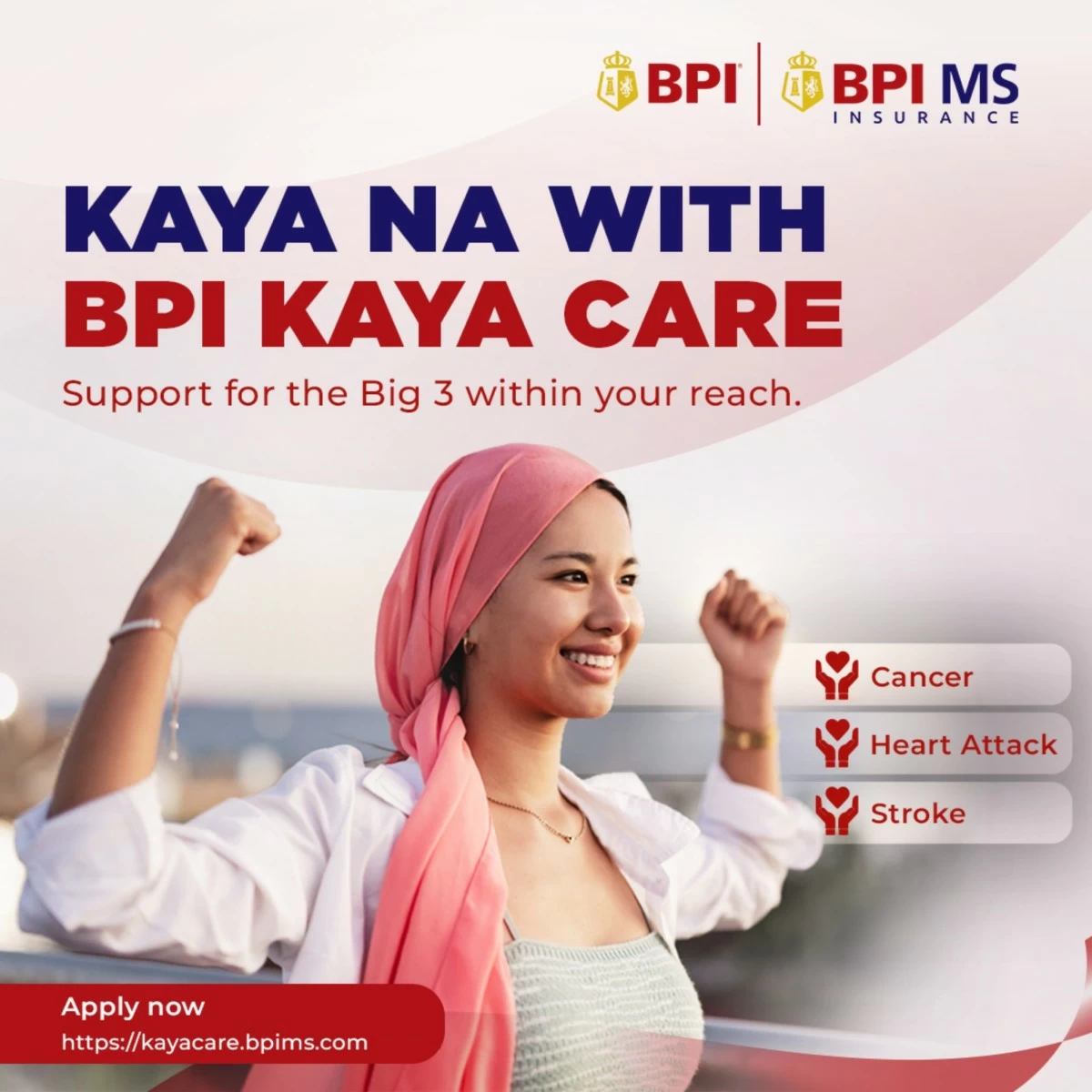
Launched last week, BPI Kaya Care critical illness insurance is a simple, accessible, and affordable plan designed to help Filipinos safeguard themselves and their loved ones against today’s most serious health risks.
BPI Kaya Care was created to address a growing health crisis—the increasing number of Filipinos diagnosed with critical illnesses.
Data from the Philippine Statistics Authority (PSA) shows that in 2023, the three leading causes of death in the country were ischemic heart disease, cancer, and cerebrovascular diseases such as stroke.
To help Filipinos prepare for these risks, BPI Kaya Care offers a lump-sum cash benefit upon diagnosis of any of these critical illnesses: cancer, heart attack, or stroke.
Clients diagnosed at an early stage receive 50 percent of the benefit, while late-stage or major diagnoses receive the full amount.
This cash benefit, which can be claimed so long as the insured survives seven days after diagnosis, enables policyholders to begin treatment promptly and maintain financial stability during a deeply challenging period.
While the benefit is primarily intended for medical interventions, families are free to use it for therapy, medication, or daily living expenses, depending on what matters most to them.
“At BPI, our purpose is clear: to Build a Better Philippines, one family, one community at a time,” said Maria Cristina Go, consumer banking head of BPI.
She added that, “For too long, critical illness insurance has felt complex and out of reach. We wanted to change that. BPI Kaya Care is more than a policy—it’s a partner that helps families focus on recovery without financial strain, support that truly matters when it matters most.”
Unlike treatment-specific government programs, BPI Kaya Care fills a critical gap: many Filipinos delay treatment after diagnosis because they need time to secure funds.
BPI Kaya Care provides immediate cash support, helping remove this hurdle so patients and families can focus on timely treatment and better health outcomes.
To ensure that this protection is within reach for a wide range of Filipino households, premiums start at only ₱859 per year, depending on the client’s age and chosen plan. Enrollment has also been made simple and convenient.
Customers may avail of the product online through kayacare.bpims.com, or by visiting any BPI branch or the nearest BPI MS office. The claims process is equally straightforward and supportive, reinforcing the product’s commitment to accessibility.
“The silent crisis of underinsurance, coupled with surging medical costs, creates an urgent need for simple, accessible insurance solutions,” said Noriyuki Kobayashi, president and chief executive officer (CEO) of BPI MS.
He added that, “BPI MS is proud to collaborate with BPI to bring BPI Kaya Care to life. By delivering this vital and affordable protection to the core and middle markets, we are helping more Filipino families secure their future and take control of their health without compromising their financial stability.”
The launch of BPI Kaya Care reflects the bank’s broader commitment to uplifting Filipino families and strengthening national resilience.
As the government continues to invest in improving healthcare infrastructure, including significant funding for specialty hospitals, BPI Kaya Care ensures that Filipino families not only have access to these facilities but also the financial means to afford essential treatments.
ADVERTISEMENT
.most-popular .layout-ratio{ padding-bottom: 79.13%; } @media (min-width: 768px) and (max-width: 1024px) { .widget-title { font-size: 15px !important; } }

{{ articles_filter_1561_widget.title }}

.most-popular .layout-ratio{ padding-bottom: 79.13%; } @media (min-width: 768px) and (max-width: 1024px) { .widget-title { font-size: 15px !important; } }

{{ articles_filter_1562_widget.title }}

.most-popular .layout-ratio{ padding-bottom: 79.13%; } @media (min-width: 768px) and (max-width: 1024px) { .widget-title { font-size: 15px !important; } }

{{ articles_filter_1563_widget.title }}

{{ articles_filter_1564_widget.title }}

.mb-article-details { position: relative; } .mb-article-details .article-body-preview, .mb-article-details .article-body-summary{ font-size: 17px; line-height: 30px; font-family: "Libre Caslon Text", serif; color: #000; } .mb-article-details .article-body-preview iframe , .mb-article-details .article-body-summary iframe{ width: 100%; margin: auto; } .read-more-background { background: linear-gradient(180deg, color(display-p3 1.000 1.000 1.000 / 0) 13.75%, color(display-p3 1.000 1.000 1.000 / 0.8) 30.79%, color(display-p3 1.000 1.000 1.000) 72.5%); position: absolute; height: 200px; width: 100%; bottom: 0; display: flex; justify-content: center; align-items: center; padding: 0; } .read-more-background a{ color: #000; } .read-more-btn { padding: 17px 45px; font-family: Inter; font-weight: 700; font-size: 18px; line-height: 16px; text-align: center; vertical-align: middle; border: 1px solid black; background-color: white; } .hidden { display: none; }
function initializeAllSwipers() { // Get all hidden inputs with cms_article_id document.querySelectorAll('[id^="cms_article_id_"]').forEach(function (input) { const cmsArticleId = input.value; const articleSelector = '#article-' + cmsArticleId + ' .body_images'; const swiperElement = document.querySelector(articleSelector); if (swiperElement && !swiperElement.classList.contains('swiper-initialized')) { new Swiper(articleSelector, { loop: true, pagination: false, navigation: { nextEl: '#article-' + cmsArticleId + ' .swiper-button-next', prevEl: '#article-' + cmsArticleId + ' .swiper-button-prev', }, }); } }); } setTimeout(initializeAllSwipers, 3000); const intersectionObserver = new IntersectionObserver( (entries) => { entries.forEach((entry) => { if (entry.isIntersecting) { const newUrl = entry.target.getAttribute("data-url"); if (newUrl) { history.pushState(null, null, newUrl); let article = entry.target; // Extract metadata const author = article.querySelector('.author-section').textContent.replace('By', '').trim(); const section = article.querySelector('.section-info ').textContent.replace(' ', ' '); const title = article.querySelector('.article-title h1').textContent; // Parse URL for Chartbeat path format const parsedUrl = new URL(newUrl, window.location.origin); const cleanUrl = parsedUrl.host + parsedUrl.pathname; // Update Chartbeat configuration if (typeof window._sf_async_config !== 'undefined') { window._sf_async_config.path = cleanUrl; window._sf_async_config.sections = section; window._sf_async_config.authors = author; } // Track virtual page view with Chartbeat if (typeof pSUPERFLY !== 'undefined' && typeof pSUPERFLY.virtualPage === 'function') { try { pSUPERFLY.virtualPage({ path: cleanUrl, title: title, sections: section, authors: author }); } catch (error) { console.error('ping error', error); } } // Optional: Update document title if (title && title !== document.title) { document.title = title; } } } }); }, { threshold: 0.1 } ); function showArticleBody(button) { const article = button.closest("article"); const summary = article.querySelector(".article-body-summary"); const body = article.querySelector(".article-body-preview"); const readMoreSection = article.querySelector(".read-more-background"); // Hide summary and read-more section summary.style.display = "none"; readMoreSection.style.display = "none"; // Show the full article body body.classList.remove("hidden"); } document.addEventListener("DOMContentLoaded", () => { let loadCount = 0; // Track how many times articles are loaded const offset = [1, 2, 3, 4, 5, 6, 7, 8, 9, 10]; // Offset values const currentUrl = window.location.pathname.substring(1); let isLoading = false; // Prevent multiple calls if (!currentUrl) { console.log("Current URL is invalid."); return; } const sentinel = document.getElementById("load-more-sentinel"); if (!sentinel) { console.log("Sentinel element not found."); return; } function isSentinelVisible() { const rect = sentinel.getBoundingClientRect(); return ( rect.top < window.innerHeight && rect.bottom >= 0 ); } function onScroll() { if (isLoading) return; if (isSentinelVisible()) { if (loadCount >= offset.length) { console.log("Maximum load attempts reached."); window.removeEventListener("scroll", onScroll); return; } isLoading = true; const currentOffset = offset[loadCount]; window.loadMoreItems().then(() => { let article = document.querySelector('#widget_1690 > div:nth-last-of-type(2) article'); intersectionObserver.observe(article) loadCount++; }).catch(error => { console.error("Error loading more items:", error); }).finally(() => { isLoading = false; }); } } window.addEventListener("scroll", onScroll); });

Sign up by email to receive news.