







PBBM highlights role of space science in serving Filipinos
Published Nov 22, 2025 08:00 am


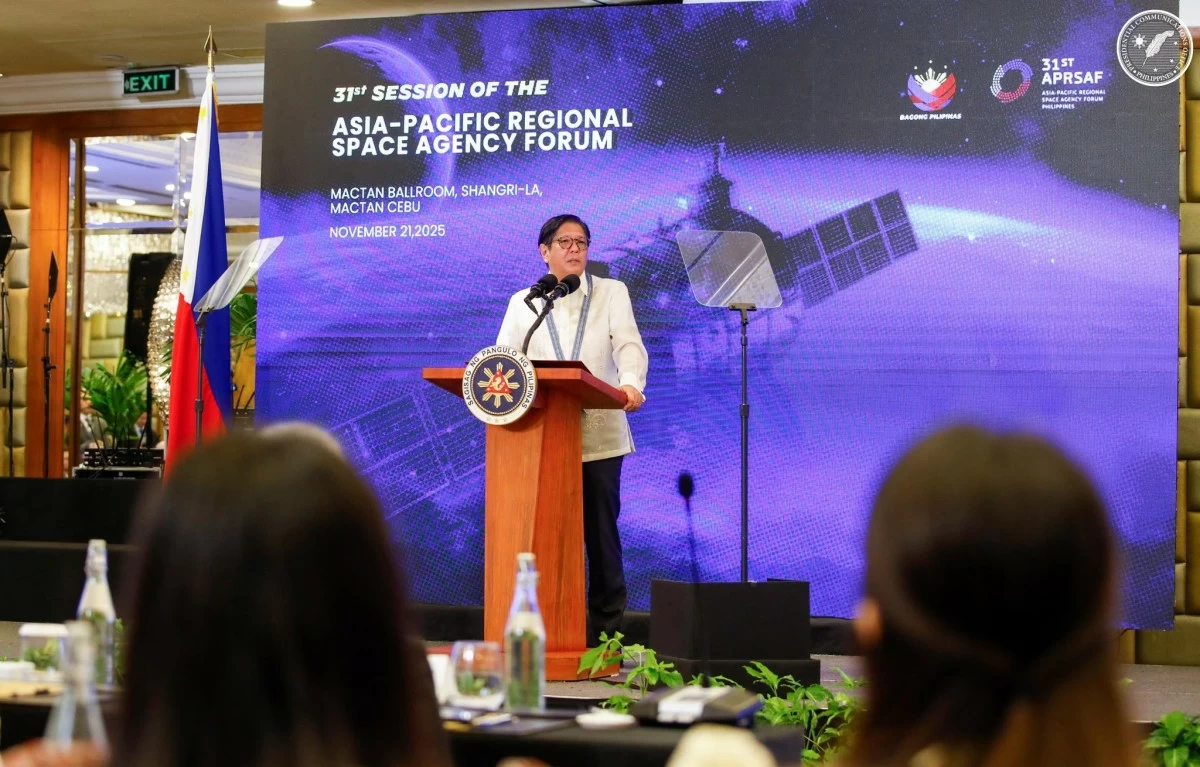
President Ferdinand 'Bongbong' Marcos Jr. (PCO)
President Marcos underscored that space science must directly benefit communities, saying the country’s growing space capabilities should strengthen climate resilience, disaster response, and sustainable development.
Marcos said this as he led the 31st Asia-Pacific Regional Space Agency Forum (APRSAF-31) held at Shangri-La Mactan in Cebu on Nov. 21.
In his speech, the President highlighted how space technology now shapes everyday life, from weather tracking to environmental protection.
“[Today], we are reminded of how deeply space exploration touches and transforms the lives of our people,” he said.
According to Marcos, this year’s theme — “Empowering the Region through Space Ecosystem in Action” — reflects a shift from discussion to actual implementation of space-enabled solutions across the region.
Demand for space technologies
Marcos said the intensifying climate crisis and increasingly complex disasters are making space-based tools essential for survival, especially for countries like the Philippines.
He described the nation’s extreme exposure to hazards, citing the Pacific typhoon belt and the Pacific Ring of Fire.
The Philippines experiences “19 to 20 tropical cyclones each year as well as an average of 20 recorded earthquakes per day,” he said.
The President emphasized that Asia-Pacific countries are relying more on satellite-generated data to improve governance, protect ecosystems, and support inclusive development.
PH expanding role
Marcos said the Philippines’ second hosting of the APRSAF, after 2016, shows its increasing commitment to regional collaboration and capability-building.
He thanked the Philippine Space Agency (PhilSA), the Japan Aerospace Exploration Agency (JAXA), and Japan’s Ministry of Education, Culture, Sports, Science and Technology (MEXT) for organizing the event.
Marcos praised PhilSA’s work over the past six years for providing satellite data to government agencies, researchers, and the private sector.
“These are used to aid disaster risk reduction and management as well as monitor the country’s maritime domain,” he said.
New satellites, stronger data systems underway
President Marcos said he is looking forward to the completion of the Multispectral Unit for Land Assessment (MULA) satellite, which will be the country’s largest Earth observation satellite once launched.
He also highlighted the Copernicus Data Centre unveiled last year by PhilSA and the European Commission, the first facility of its kind in Asia.
He said the center’s pilot services are helping put “data into the hands of Filipino experts and decision-makers.”
The APRSAF-31 gathers over 40 countries in Cebu from November 18 to 21 to discuss space-driven solutions and strengthen partnerships in disaster management, Earth observation, and industry development.
Established in 1993, APRSAF remains the region’s largest space-related conference, providing a platform for joint initiatives that support communities across the Asia-Pacific.