

ADVERTISEMENT

Japan OKs $135 billion stimulus package to help revive its sluggish economy

Published Nov 21, 2025 09:05 pm
TOKYO (AP) — Japan's Cabinet approved a 21.3 trillion yen ($135.4 billion) stimulus package Friday to help spur the economy through expansionary government spending and to relieve the impact of higher prices.
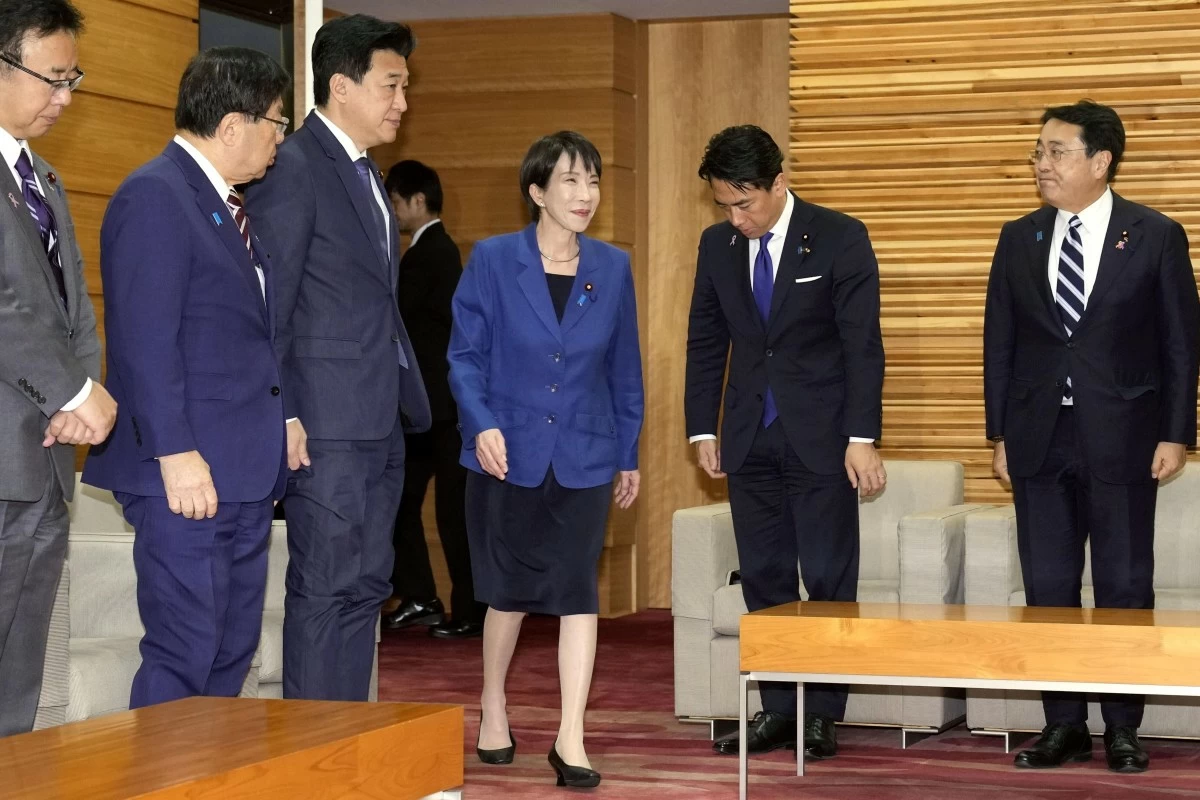
Japan's Prime Minister Sanae Takaichi, center, arrives for a cabinet meeting at her office in Tokyo Friday, Nov. 21, 2025. (Yuki Sato/Kyodo News via AP)
After taking office last month, Prime Minister Sanae Takaichi promised to boost government spending despite concerns that such moves will delay progress on trimming Japan's national debt, which is about triple the size of its economy.
Takaichi told reporters that the package aims to quickly deliver on her promises.
"Through wise spending, we will change worries into hope and achieve a strong economy," she said.
"What we should do now is to strengthen the national power through expansionary spending, through wise spending, and not to cause harm through excessively contractionary policies," she said.
The spending package far exceeds those of the pre-COVID-19 pandemic years and is also meant partly to blunt the impact of higher U.S. tariffs on Japanese exports to America under President Donald Trump.
Exports to the U.S. fell in October for the seventh straight month, the government said Friday, though shipments to the rest of the world rose 3.7%, thanks partly to higher exports to the rest of Asia.
In recent days, investors have sold off Japanese government bonds, pushing yields higher, while the yen has fallen to nearly its lowest level this year.
Share prices have also taken a hit from renewed friction with China after Takaichi made comments that angered Beijing, provoking retaliatory moves including an advisory warning Chinese tourists and students against going to Japan.
The benchmark Nikkei 225 index fell 2.4% on Friday, mainly due to heavy selling of technology shares.
The lavish spending package approved Friday includes subsidies for energy costs, a cut in the gasoline tax and other measures to help consumers struggling with the rising cost of living. The government reported Friday that core inflation excluding volatile food costs was 3% in October, higher than the central bank's target of around 2%.
Specific subsidies include one-time cash handouts of 20,000 yen (about $130) per child, which would require about 400 billion yen ($2.6 billion) in government funding and issuing rice vouchers or other coupons worth 3,000 yen (about $20) per person, to be distributed by local authorities.
Takaichi's government must compile a supplementary budget and gain approval by the parliament by the end of this year to fund the package. That's a major challenge for her ruling coalition, which lacks a majority in both the Upper and Lower houses of the Diet.
Takaichi succeeded former Prime Minister Shigeru Ishiba, who was virtually ousted by his rivals in the ruling party after losing major elections due to voter dissatisfaction over his minority government's slow response to soaring prices and lagging wages.
As Japan's first female prime minister, Takaichi has so far enjoyed high levels of public support largely because of expectations she might shake up Japan's gerontocratic politics. But since she has a minority government, she needs cooperation with opposition parties to get her supplementary budget and spending package passed.
Opposition lawmakers and experts have questioned whether the package will be effective in attaining its aims. One of which is to slightly lower consumer prices by cutting energy costs. Any impact on inflation is expected to be transient since increased demand from other stimulus would tend to push prices higher.
The package also is meant to raise Japan's gross domestic product by 24 trillion yen ($155 billion), or an annualized rate of 1.4%, according to the Cabinet Office.
Japan's economy, the world's fourth largest, contracted at a 1.8% annual pace in July-September.

Related Tags

World news
ADVERTISEMENT
.most-popular .layout-ratio{ padding-bottom: 79.13%; } @media (min-width: 768px) and (max-width: 1024px) { .widget-title { font-size: 15px !important; } }

{{ articles_filter_1561_widget.title }}

.most-popular .layout-ratio{ padding-bottom: 79.13%; } @media (min-width: 768px) and (max-width: 1024px) { .widget-title { font-size: 15px !important; } }

{{ articles_filter_1562_widget.title }}

.most-popular .layout-ratio{ padding-bottom: 79.13%; } @media (min-width: 768px) and (max-width: 1024px) { .widget-title { font-size: 15px !important; } }

{{ articles_filter_1563_widget.title }}

{{ articles_filter_1564_widget.title }}

.mb-article-details { position: relative; } .mb-article-details .article-body-preview, .mb-article-details .article-body-summary{ font-size: 17px; line-height: 30px; font-family: "Libre Caslon Text", serif; color: #000; } .mb-article-details .article-body-preview iframe , .mb-article-details .article-body-summary iframe{ width: 100%; margin: auto; } .read-more-background { background: linear-gradient(180deg, color(display-p3 1.000 1.000 1.000 / 0) 13.75%, color(display-p3 1.000 1.000 1.000 / 0.8) 30.79%, color(display-p3 1.000 1.000 1.000) 72.5%); position: absolute; height: 200px; width: 100%; bottom: 0; display: flex; justify-content: center; align-items: center; padding: 0; } .read-more-background a{ color: #000; } .read-more-btn { padding: 17px 45px; font-family: Inter; font-weight: 700; font-size: 18px; line-height: 16px; text-align: center; vertical-align: middle; border: 1px solid black; background-color: white; } .hidden { display: none; }
function initializeAllSwipers() { // Get all hidden inputs with cms_article_id document.querySelectorAll('[id^="cms_article_id_"]').forEach(function (input) { const cmsArticleId = input.value; const articleSelector = '#article-' + cmsArticleId + ' .body_images'; const swiperElement = document.querySelector(articleSelector); if (swiperElement && !swiperElement.classList.contains('swiper-initialized')) { new Swiper(articleSelector, { loop: true, pagination: false, navigation: { nextEl: '#article-' + cmsArticleId + ' .swiper-button-next', prevEl: '#article-' + cmsArticleId + ' .swiper-button-prev', }, }); } }); } setTimeout(initializeAllSwipers, 3000); const intersectionObserver = new IntersectionObserver( (entries) => { entries.forEach((entry) => { if (entry.isIntersecting) { const newUrl = entry.target.getAttribute("data-url"); if (newUrl) { history.pushState(null, null, newUrl); let article = entry.target; // Extract metadata const author = article.querySelector('.author-section').textContent.replace('By', '').trim(); const section = article.querySelector('.section-info ').textContent.replace(' ', ' '); const title = article.querySelector('.article-title h1').textContent; // Parse URL for Chartbeat path format const parsedUrl = new URL(newUrl, window.location.origin); const cleanUrl = parsedUrl.host + parsedUrl.pathname; // Update Chartbeat configuration if (typeof window._sf_async_config !== 'undefined') { window._sf_async_config.path = cleanUrl; window._sf_async_config.sections = section; window._sf_async_config.authors = author; } // Track virtual page view with Chartbeat if (typeof pSUPERFLY !== 'undefined' && typeof pSUPERFLY.virtualPage === 'function') { try { pSUPERFLY.virtualPage({ path: cleanUrl, title: title, sections: section, authors: author }); } catch (error) { console.error('ping error', error); } } // Optional: Update document title if (title && title !== document.title) { document.title = title; } } } }); }, { threshold: 0.1 } ); function showArticleBody(button) { const article = button.closest("article"); const summary = article.querySelector(".article-body-summary"); const body = article.querySelector(".article-body-preview"); const readMoreSection = article.querySelector(".read-more-background"); // Hide summary and read-more section summary.style.display = "none"; readMoreSection.style.display = "none"; // Show the full article body body.classList.remove("hidden"); } document.addEventListener("DOMContentLoaded", () => { let loadCount = 0; // Track how many times articles are loaded const offset = [1, 2, 3, 4, 5, 6, 7, 8, 9, 10]; // Offset values const currentUrl = window.location.pathname.substring(1); let isLoading = false; // Prevent multiple calls if (!currentUrl) { console.log("Current URL is invalid."); return; } const sentinel = document.getElementById("load-more-sentinel"); if (!sentinel) { console.log("Sentinel element not found."); return; } function isSentinelVisible() { const rect = sentinel.getBoundingClientRect(); return ( rect.top < window.innerHeight && rect.bottom >= 0 ); } function onScroll() { if (isLoading) return; if (isSentinelVisible()) { if (loadCount >= offset.length) { console.log("Maximum load attempts reached."); window.removeEventListener("scroll", onScroll); return; } isLoading = true; const currentOffset = offset[loadCount]; window.loadMoreItems().then(() => { let article = document.querySelector('#widget_1690 > div:nth-last-of-type(2) article'); intersectionObserver.observe(article) loadCount++; }).catch(error => { console.error("Error loading more items:", error); }).finally(() => { isLoading = false; }); } } window.addEventListener("scroll", onScroll); });

Sign up by email to receive news.