






Manila Bulletin
 Business
Trade & Industry
Harmonized rules critical to curb barriers for small modular reactors—IAEA
Business
Trade & Industry
Harmonized rules critical to curb barriers for small modular reactors—IAEA
Business
Trade & Industry
Harmonized rules critical to curb barriers for small modular reactors—IAEA
Harmonized rules critical to curb barriers for small modular reactors—IAEA
Published Nov 21, 2025 02:09 pm


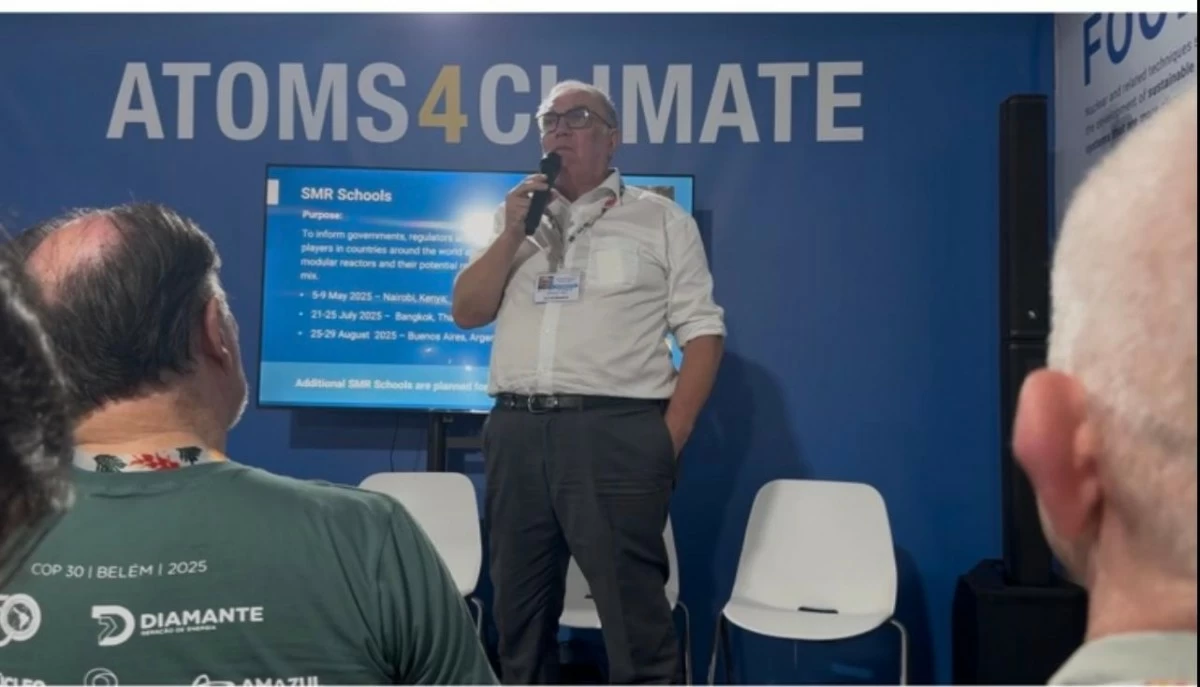
IAEA Deputy Director Mikhail Chudakov at the Atoms4Climate Pavilion at the COP30 in Belem, Brazil
BELÉM, BRAZIL — The International Atomic Energy Agency (IAEA) is urging nations with nuclear ambitions to harmonize their regulatory rulebooks, arguing that unified standards are the only way to dismantle mounting barriers that are currently choking the planned mass-scale deployment of Small Modular Reactors (SMRs).
Speaking at a side event during the ongoing COP30 Climate Change Summit, IAEA Deputy Director General Mikhail Chudakov announced the agency is establishing “golden standards” for nuclear regulation harmonization. This effort is designed to catalyze convergence in rules, procedures, and best practices essential for targeted SMR projects.
“We created nuclear harmonization and standardization… we are trying to get that commonality in golden standards in rules and procedures and use and best practices in infrastructure development,” Chudakov stressed.
To drive the industry forward on addressing fragmented regulations, the IAEA has released its Nuclear Harmonization and Standardization Initiative (NHSI). This key document provides a framework for aligning SMR design, construction, regulatory frameworks, and industrial processes.
The initiative operates on a dual-track system, pairing a Regulatory Track with an Industry Track to ensure coherence across the entire SMR development ecosystem.
The NHSI Regulatory Track focuses on deeper regulatory collaboration to avoid work duplication, increase efficiency, and facilitate common regulatory positions without compromising nuclear safety or national sovereignty. The IAEA stated this track “has developed ambitious but feasible programs of work that build on previous activities and progressively make important steps toward harmonization of regulatory approaches.”
The NHSI Industry Track’s main goal is to establish a cohesive industrial playbook—standardizing how SMRs are developed, built, and operated globally. The IAEA says this approach leverages unified standards and best practices to crush bureaucratic bottlenecks on licensing, cut costs, and accelerate SMR rollouts worldwide.
Chudakov acknowledged that creating a single global standard is complex due to divergent national procedures. However, he maintained that the unified framework campaign is pressuring regulators to align and carve the smoothest path for SMR deployment.
The alignment initiative, he said, will enable “regulatory borders to follow these recommendations.” He reiterated that with standardized benchmarks in place, SMR deployment could become cheaper, faster, and scalable enough to meet future demand.
Based on 2024 IAEA data, the SMR race is accelerating: roughly 70 reactor designs are under development across 18 countries. Two SMRs are already operating in China and Russia, while four are in advanced construction stages in Argentina, China, and Russia.
“SMR is very promising in many countries,” Chudakov noted, while reminding aspiring nuclear nations that deployment success must be anchored on three non-negotiables: public acceptance, stakeholder engagement, and government commitment to nuclear initiatives.
Beyond regulatory hurdles, financing remains a significant obstacle, according to Jonathan Cobb, senior program lead for Climate at World Nuclear Association. Upfront capital costs are still running dangerously high.
“The financial burden that we have now will be a particular challenge for most small reactors,” he stated. Cobb also noted that even smaller reactors must navigate the same rigorous regulatory maze upheld for conventional large reactor installations, though he saw positive signs.
“We are seeing signs that regulators are addressing this,” he said, spotlighting forward-looking efforts emerging among U.S. and Canadian regulators. He highlighted that “there is genuine appetite to look how you can maintain stringent regulations, with the same high standards of regulations and make them work for SMRs.”