







BARMM stakeholders eye long-term stability beyond peace deal
Published Nov 21, 2025 11:36 am


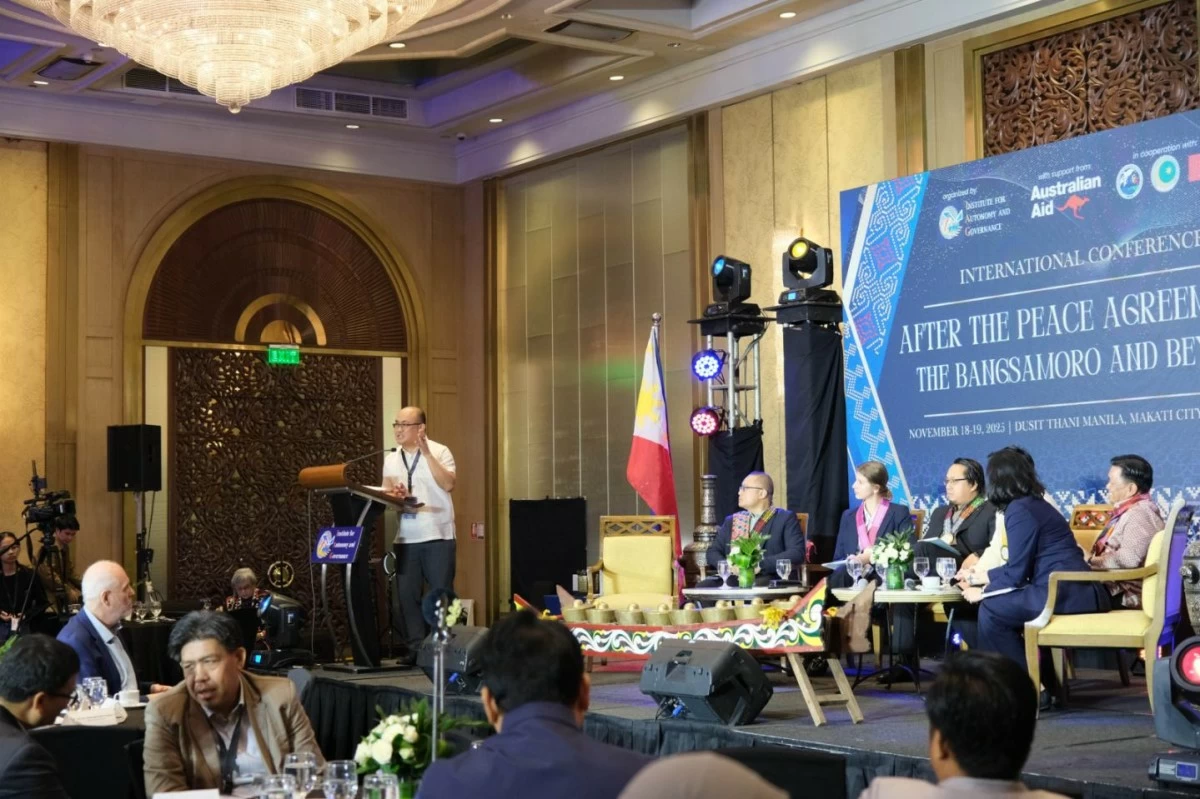
Office of the Presidential Adviser on Peace, Reconciliation and Unity (OPAPRU) Director Wendell Orbeso delivers a speech at the international conference “After the Peace Agreements: The Bangsamoro and Beyond” held in Makati City on Nov. 19, 2025. During the meet, government and peace stakeholders advocated for “futures thinking” and scenario-based planning to become standard tools in policymaking across the Bangsamoro Autonomous Region in Muslim Mindanao (BARMM) to sustain the gains from the peace process and prepare for emerging risks. (Photo: OPAPRU)
Government and peace stakeholders advocated for “futures thinking” and scenario-based planning to become standard tools in policymaking across the Bangsamoro Autonomous Region in Muslim Mindanao (BARMM) to sustain the gains from the peace process and prepare for emerging risks.
This direction was highlighted during a session at the international conference “After the Peace Agreements: The Bangsamoro and Beyond” spearheaded by the Office of the Presidential Adviser on Peace, Reconciliation and Unity (OPAPRU), in cooperation with the Institute for Autonomy and Governance (IAG), BARMM government, and Southeast Asian Women Peace Mediators (SEAWPM) held in Makati City recently.
Unlike past efforts that relied heavily on linear planning, the discussion, facilitated by Director Wendell Orbeso, of OPAPRU’s Moro Islamic Liberation Front (MILF) Peace Process Office and Joint Normalization Committee (JNC) Secretariat head, focused on “utilizing futures thinking tools that would enable peace stakeholders to anticipate challenges and imagine bold possibilities.”
The speakers emphasized the need for long-term and anticipatory strategies that allow institutions to detect early warning signs, explore alternative futures, and align development plans with the aspirations of the Bangsamoro.
Strategies and approaches
Mohammad Abqary Alon, of the Office of the Chief Minister’s Strategic Communications Team, said young leaders are ready to champion this shift, noting how unpredictability in governance now demands more flexible planning models.
“So in the process of planning, we are going to create an action plan that would be comprehensive, more than the linear planning process that was done before,” he said.
Meanwhile, United Nations Development Programme (UNDP) New York Consultant Victoria Kruger outlined global approaches being introduced in the region, including scenario building and participatory visioning.
She said such tools help confront youth sentiments of hopelessness and exclusion by shaping collective long-term goals. These methods, she added, have been effective in post-conflict settings such as Colombia.
Lawyer Ishmael Bahjin, director of OPAPRU’s Social Healing and Peace Building Office (SHAPEO), framed the Comprehensive Agreement on the Bangsamoro (CAB) as a long-term driver for preventing and countering violent extremism (PCVE), saying its implementation already addresses root causes such as marginalization, poor governance, and proliferation of firearms.
He warned that “weak signals,” such as factionalism among armed groups, must be monitored early through futures tools to safeguard the peace process.
“There's a shift from historical injustices to political self-determination, and correspondingly, our PCVE strategy must, therefore, also shift from a security response to more of a development and governance inoculation,” he stressed.
Salic Sharief Jr., programme director of Conciliation Resources, said foresight exercises help clarify entrenched positions and allow stakeholders to test scenarios that may unfold in a volatile environment. He noted that “purposeful detours,” or shifts in strategies along the way, are normal in pursuing a shared future.
Moro Islamic Liberation Front (MILF) Peace Implementing Panel Director General Mohajirin Ali said BARMM institutions are already applying forecasting techniques in their development plans.
He urged agencies to make these tools a “basic practice,” citing the region’s second Bangsamoro Development Plan as an example of long-term goal-setting rooted in futures thinking.
From the national government’s perspective, Office of the Special Assistant to the President Assistant Secretary Ria Danielle Lumapas noted that acknowledging gaps in implementation and improving inter-agency coordination are essential before futures planning can be effective.
“We have to identify that a problem exists before we can even go into planning,” she said.
Sulu case
Bahjin also laid out a long-term vision for Sulu, which opted out of BARMM, saying the province can still position itself as a partner in peace and functional integration, particularly in sectors with shared benefits. He said Sulu could tap its maritime heritage to reclaim its role as a regional trading hub.
As for the region’s political future, Lumapas said the upcoming BARMM parliamentary elections, the first since the transition government was formed, represent the final step in completing the political track of the peace agreement. The polls were postponed to March 2026 from Oct. 13, 2025.
She said an elected parliament would give the Bangsamoro government “greater legitimacy.”