






Manila Bulletin
 Lifestyle
Health and Wellness
Understanding the science behind painless hair restoration
Lifestyle
Health and Wellness
Understanding the science behind painless hair restoration
Lifestyle
Health and Wellness
Understanding the science behind painless hair restoration
Understanding the science behind painless hair restoration
What works for dealing with hair loss
Published Nov 17, 2025 10:01 pm


At A Glance
- The convergence of multiple therapeutic mechanisms, backed by peer-reviewed Italian research and certified medical technology, represents a genuine advancement in a field that has often disappointed.
After two decades in preventive medicine and dermatology, I’ve learned that the most profound medical advances often come not from doing something entirely new, but from orchestrating existing science in smarter ways. The latest development in treating hair pathologies, a technology called Tricopat, exemplifies this perfectly.
Let me be direct. The field of trichology has been cluttered with overpromised treatments and underwhelming results. So when I encountered data from the University of Bologna showing consistent, measurable improvements in hair density and diameter, my first instinct as a physician was skepticism. But the methodology behind these results warrants serious attention.
Understanding the biological foundation
Hair loss, whether androgenetic alopecia, telogen effluvium, or inflammatory conditions like lichen planopilaris, shares common pathophysiological threads. Reduced microcirculation to the follicle, inadequate cellular metabolism, and compromised delivery of growth factors all contribute to follicular miniaturization and eventual hair loss.
Traditional approaches have tackled these issues individually: minoxidil for blood flow, finasteride for hormonal pathways, and topical treatments for growth factor delivery. Each has its place, but their efficacy plateaus between 40 to 60 percent, leaving substantial room for improvement. The question becomes: what if we could address multiple pathogenic factors simultaneously?
The tricogenesi protocol: Convergent mechanisms
The Italian-developed Tricopat system combines three distinct therapeutic modalities into a single treatment session. First, controlled micro-incisions at 0.25mm, shallow enough to avoid scarring but sufficient to trigger the dermis repair cascade. This isn’t simply wound creation. It’s the strategic activation of your body’s healing machinery, prompting the release of transforming growth factor-beta, platelet-derived growth factor, and fibroblast growth factor seven.
Second, radial pressure wave technology enhances blood microcirculation to follicular units. Think of this as targeted stimulation that increases oxygen delivery and nutrient uptake at the cellular level. The result is a metabolically optimized environment for hair growth.
Third, iontophoresis leverages electrical current to drive active ingredients, specifically preformed growth factors, deep into the dermal layer. Unlike topical applications that must penetrate the stratum corneum, iontophoresis bypasses this barrier entirely, achieving therapeutic concentrations where they’re needed most.
What the clinical evidence shows
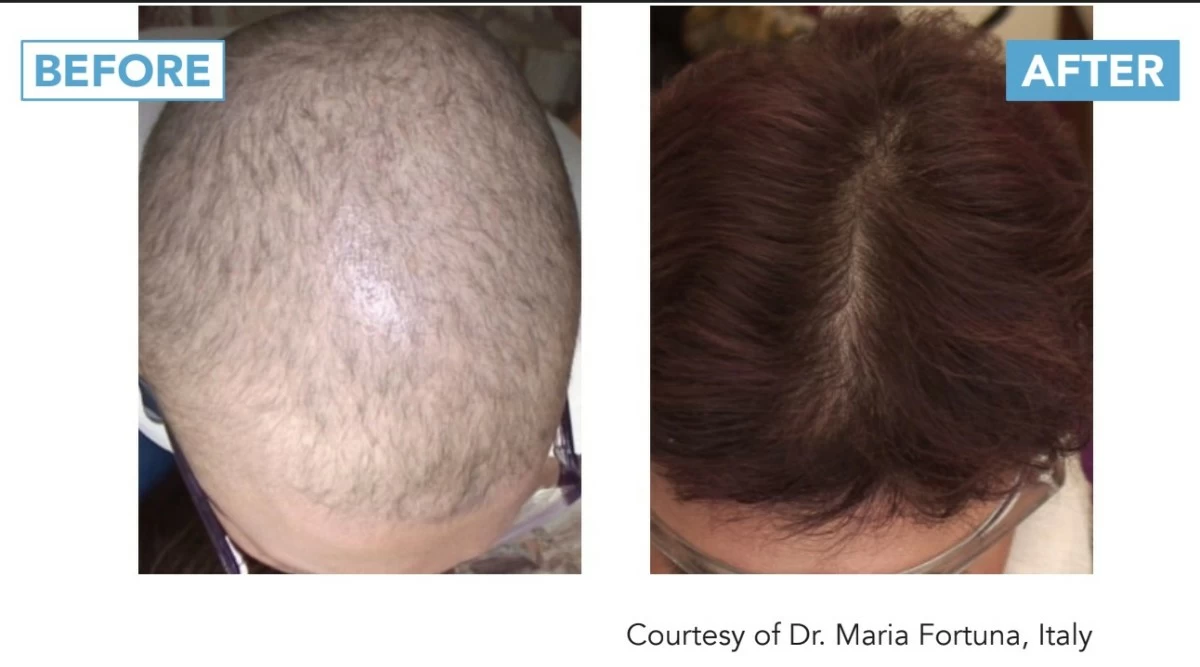
The published data deserves scrutiny. In a pilot study of 60 patients (30 male, 30 female) with androgenetic alopecia and telogen effluvium, researchers documented outcomes using trichoscopy and Trichoscan software—objective measurement tools, not subjective impressions.
The numbers are compelling. Anterior scalp hair density increased 13 to 14 percent across both sexes. Hair diameter improved eight to 15 percent. Perhaps most telling, vellus hair counts decreased while terminal hair increased, indicating genuine follicular reactivation rather than simple cosmetic improvement. Pull tests, initially positive in affected patients, became negative by treatment completion.
What strikes me about these results isn’t just the magnitude but the consistency. No patients worsened. 60 out of 60 showed improvement on trichoscopy. That level of uniformity suggests we’re working with fundamental biology rather than marginal effects.
Beyond androgenetic alopecia
Recent Italian Journal of Dermatology and Venereology publications extend these findings to inflammatory scalp conditions. In alopecia areata incognita, a particularly challenging autoimmune variant, the protocol combined with topical corticosteroids delivered through iontophoresis showed a remarkable reduction in inflammatory markers: Yellow dots, pigtail hairs, and empty follicles largely disappeared after four sessions.
For lichen planopilaris, a scarring alopecia where treatment goals focus on halting progression, the same approach reduced perifollicular hyperkeratosis and erythema while thickening surrounding hair. Patients reported itching, that torturous symptom that signals active inflammation, resolved after just two treatments.
The practical reality
The protocol requires four sessions spaced three weeks apart. Each session takes 20 to 25 minutes. There’s no anesthesia requirement, no downtime, and no activity restrictions post-treatment. The procedure combines Italian medical device certification with over 15 years of developmental research at Bologna’s Scientific and Technological Hub.
This matters in our context here in Manila because effective hair restoration shouldn’t require overseas travel or excessive time commitments. Nor should it be prohibitively painful—a common deterrent with procedures like traditional microneedling or platelet-rich plasma injections.
The professional perspective
Will Tricopat work for everyone? No treatment does. Proper diagnosis remains paramount. What we’re treating determines whether any intervention will succeed. But the convergence of multiple therapeutic mechanisms, backed by peer-reviewed Italian research and certified medical technology, represents a genuine advancement in a field that has often disappointed.
As both a physician and someone who writes about health, I find this technology interesting not because it’s revolutionary in concept, but because it’s evolutionary in execution. Good science, thoughtfully applied.