







US, Japan join AFP maritime exercise in WPS
Published Nov 16, 2025 11:30 am
|
Updated Nov 16, 2025 02:22 pm


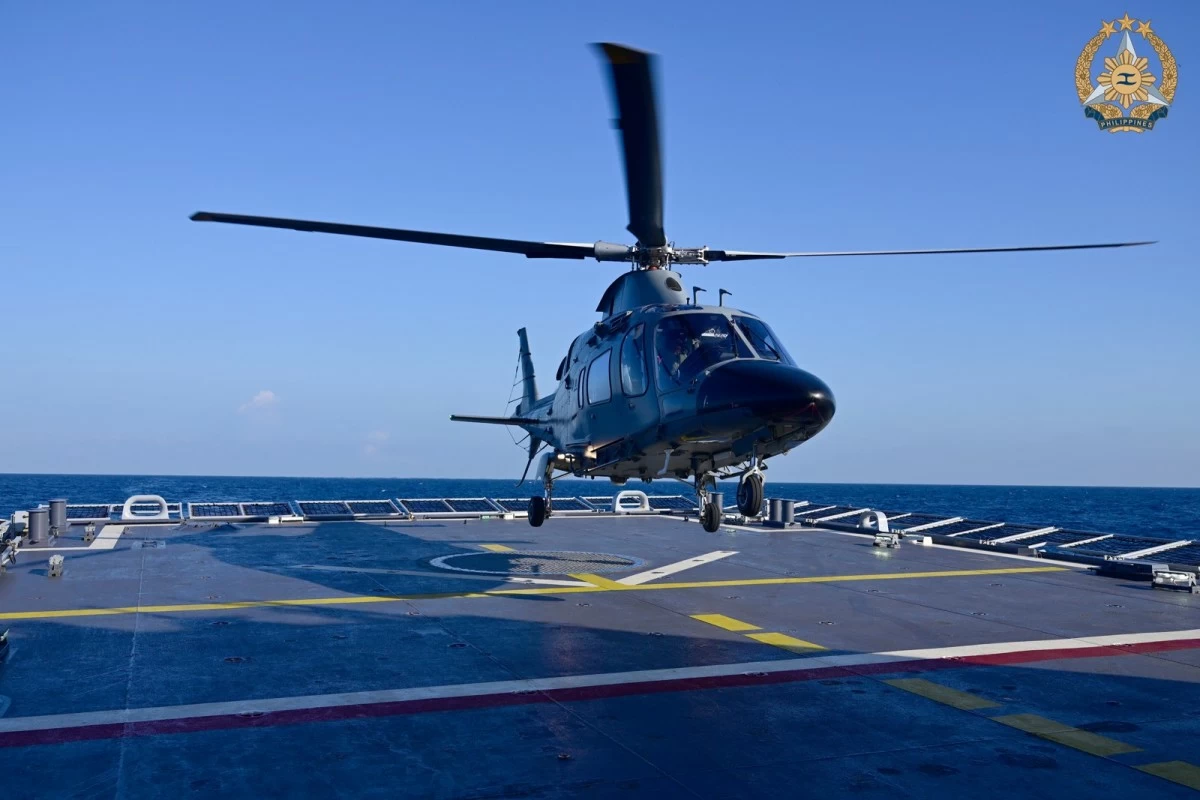
A Philippine Navy AW109 helicopter touches down on the deck of BRP Jose Rizal (FF-150) during a Multilateral Maritime Cooperative Activity on March 28, 2025. (File photo: Armed Forces of the Philippines)
The Armed Forces of the Philippines (AFP) strengthened its security ties with the United States and Japan as their naval and air assets converged in the West Philippine Sea (WPS) for a two-day Multilateral Maritime Cooperative Activity (MMCA), a ranking official disclosed Sunday, Nov. 16.
The AFP deployed guided missile frigates BRP Jose Rizal (FF150) and BRP Antonio Luna (FF151), and anti-submarine warfare helicopter AW-159 for the MMCA held from Nov. 14 to 15, according to AFP public affairs office chief Col. Xerxes Trinidad.
Meanwhile, the US Indo-Pacific Command (Indopacom) sent the Nimitz Carrier Strike Group which is composed of the aircraft carrier USS Nimitz (CVN68), and the guided-missile destroyers USS Wayne Meyer (DDG 108), USS Gridley (DDG101), and USS Lenah Sutcliffe Higbee.
The Japan Maritime Self-Defense Force (JMSDF) joined with the destroyer JS Akebono (DD-108) and anti-submarine helicopter SH-60K Seahawk.
While the MMCA series has grown familiar through repeated joint sails, this iteration took on added weight as it brought together three treaty and security partners in a coordinated show of presence in waters where Chinese incursions have become more frequent.
The Philippine Coast Guard’s (PCG) BRP Melchora Aquino and BRP Cape San Agustin also joined the MMCA, enhancing maritime domain awareness (MDA) operations that have become increasingly vital for documenting and responding to coercive activities in the WPS.
Throughout the joint activity, the three militaries synchronized ship maneuvers, communication drills, MDA reporting, cross-deck helicopter operations, anti-submarine warfare elements, and a final tactical exercise.
This was already the eighth MMCA for this year and the 13th since the initiative began in 2024.
The AFP emphasized that the continuing MMCA series “reflects its commitment to safeguarding the nation’s sovereign rights and advancing collective defense readiness alongside trusted partners.”
“These engagements highlight not only the Philippines’ steadfast resolve to defend its maritime domains but also its shared commitment with partners to strengthen deterrence, enhance interoperability, and uphold freedom of navigation under a rules-based international order in the Indo-Pacific,” Trinidad said.
According to the AFP, the participation of both the US and Japan also reflected the broader security architecture underpinning Manila’s external defense posture.
The Philippines and the United States are bound by the 1951 Mutual Defense Treaty, which commits both sides to act in mutual support in case of an armed attack on either party’s armed forces, public vessels or aircraft in the Pacific, including the WPS.
In relation, Manila’s security cooperation with Japan has rapidly accelerated under the newly signed Reciprocal Access Agreement (RAA), which facilitates greater interoperability, movement of forces, and joint training as Tokyo expands its security role in the region.