ADVERTISEMENT

More int'l aid pour in for PH typhoon relief

Published Nov 16, 2025 09:29 am
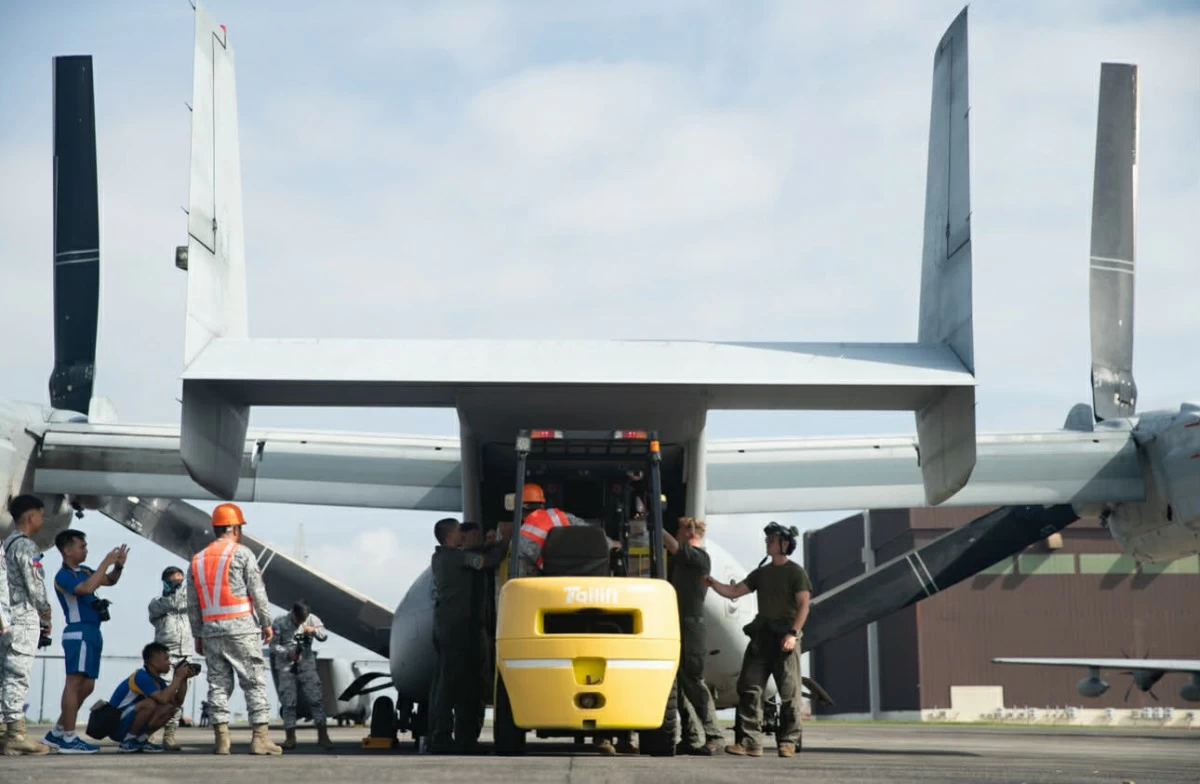
United States Marines and Philippine airmen load palletized family food packs onto a US Navy MV-22B Osprey at Clark Air Base on Nov. 13, 2025. (Photo from US Embassy in Manila)
The Philippines is at the receiving end of millions worth of international aid for its relief and recovery operations after twin supertyphoons—Tino and Uwan—devastated cities and provinces across the country.
The United States made the announcement of an additional $1.5 million (P87 million) in “emergency, life-saving assistance” on Saturday, Nov. 15, as support for the government-led response to Typhoons Tino and Uwan.
“As millions of Filipinos face the challenges left by these overlapping disasters, including the Cebu earthquake in September, our continued rapid response stands as a testament to the depth of the enduring ties between the United States and the Philippines, especially in times of crisis,” a statement from the US Embassy in Manila said.
Calling the Philippines “one of our closest friends, partners, and allies,” the US stressed that it will continue to support the government’s “efforts to save lives, alleviate suffering, and address urgent needs.”
This latest aid brought the total US response to the two typhoons to $2.5 million (P145 million), which includes support for logistics, emergency shelter, water, sanitation resources, and the management of evacuation centers.
South Korea also announced a $1 million (P59.03 million) in humanitarian assistance to the Philippines to be coursed through the International Federation of Red Cross and Red Crescent Societies (IFRC).
“The Embassy of the Republic of Korea extends its heartfelt sympathy to all those affected by Typhoons Tino and Uwan. Our thoughts are with the families and communities recovering from the extensive damage across the country,” the statement read.
“We hope this support will help speed up relief operations and contribute to bringing affected communities back to normal as soon as possible. Korea continues to stand by the Filipino people during this challenging time,” it added.
The Australian government will likewise provide AUD3 million (P115.9 million) in humanitarian assistance, noting how the Philippines “has endured a series of natural disasters over the last three months” that have affected millions of Filipinos.
The aid will provide in-country shelter, water sanitation and hygiene, health services and food assistance.
“Australia always stands ready to support the Philippines. We commend the Philippine Government on their quick and extensive response to multiple disasters impacting millions of Filipinos,” Australian Ambassador to the Philippines Marc Innes-Brown said.
“Australia is willing to work with the Philippine Government where it is needed as they continue their response efforts across the country,” the envoy added.
As a “reliable friend and Strategic Partner,” Australia said it is “well-positioned” to provide the assistance needed by the Philippine government, stressing that Australia's humanitarian partners work closely with local governments and civil society groups “to ensure all efforts are coordinated and assistance reaches those most in need.”
The Canadian government is also sending C$550,000 (P23 million) for the emergency relief efforts in the country in the wake of Typhoons Tino and Uwan.
This is in addition to the earlier C$650,000 (P27 million) announced on Oct. 15 in support of the earthquake and typhoon relief efforts.
“Canada stands ready to assist those affected and will continue working with partners to advance disaster risk reduction, resilience, and preparedness,” it stressed.

Related Tags

United States relief aid Tino UWAN Marc Innes-Brown Canada
ADVERTISEMENT
.most-popular .layout-ratio{ padding-bottom: 79.13%; } @media (min-width: 768px) and (max-width: 1024px) { .widget-title { font-size: 15px !important; } }

{{ articles_filter_1561_widget.title }}

.most-popular .layout-ratio{ padding-bottom: 79.13%; } @media (min-width: 768px) and (max-width: 1024px) { .widget-title { font-size: 15px !important; } }

{{ articles_filter_1562_widget.title }}

.most-popular .layout-ratio{ padding-bottom: 79.13%; } @media (min-width: 768px) and (max-width: 1024px) { .widget-title { font-size: 15px !important; } }

{{ articles_filter_1563_widget.title }}

{{ articles_filter_1564_widget.title }}

.mb-article-details { position: relative; } .mb-article-details .article-body-preview, .mb-article-details .article-body-summary{ font-size: 17px; line-height: 30px; font-family: "Libre Caslon Text", serif; color: #000; } .mb-article-details .article-body-preview iframe , .mb-article-details .article-body-summary iframe{ width: 100%; margin: auto; } .read-more-background { background: linear-gradient(180deg, color(display-p3 1.000 1.000 1.000 / 0) 13.75%, color(display-p3 1.000 1.000 1.000 / 0.8) 30.79%, color(display-p3 1.000 1.000 1.000) 72.5%); position: absolute; height: 200px; width: 100%; bottom: 0; display: flex; justify-content: center; align-items: center; padding: 0; } .read-more-background a{ color: #000; } .read-more-btn { padding: 17px 45px; font-family: Inter; font-weight: 700; font-size: 18px; line-height: 16px; text-align: center; vertical-align: middle; border: 1px solid black; background-color: white; } .hidden { display: none; }
function initializeAllSwipers() { // Get all hidden inputs with cms_article_id document.querySelectorAll('[id^="cms_article_id_"]').forEach(function (input) { const cmsArticleId = input.value; const articleSelector = '#article-' + cmsArticleId + ' .body_images'; const swiperElement = document.querySelector(articleSelector); if (swiperElement && !swiperElement.classList.contains('swiper-initialized')) { new Swiper(articleSelector, { loop: true, pagination: false, navigation: { nextEl: '#article-' + cmsArticleId + ' .swiper-button-next', prevEl: '#article-' + cmsArticleId + ' .swiper-button-prev', }, }); } }); } setTimeout(initializeAllSwipers, 3000); const intersectionObserver = new IntersectionObserver( (entries) => { entries.forEach((entry) => { if (entry.isIntersecting) { const newUrl = entry.target.getAttribute("data-url"); if (newUrl) { history.pushState(null, null, newUrl); let article = entry.target; // Extract metadata const author = article.querySelector('.author-section').textContent.replace('By', '').trim(); const section = article.querySelector('.section-info ').textContent.replace(' ', ' '); const title = article.querySelector('.article-title h1').textContent; // Parse URL for Chartbeat path format const parsedUrl = new URL(newUrl, window.location.origin); const cleanUrl = parsedUrl.host + parsedUrl.pathname; // Update Chartbeat configuration if (typeof window._sf_async_config !== 'undefined') { window._sf_async_config.path = cleanUrl; window._sf_async_config.sections = section; window._sf_async_config.authors = author; } // Track virtual page view with Chartbeat if (typeof pSUPERFLY !== 'undefined' && typeof pSUPERFLY.virtualPage === 'function') { try { pSUPERFLY.virtualPage({ path: cleanUrl, title: title, sections: section, authors: author }); } catch (error) { console.error('ping error', error); } } // Optional: Update document title if (title && title !== document.title) { document.title = title; } } } }); }, { threshold: 0.1 } ); function showArticleBody(button) { const article = button.closest("article"); const summary = article.querySelector(".article-body-summary"); const body = article.querySelector(".article-body-preview"); const readMoreSection = article.querySelector(".read-more-background"); // Hide summary and read-more section summary.style.display = "none"; readMoreSection.style.display = "none"; // Show the full article body body.classList.remove("hidden"); } document.addEventListener("DOMContentLoaded", () => { let loadCount = 0; // Track how many times articles are loaded const offset = [1, 2, 3, 4, 5, 6, 7, 8, 9, 10]; // Offset values const currentUrl = window.location.pathname.substring(1); let isLoading = false; // Prevent multiple calls if (!currentUrl) { console.log("Current URL is invalid."); return; } const sentinel = document.getElementById("load-more-sentinel"); if (!sentinel) { console.log("Sentinel element not found."); return; } function isSentinelVisible() { const rect = sentinel.getBoundingClientRect(); return ( rect.top < window.innerHeight && rect.bottom >= 0 ); } function onScroll() { if (isLoading) return; if (isSentinelVisible()) { if (loadCount >= offset.length) { console.log("Maximum load attempts reached."); window.removeEventListener("scroll", onScroll); return; } isLoading = true; const currentOffset = offset[loadCount]; window.loadMoreItems().then(() => { let article = document.querySelector('#widget_1690 > div:nth-last-of-type(2) article'); intersectionObserver.observe(article) loadCount++; }).catch(error => { console.error("Error loading more items:", error); }).finally(() => { isLoading = false; }); } } window.addEventListener("scroll", onScroll); });

Sign up by email to receive news.