







US announces $1.5M aid for 'Uwan' victims
Published Nov 15, 2025 05:54 pm


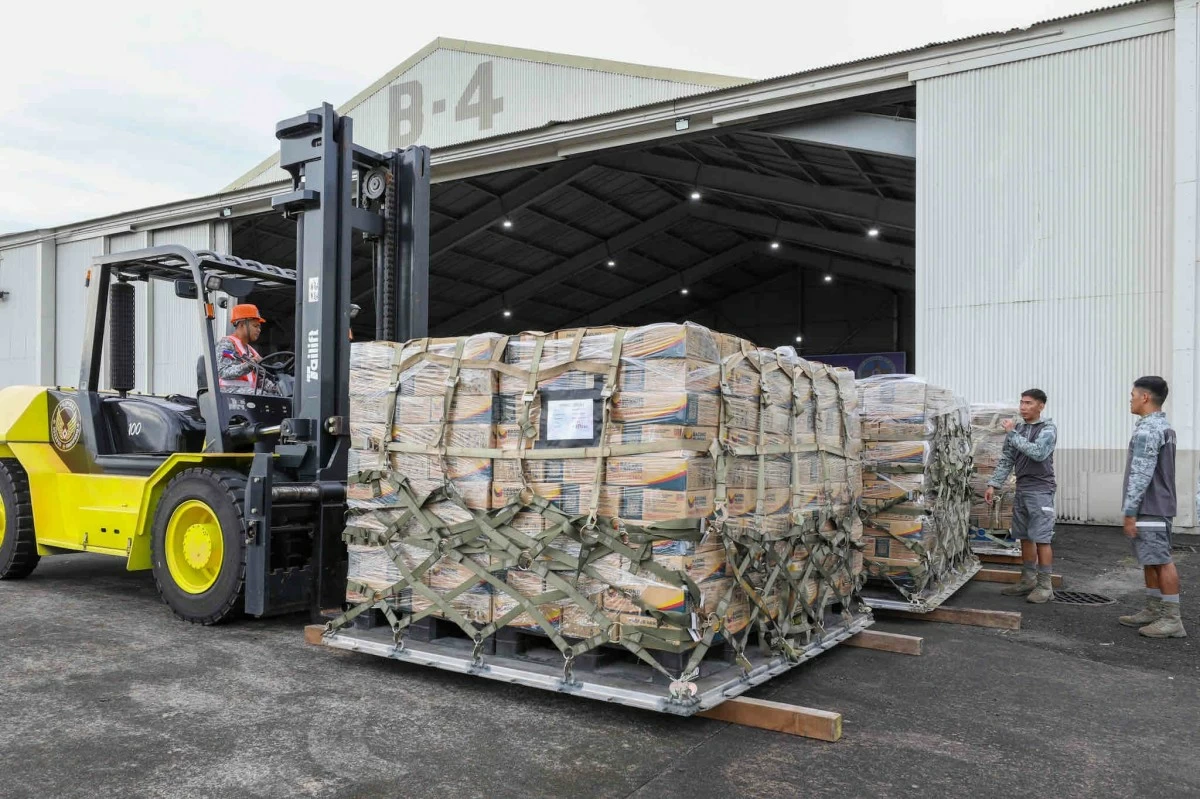
(Photo: Department of National Defense)
The United States stepped up its humanitarian support to communities battered by Super Typhoon “Uwan” by allocating an additional $1.5 million for them.
This was announced by US Ambassador to the Philippines MaryKay L. Carlson as she joined Department of National Defense (DND) Secretary Gilberto C. Teodoro Jr. during their inspection of the shipment of family food packs that will be delivered to the typhoon victims at the Clark Air Base in Pampanga on Saturday, Nov. 15.
The operation showcased the real-time interoperability between the Armed Forces of the Philippines (AFP), US Indo-Pacific Command (USINDOPACOM), and civilian disaster agencies such as the Department of Social Welfare and Development (DSWD) and the Office of Civil Defense (OCD), who have been working closely to sustain relief deliveries to Catanduanes and other hard-hit communities.
According to Carlson, the additional assistance will bring the total US support for Uwan response in the Philippines to US$2.5 million.
Carlson commended the Philippines’ proactive disaster preparedness and the tireless efforts of responders working under challenging conditions.
“Your dedication, teamwork, and compassion embody the very best of what partnership represents,” she said.
During the visit, Teodoro and Carlson met with Philippine and US service members involved in staging, loading, and transporting the relief goods.
They also inspected an opened family food pack to review its contents and conducted a cabin tour of a U.S. C-130 aircraft to observe its capacity for rapid humanitarian lift.
DSWD data showed that out of the 100 pallets committed for Catanduanes, 85 pallets carrying 8,500 food packs have already reached Virac.
The remaining 15 pallets consisted of 1,500 food packs are in transit and expected to arrive within the day, part of a rapid supply chain that uses US C-130 aircraft to reinforce AFP-led relief flights.
Meanwhile, Teodoro emphasized that beyond the food packs and aircraft, the mission highlighted the trust and cohesion that define the modern alliance between Manila and Washington.
“I believe that the alliance between the United States and the Philippines becomes stronger every time we are tested together,” he said. “And be it in crises, in helping people, or in asserting the rule of international law, we go through these trials together daily. And the daily interaction only makes our people-to-people ties much, much stronger.”
Teodoro noted that the presence of US assets under AFP direction shows how joint humanitarian work is no longer episodic but institutionalized.