






 Entertainment
Movies and TV
Nicolas Cage returns to the big screen with new thriller 'The Carpenter's Son'
Entertainment
Movies and TV
Nicolas Cage returns to the big screen with new thriller 'The Carpenter's Son'
Nicolas Cage returns to the big screen with new thriller 'The Carpenter's Son'


At A Glance
- The film follows Jesus as a young boy being tempted by Satan to rebel against his father, Joseph as played by Cage.
LOS ANGELES (AP) — In the second century, as the canonical Gospels were being copied and circulated throughout the Roman Empire, another text about the life of Jesus was simultaneously spreading. Although the Infancy Gospel of Thomas didn’t make it into the New Testament, it remained popular among Christians for centuries.
When filmmaker Lotfy Nathan was introduced to the apocryphal text about Jesus’ childhood by his history-loving father, he immediately began poring over it as a springboard for what would eventually become “The Carpenter’s Son,” the supernatural thriller starring Nicolas Cage.
“The thought gave me chills,” recalled the writer and director, who was raised Coptic Orthodox. “The novelty of this, in a way, being an origin story that hadn’t been told before.”
From scroll to screen
The film, which stars FKA twigs and Noah Jupe alongside Cage, follows Jesus as a young boy being tempted by Satan to rebel against his father, Joseph (Cage). The film’s source material is established with an opening title card. “Based on the Infancy Gospel of Thomas,” it reads. But Nathan concedes he couldn’t rely solely on the text and had to fill in narrative gaps, as with a storyline involving Satan.
“It’s written like a laundry list of events. It doesn’t really have an arc, so to speak,” he said of the apocryphal account of Jesus’ life from ages 5 to 12. “I had a historian pull a lot of research for me before I wrote the first draft.”
Reporter Krysta Fauria did graduate studies in religion and once unearthed an ancient Roman coin at an archaeological dig. Having spent several years on the entertainment beat for The Associated Press, she’s now easily recognized by Cage.
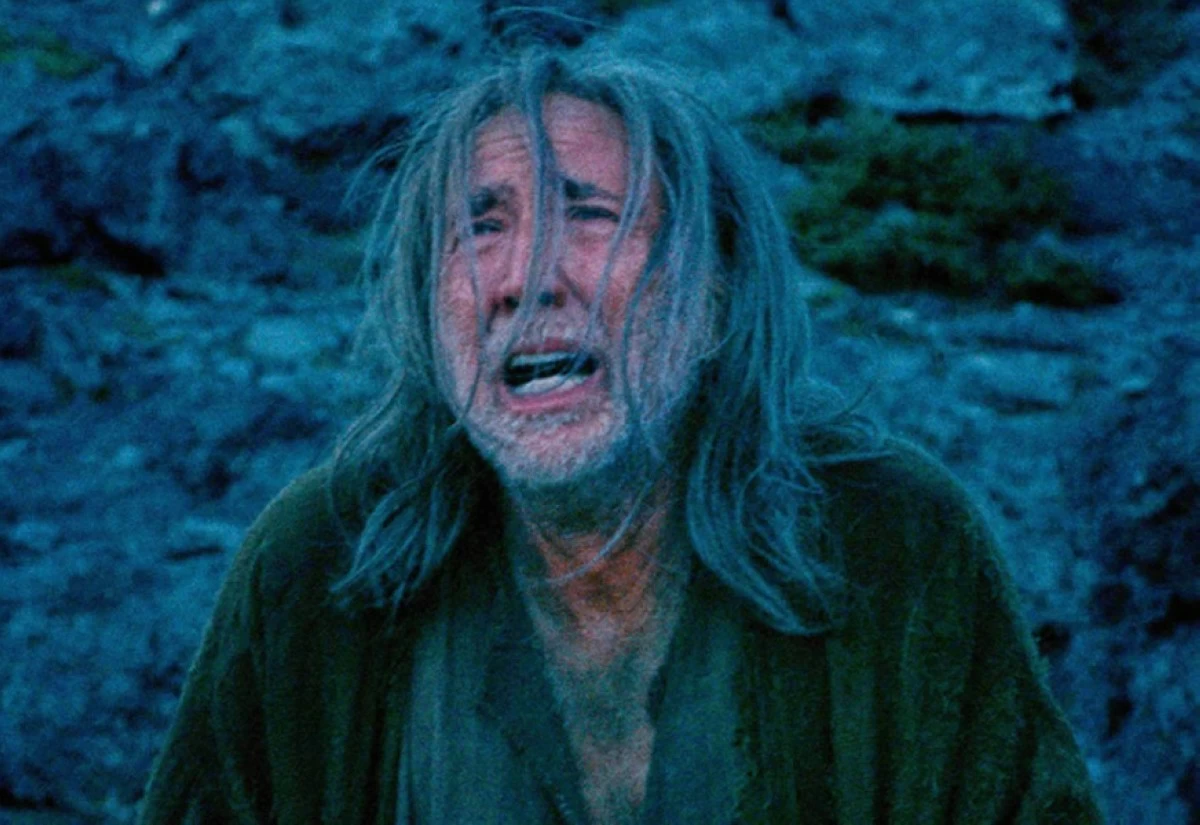
As fate would have it, Cage had already read the Infancy Gospel of Thomas years ago, during a period in his life of deep philosophical curiosity and reflection. When Nathan came to the Oscar winner with the script, Cage said he saw a through line to a type of story he’s long been attracted to.
“Family dramas, it’s no secret, is one of my favorite subject matters or genres. I couldn’t think of a more compelling family dynamic than the Nativity,” Cage told The Associated Press. “As I read it and thought about it, I never thought of it as a horror film per se. I saw it as a family drama about an existential crisis.”
The Infancy Gospel of Thomas or Paidika
The Infancy Gospel of Thomas might seem novel and obscure for some contemporary audiences, but history attests to both its popularity and longevity, according to Tony Burke, a professor at York University in Toronto whose specialties include early Christian apocrypha.
Stories within it permeated ancient Christian lore, art and even some medieval plays. One account from the text about Jesus giving life to clay birds even made its way into the Quran.
Also referred to as the Paidika — a nod to its original Greek title, “Paidika Iesou,” which translates to “The Childhood Acts of Jesus” — the Infancy Gospel of Thomas often surprises modern readers.
“This is not the Jesus that they expect — a Jesus that kills a boy in the marketplace or strikes down his teacher,” Burke said, though he argues that Christian audiences during that time wouldn’t have been bothered by this characterization. “In the ancient world, it was not that uncommon to tell stories of revered holy men cursing as well as blessing.”
A reverential approach
“The Carpenter’s Son” isn’t the only recent film to reimagine the apocryphal gospel. “The Young Messiah,” the 2016 drama based upon Anne Rice’s novel “Christ the Lord: Out of Egypt,” also pulls from the Paidika.
Both films reinterpret some of the aspects of the text that are ostensibly at odds with the Jesus of the canonical Gospels. In “The Young Messiah,” for example, it’s Satan who kills the boy in the marketplace, then frames Jesus. That encounter is left out of “The Carpenter’s Son” entirely.
Despite their popularity, telling any story about Jesus on-screen is tricky, especially when filmmakers veer into territory outside of the canonical Gospels. Cage recalled seeing “The Last Temptation of Christ,” Martin Scorsese’s notoriously controversial 1988 drama starring Willem Dafoe as Jesus, in theaters when it first came out.
“I was in line to get my tickets and I remember there were the picketers and they were angry. And I said, ‘Well have you seen the movie?’ And they said no,” Cage recalled. “Don’t you think you should see it before you make a statement about it or judge it?”
Still, he’s cognizant of the fact that any film tackling subjects sacred to people is vulnerable to critique. The American Family Association, a conservative Christian advocacy group, has denounced the film and urged people to sign a petition blocking its release.
“Nobody wanted to offend anybody in the making of this movie,” Cage said emphatically. “If anyone does go to this movie, they would see that everyone treated it with love and not with any approach of mockery or contempt. It was all about love.”