







Where stories come to roost
Published Nov 13, 2025 02:35 pm


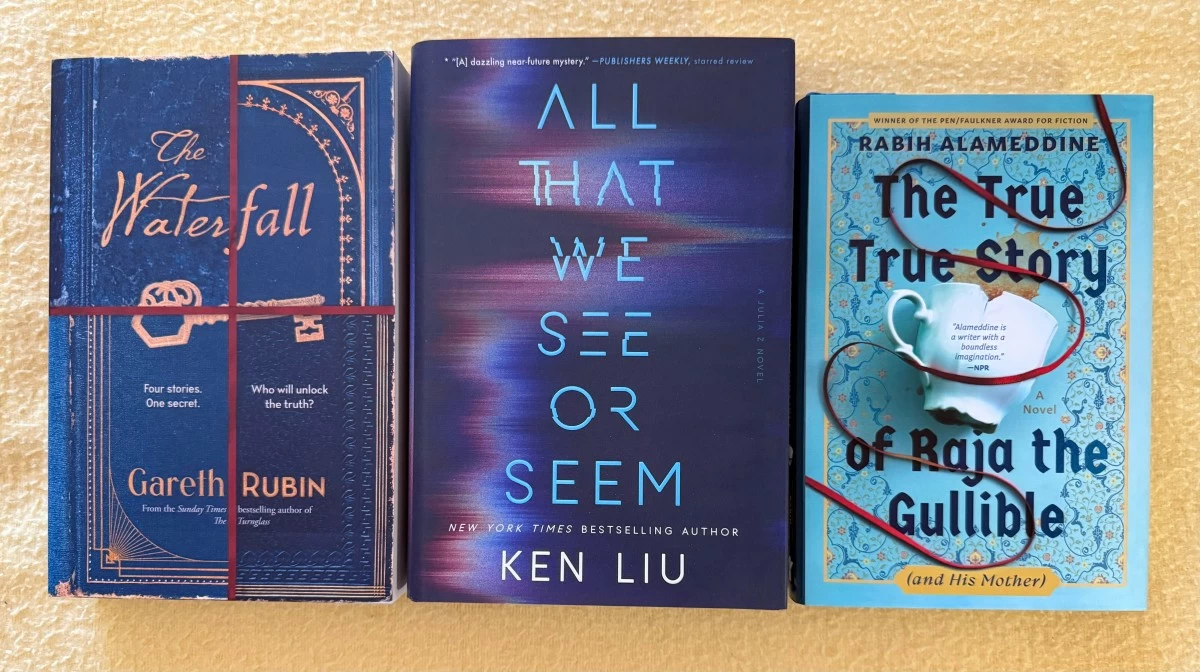
If there’s a thread running through the three novels today, it would have to do with the extraordinary brand of storytelling. Rubin’s is four seemingly distinct stories in time, but they’re interconnected. Liu tackles AI communication and Dream Art, while Alameddine has previously won the Pen/Faulkner Award for Fiction and has a stirring tale of growing up gay in Lebanon.
"The Waterfall" by Gareth Rubin
Rubin’s novels are noted for their unusual structure and how he creates stories within stories to keep us guessing. In The Turnglass, we had two distinct stories facing each other, and the key was understanding how they interconnected. In his latest, "The Waterfall," he literally doubles the fun, as the novel is four interconnected stories. First up is a last testament written by William Shakespeare as he investigates the death of his friend and fellow playwright, Christopher Marlowe. Then we have a gothic mystery set in a former priory that’s been turned into a clinic for sleep. The Shakespearean testament plays an important role in what happens. Third is a golden era detective tale set in Venice in the 1920s, with Honora Feldman as our crack amateur sleuth. Last, there’s an American noir story set in Los Angeles in the 1940s, with Ken Kourian on the trail of a serial killer, who is recreating murders from a novel entitled The Waterfall.
Evidently, its stories turn themselves inside out to impinge on and affect the outcome of other stories. What is fascinating is how Rubin assumes different voices with each story. In the first, Shakespeare is the narrator; but in the third story, narrating is Pippa, the driver/assistant/second wheel of Honora Feldman. Here, Rubin is having fun, taking on the persona of a tomboyish ingenue in the 1920s. Plus, his descriptions of the expat community in Venice are so spot on. Ken, a hard-boiled Army man sidelining as a consultant in Hollywood for the 1940s war films, is straight out of Humphrey Bogart-casting. It makes it fun to be reading these four stories and discovering how they connect to each other across space and time. It is an ambitious project, and what is surprising is how Rubin still manages to make it an easy, entertaining read. You’ll actually be rushing to the end to discover how Rubin juggles all these pins without dropping one.
"All That We See or Seem" by Ken Liu
This is the first installment in what Ken Liu has planned as a series of Julia Z books. Back when she was 14, Julia had her brush with fame and notoriety as the ‘orphan hacker’; and now, she’s just trying to stay under the radar and live in digital obscurity. It’s when a successful Boston lawyer named Piers approaches her that she’s tempted to help him with his search for his missing wife, Elli. Elli is a oneirofex, a dream artist - she taps into the memories of each member of an audience, and creates a shared virtual landscape. While the collective dreams are anonymous, she was apparently conducting one-on-one sessions with particular individuals, and one of them is the head of an international crime syndicate. He feels she has stolen his dreams, and when she vanishes, the hunt is on to get her and his dreams back.
The international crime boss is referred to only as The Prince, and his main henchman in the US is a sadistic fixer named Victor. It’s Victor who initiates the search for Elli, while giving Piers the impression that they’ve kidnapped her and will only release her when Piers turns over the files that contain his ‘stolen dreams’. It’s Julia’s involvement in helping Piers that the mystery part of this SciFi novel comes alive impressively and entertainingly. It’s SciFi that’s driven by AI technology knowledge, and the notion of Elli’s dream art is another world of its own. By merging the two and letting Piers act as our ‘everyman’ who is taken on a journey to understand these worlds, the novel teases its way into our brains and becomes a compulsively readable novel. I know I was racing to the end, eager to find out how Julia would extricate herself from dicey situations. Then, it’ll be good to head back to the beginning, to better appreciate the texture and nuances of this story.
"The True True Story of Raja the Gullible" by Rabih Alameddine
Winner of a Pen/Faulkner Award for Fiction for a previous work, here is Alameddine’s latest. It’s a tragicomic love story set in Lebanon; a saga of family, memory, and the special attachment between a mother and her homosexual son. When we first meet Raja, he is 63, teaches philosophy in a Beirut high school, and is known as the neighborhood homosexual. He lives with his octogenarian mother Zalfa, and any thought he may have of wanting any semblance of privacy is a personal insult to her. The story flits across the six decades of Raja’s life and the imposing role his mother would play throughout. Anyone who has a widowed mother and is in a love-hate relationship with her, anyone who can’t stand his brother and his immediate family, feels he’s been bullied his whole life by them - they will identify and fall in love with this tale.
Offered a writing residency in the US, Raja then proceeds to regale us with the story of his life and how hard it was to be a young gay teenager in Lebanon. There’s a hostage situation with a classic Stockholm syndrome incident with schoolmate Boodie - that happened when Raja was still a teenager and took place during the time Lebanon was invaded by Israel. There are mistakes, self-discovery, traumas, and forgiveness - and rising above all this is identity and family. It’s the kind of novel you may at first think isn’t your cup of tea - but you’ll be seduced by the singular, acerbic voice of Raja and the hilarious anecdotes of his encounters with his mother and how she would meddle into every aspect of his life. These are ordinary people we could pass by in the streets of any city, and not spare a second thought for them; Alameddine’s magic is in making their lives so precious. Beautifully rendered novel.