ADVERTISEMENT

'To You, Toyota': Mobility with a human face

Published Nov 12, 2025 05:48 pm

The words “To You Toyota” which glowed softly above the sprawling Toyota booth at the Japan Mobility Show 2025 presented a simple slogan. Yet, it is one that carries a profound shift in thinking for the world’s largest automaker.For decades, Toyota has championed the idea of “Mobility for All,” a call to make movement possible for everyone, everywhere. But, as Koji Sato, Toyota’s president and CEO, told the crowd at the Tokyo Big Sight, that vision is evolving.
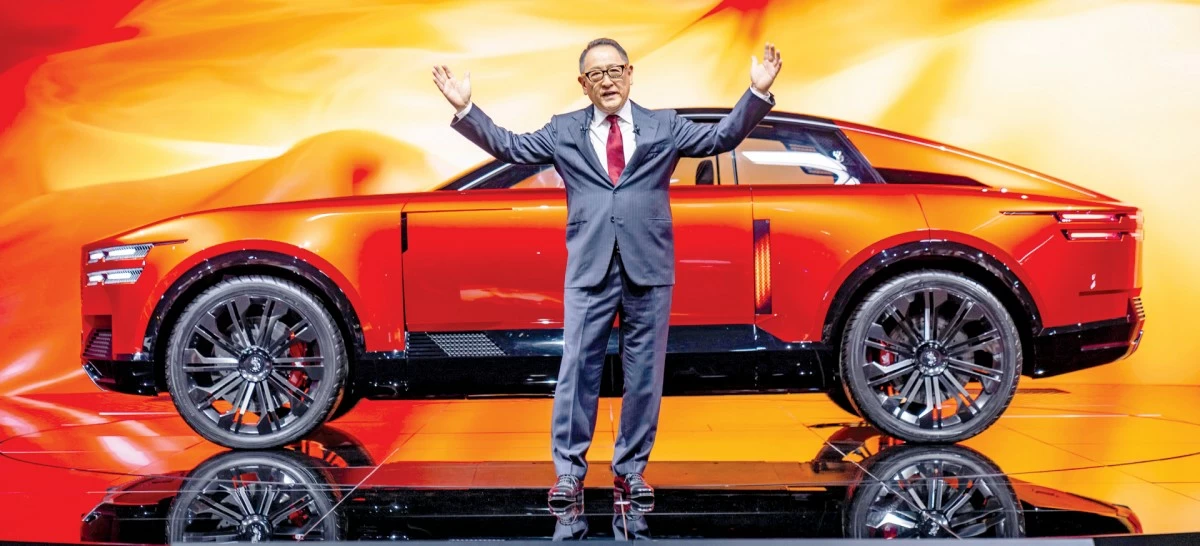
TOYOTA CHAIRMAN AKIO TOYODA presenting the Century, the  ultra-luxury car under the Toyota group.
TOYOTA CHAIRMAN AKIO TOYODA presenting the Century, the ultra-luxury car under the Toyota group.
“We often say ‘for all,’” he admitted, “but in truth, there isn’t a single product that perfectly suits everyone in the same way. What we think when we’re making something is: We want to help someone. We want to make someone smile. We always picture the face of a certain singular ‘you’ and keep that face in mind as we make things.”
Toyota Corolla Concept
That idea — of designing mobility for a specific “you” — shaped every vehicle Toyota displayed at the Japan mobility show which ran from Oct 30 to Nov. 9, recording over one million visitors. A record 522 companies and organizations participated in the show held under the concept “A unique opportunity to explore the future of mobility.”
THE COROLLA, shown at the end of the 'To You Toyota' ad. 'The Corolla is symbolic of our 'to you' — in other words, car-making for a specific someone. In line with the times and people's lives, the Corolla has always transformed for the 'you' right in front of it,' Toyota President Kato said during the presentation on Press Day of the Japan Mobility Show 2025.
Toyota’s exhibit told stories of people and their needs: farmers, healthcare workers, delivery drivers, sen-iors, and city dwellers — each represented in a concept vehicle built around their everyday realities.
IMV Origin: For ‘You’ who builds and sustains communities
My favorite was the IMV Origin Concept, a rugged, utilitarian pickup that embodies Toyota’s vision for emerging markets. It was inspired by people living in rural towns and villages, where vehicles are lifelines more than transportation.
In a bold move, Toyota plans to ship this vehicle unfinished. Local workers will assemble and customize it according to each community’s needs — as a people carrier, farm vehicle, or delivery truck.
THE IMV ORIGIN, a vehicle that takes on the challenge of constant reinvention based on the concept of 'deliberate incompleteness.' it is delivered unfinished for the customer to complete it according to its use.
“Not finishing it is what makes it a ‘for you’ car,” Sato explained. The concept, he said, encourages local in-novation and job creation — a fresh way to interpret Toyota’s manufacturing spirit, or ‘monozukuri’.
He said: “As a carmaker, not finishing this vehicle was frustrating. However, not finishing it is what makes it a "for you" car, because people have different needs in their daily life and work.”
“The IMV Origin is a vehicle that takes on the challenge of constant reinvention based on the concept of de-liberate incompleteness’,” he said.
With its squared-off styling and flat surfaces, the IMV Origin looks almost simple, but that simplicity is its strength: it’s a platform for ideas. It reflects Toyota’s faith in communities to shape their own mobility solu-tions.
The HiAce health clinic: Mobility that heals
A mobile health clinic based on the new HiAce presented another face of “To you” slogan. Outfitted with medical and diagnostic equipment, refrigeration, clean power, and telemedicine capability, the concept was designed for remote or underserved areas.
The vehicle demonstrates what Toyota calls “Act for Others” — the founding ethos that goes back to Sakichi Toyoda’s wooden loom, invented to ease his mother’s struggles. In that spirit, this HiAce redefines mobility as an instrument of compassion. It doesn’t just transport people — it brings healthcare to where it’s needed most.
The “mobility to heal’ project was launched in the Philippines in July as the fourth pillar of Toyota Motor Philippines Foundation. Two fully equipped mobile health clinics housed in a Toyota HiAce, are now servicing towns in Cavite.
TOYOTA LAND CRUISER FJ, one of the most viewed car at the Toyota booth at the Japan Mobility Show.
Kayoibako: The Box that Moves with You
One of the show’s most charming vehicles was the Kayoibako. The name comes from Japan’s delivery boxes, and the concept is just as flexible.
Compact, modular, and electric, the Kayoibako is designed to meet multiple urban needs. It can transform into a mini delivery van, a mobile café, or a micro-shop — whatever its user imagines.
THE KAYOIBAKO — Just as cardboard boxes come in different sizes, so does the Kayoibako. From small to extra-large…Daihatsu will make the small boxes, and Toyota will make the big ones. This vehicle can be  fitted with equipment to bring healthcare to the underserved areas, can also be equipped with office stuff for a mobile office, or turned into a mobile store or cafe — according to the owner's requirements.
THE KAYOIBAKO — Just as cardboard boxes come in different sizes, so does the Kayoibako. From small to extra-large…Daihatsu will make the small boxes, and Toyota will make the big ones. This vehicle can be fitted with equipment to bring healthcare to the underserved areas, can also be equipped with office stuff for a mobile office, or turned into a mobile store or cafe — according to the owner's requirements.
“Mobility is not just getting in and going,” Sato said. “It’s about getting closer to ‘you’ and delivering something.”
The Kayoibako also represents collaboration across the Toyota Group. Daihatsu, known for its small-car ex-pertise, will produce the smaller “boxes,” while Toyota handles the larger ones — together forming a family of versatile, scalable mobility tools.
Personal mobility devices: For ‘You’ who seeks independence
Beyond the big concepts were smaller, more personal machines — mobility devices designed for seniors and people with disabilities. Some resembled sleek scooters or powered wheelchairs; others looked like compact pods that could autonomously move short distances.
A PERSONAL VEHICLE designed for people with mobility issues, yet compete in sports or work in factories and offices.
These prototypes might not attract the same attention as futuristic sports cars, but they express the heart of Toyota’s new philosophy. They give back what many people lose with age or disability — independence, movement, and the dignity that comes with both.
The thread that connects it all
“To You Toyota” is not just marketing — it’s an invitation to rethink what mobility can mean.
For one person, it’s a truck that creates jobs. For another, it’s a van that brings a doctor to their door. For someone else, it’s a small electric box that powers a local shop. For a senior, it’s the ability to move freely again.
Toyota’s vision, in the end, is not about cars — it’s about connection. It’s about every “you” who needs to move, and the quiet human stories that begin each time an engine starts. (Photos courtesy of Toyota website)

Related Tags

TOYOTA MOBILITY FOR ALL SPOTLIGHT FEATURES
ADVERTISEMENT
.most-popular .layout-ratio{ padding-bottom: 79.13%; } @media (min-width: 768px) and (max-width: 1024px) { .widget-title { font-size: 15px !important; } }

{{ articles_filter_1561_widget.title }}

.most-popular .layout-ratio{ padding-bottom: 79.13%; } @media (min-width: 768px) and (max-width: 1024px) { .widget-title { font-size: 15px !important; } }

{{ articles_filter_1562_widget.title }}

.most-popular .layout-ratio{ padding-bottom: 79.13%; } @media (min-width: 768px) and (max-width: 1024px) { .widget-title { font-size: 15px !important; } }

{{ articles_filter_1563_widget.title }}

{{ articles_filter_1564_widget.title }}

.mb-article-details { position: relative; } .mb-article-details .article-body-preview, .mb-article-details .article-body-summary{ font-size: 17px; line-height: 30px; font-family: "Libre Caslon Text", serif; color: #000; } .mb-article-details .article-body-preview iframe , .mb-article-details .article-body-summary iframe{ width: 100%; margin: auto; } .read-more-background { background: linear-gradient(180deg, color(display-p3 1.000 1.000 1.000 / 0) 13.75%, color(display-p3 1.000 1.000 1.000 / 0.8) 30.79%, color(display-p3 1.000 1.000 1.000) 72.5%); position: absolute; height: 200px; width: 100%; bottom: 0; display: flex; justify-content: center; align-items: center; padding: 0; } .read-more-background a{ color: #000; } .read-more-btn { padding: 17px 45px; font-family: Inter; font-weight: 700; font-size: 18px; line-height: 16px; text-align: center; vertical-align: middle; border: 1px solid black; background-color: white; } .hidden { display: none; }
function initializeAllSwipers() { // Get all hidden inputs with cms_article_id document.querySelectorAll('[id^="cms_article_id_"]').forEach(function (input) { const cmsArticleId = input.value; const articleSelector = '#article-' + cmsArticleId + ' .body_images'; const swiperElement = document.querySelector(articleSelector); if (swiperElement && !swiperElement.classList.contains('swiper-initialized')) { new Swiper(articleSelector, { loop: true, pagination: false, navigation: { nextEl: '#article-' + cmsArticleId + ' .swiper-button-next', prevEl: '#article-' + cmsArticleId + ' .swiper-button-prev', }, }); } }); } setTimeout(initializeAllSwipers, 3000); const intersectionObserver = new IntersectionObserver( (entries) => { entries.forEach((entry) => { if (entry.isIntersecting) { const newUrl = entry.target.getAttribute("data-url"); if (newUrl) { history.pushState(null, null, newUrl); let article = entry.target; // Extract metadata const author = article.querySelector('.author-section').textContent.replace('By', '').trim(); const section = article.querySelector('.section-info ').textContent.replace(' ', ' '); const title = article.querySelector('.article-title h1').textContent; // Parse URL for Chartbeat path format const parsedUrl = new URL(newUrl, window.location.origin); const cleanUrl = parsedUrl.host + parsedUrl.pathname; // Update Chartbeat configuration if (typeof window._sf_async_config !== 'undefined') { window._sf_async_config.path = cleanUrl; window._sf_async_config.sections = section; window._sf_async_config.authors = author; } // Track virtual page view with Chartbeat if (typeof pSUPERFLY !== 'undefined' && typeof pSUPERFLY.virtualPage === 'function') { try { pSUPERFLY.virtualPage({ path: cleanUrl, title: title, sections: section, authors: author }); } catch (error) { console.error('ping error', error); } } // Optional: Update document title if (title && title !== document.title) { document.title = title; } } } }); }, { threshold: 0.1 } ); function showArticleBody(button) { const article = button.closest("article"); const summary = article.querySelector(".article-body-summary"); const body = article.querySelector(".article-body-preview"); const readMoreSection = article.querySelector(".read-more-background"); // Hide summary and read-more section summary.style.display = "none"; readMoreSection.style.display = "none"; // Show the full article body body.classList.remove("hidden"); } document.addEventListener("DOMContentLoaded", () => { let loadCount = 0; // Track how many times articles are loaded const offset = [1, 2, 3, 4, 5, 6, 7, 8, 9, 10]; // Offset values const currentUrl = window.location.pathname.substring(1); let isLoading = false; // Prevent multiple calls if (!currentUrl) { console.log("Current URL is invalid."); return; } const sentinel = document.getElementById("load-more-sentinel"); if (!sentinel) { console.log("Sentinel element not found."); return; } function isSentinelVisible() { const rect = sentinel.getBoundingClientRect(); return ( rect.top < window.innerHeight && rect.bottom >= 0 ); } function onScroll() { if (isLoading) return; if (isSentinelVisible()) { if (loadCount >= offset.length) { console.log("Maximum load attempts reached."); window.removeEventListener("scroll", onScroll); return; } isLoading = true; const currentOffset = offset[loadCount]; window.loadMoreItems().then(() => { let article = document.querySelector('#widget_1690 > div:nth-last-of-type(2) article'); intersectionObserver.observe(article) loadCount++; }).catch(error => { console.error("Error loading more items:", error); }).finally(() => { isLoading = false; }); } } window.addEventListener("scroll", onScroll); });

Sign up by email to receive news.