ADVERTISEMENT

Severe solar storms could hit Earth, trigger auroras

Published Nov 12, 2025 03:27 pm
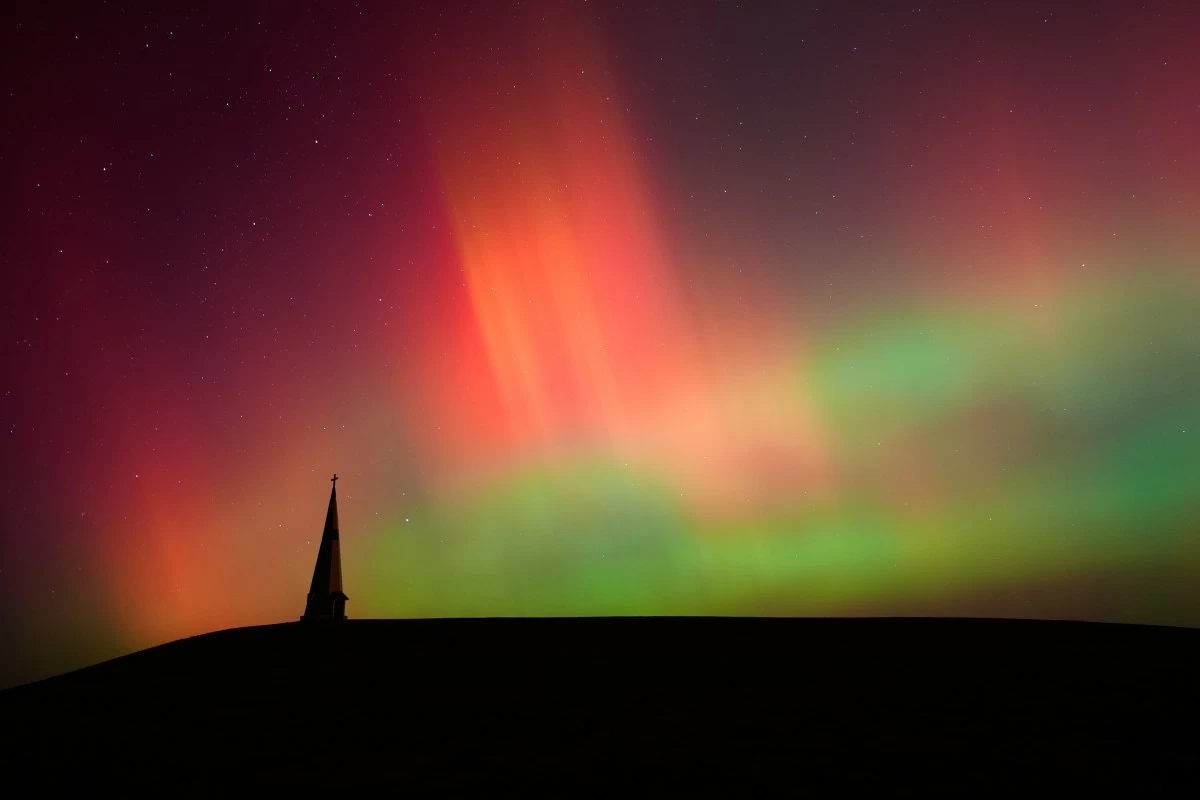
THE northern lights fill the sky behind the Saint Joseph the Woodworker Shrine Tuesday, Nov. 11, 2025, near Valley Falls, Kansas. (AP)
NEW YORK (AP) – Space weather forecasters issued an alert on Tuesday for incoming severe solar storms that could produce colorful northern lights and temporarily disrupt communications.
In the past few days, the sun has burped out several bursts of energy called coronal mass ejections that could reach Earth Tuesday night and early Wednesday. The potential severe geomagnetic storms could disrupt radio and GPS communications, according to forecasters with the National Oceanic and Atmospheric Administration.
How bright the auroras are and how far south they are visible will depend on when the solar bursts get here and how they interact with Earth's atmosphere. The vibrant displays could be visible across much of the northern US, and as far south as Alabama and Northern California.
The sun is at the maximum phase of its 11-year activity cycle, making the light displays more common and widespread. Colorful northern lights have decorated night skies in unexpected places and space weather experts say there are more auroras still to come.
Aurora displays known as the northern and southern lights are commonly visible near the poles, where charged particles from the sun interact with Earth’s atmosphere.
Skygazers are spotting the lights deeper into the United States and Europe because the sun is going through a major face-lift. Every 11 years, its poles swap places, causing magnetic twists and tangles along the way.
Last year, the strongest geomagnetic storm in two decades slammed Earth, producing light displays across the Northern Hemisphere. And soon afterward, a powerful solar storm dazzled skygazers far from the Arctic Circle when dancing lights appeared in unexpected places, including Germany, the United Kingdom, New England, and New York City.
The sun’s active spurt is expected to last at least through the end of this year, though when solar activity will peak won’t be known until months after the fact, according to NASA and NOAA.
Solar storms can bring more than colorful lights to Earth.
When fast-moving particles and plasma slam into Earth’s magnetic field, they can temporarily disrupt the power grid. Space weather can also interfere with air traffic control radio and satellites in orbit. Severe storms are capable of scrambling other radio and GPS communications.
In 1859, a severe solar storm triggered auroras as far south as Hawaii and set telegraph lines on fire in a rare event. And a 1972 solar storm may have detonated magnetic US sea mines off the coast of Vietnam.
Space weather experts aren’t able to predict a solar storm months in advance. Instead, they alert relevant parties to prepare in the days before a solar outburst hits Earth.
Northern lights forecasts can be found on NOAA’s Space Weather Prediction Center website or an aurora forecasting app.
Consider aurora-watching in a quiet, dark area away from city lights. Experts recommend skygazing from a local or national park. And check the weather forecast because clouds can cover up the spectacle entirely.
Taking a picture with a smartphone camera may also reveal hints of the aurora that aren’t visible to the naked eye.

Related Tags

World news
ADVERTISEMENT
.most-popular .layout-ratio{ padding-bottom: 79.13%; } @media (min-width: 768px) and (max-width: 1024px) { .widget-title { font-size: 15px !important; } }

{{ articles_filter_1561_widget.title }}

.most-popular .layout-ratio{ padding-bottom: 79.13%; } @media (min-width: 768px) and (max-width: 1024px) { .widget-title { font-size: 15px !important; } }

{{ articles_filter_1562_widget.title }}

.most-popular .layout-ratio{ padding-bottom: 79.13%; } @media (min-width: 768px) and (max-width: 1024px) { .widget-title { font-size: 15px !important; } }

{{ articles_filter_1563_widget.title }}

{{ articles_filter_1564_widget.title }}

.mb-article-details { position: relative; } .mb-article-details .article-body-preview, .mb-article-details .article-body-summary{ font-size: 17px; line-height: 30px; font-family: "Libre Caslon Text", serif; color: #000; } .mb-article-details .article-body-preview iframe , .mb-article-details .article-body-summary iframe{ width: 100%; margin: auto; } .read-more-background { background: linear-gradient(180deg, color(display-p3 1.000 1.000 1.000 / 0) 13.75%, color(display-p3 1.000 1.000 1.000 / 0.8) 30.79%, color(display-p3 1.000 1.000 1.000) 72.5%); position: absolute; height: 200px; width: 100%; bottom: 0; display: flex; justify-content: center; align-items: center; padding: 0; } .read-more-background a{ color: #000; } .read-more-btn { padding: 17px 45px; font-family: Inter; font-weight: 700; font-size: 18px; line-height: 16px; text-align: center; vertical-align: middle; border: 1px solid black; background-color: white; } .hidden { display: none; }
function initializeAllSwipers() { // Get all hidden inputs with cms_article_id document.querySelectorAll('[id^="cms_article_id_"]').forEach(function (input) { const cmsArticleId = input.value; const articleSelector = '#article-' + cmsArticleId + ' .body_images'; const swiperElement = document.querySelector(articleSelector); if (swiperElement && !swiperElement.classList.contains('swiper-initialized')) { new Swiper(articleSelector, { loop: true, pagination: false, navigation: { nextEl: '#article-' + cmsArticleId + ' .swiper-button-next', prevEl: '#article-' + cmsArticleId + ' .swiper-button-prev', }, }); } }); } setTimeout(initializeAllSwipers, 3000); const intersectionObserver = new IntersectionObserver( (entries) => { entries.forEach((entry) => { if (entry.isIntersecting) { const newUrl = entry.target.getAttribute("data-url"); if (newUrl) { history.pushState(null, null, newUrl); let article = entry.target; // Extract metadata const author = article.querySelector('.author-section').textContent.replace('By', '').trim(); const section = article.querySelector('.section-info ').textContent.replace(' ', ' '); const title = article.querySelector('.article-title h1').textContent; // Parse URL for Chartbeat path format const parsedUrl = new URL(newUrl, window.location.origin); const cleanUrl = parsedUrl.host + parsedUrl.pathname; // Update Chartbeat configuration if (typeof window._sf_async_config !== 'undefined') { window._sf_async_config.path = cleanUrl; window._sf_async_config.sections = section; window._sf_async_config.authors = author; } // Track virtual page view with Chartbeat if (typeof pSUPERFLY !== 'undefined' && typeof pSUPERFLY.virtualPage === 'function') { try { pSUPERFLY.virtualPage({ path: cleanUrl, title: title, sections: section, authors: author }); } catch (error) { console.error('ping error', error); } } // Optional: Update document title if (title && title !== document.title) { document.title = title; } } } }); }, { threshold: 0.1 } ); function showArticleBody(button) { const article = button.closest("article"); const summary = article.querySelector(".article-body-summary"); const body = article.querySelector(".article-body-preview"); const readMoreSection = article.querySelector(".read-more-background"); // Hide summary and read-more section summary.style.display = "none"; readMoreSection.style.display = "none"; // Show the full article body body.classList.remove("hidden"); } document.addEventListener("DOMContentLoaded", () => { let loadCount = 0; // Track how many times articles are loaded const offset = [1, 2, 3, 4, 5, 6, 7, 8, 9, 10]; // Offset values const currentUrl = window.location.pathname.substring(1); let isLoading = false; // Prevent multiple calls if (!currentUrl) { console.log("Current URL is invalid."); return; } const sentinel = document.getElementById("load-more-sentinel"); if (!sentinel) { console.log("Sentinel element not found."); return; } function isSentinelVisible() { const rect = sentinel.getBoundingClientRect(); return ( rect.top < window.innerHeight && rect.bottom >= 0 ); } function onScroll() { if (isLoading) return; if (isSentinelVisible()) { if (loadCount >= offset.length) { console.log("Maximum load attempts reached."); window.removeEventListener("scroll", onScroll); return; } isLoading = true; const currentOffset = offset[loadCount]; window.loadMoreItems().then(() => { let article = document.querySelector('#widget_1690 > div:nth-last-of-type(2) article'); intersectionObserver.observe(article) loadCount++; }).catch(error => { console.error("Error loading more items:", error); }).finally(() => { isLoading = false; }); } } window.addEventListener("scroll", onScroll); });

Sign up by email to receive news.