






Manila Bulletin
 Business
Banking & Finance
MDBs renew commitment to boost livelihoods and climate resilience at COP30
Business
Banking & Finance
MDBs renew commitment to boost livelihoods and climate resilience at COP30
Business
Banking & Finance
MDBs renew commitment to boost livelihoods and climate resilience at COP30
MDBs renew commitment to boost livelihoods and climate resilience at COP30
Published Nov 12, 2025 11:17 am


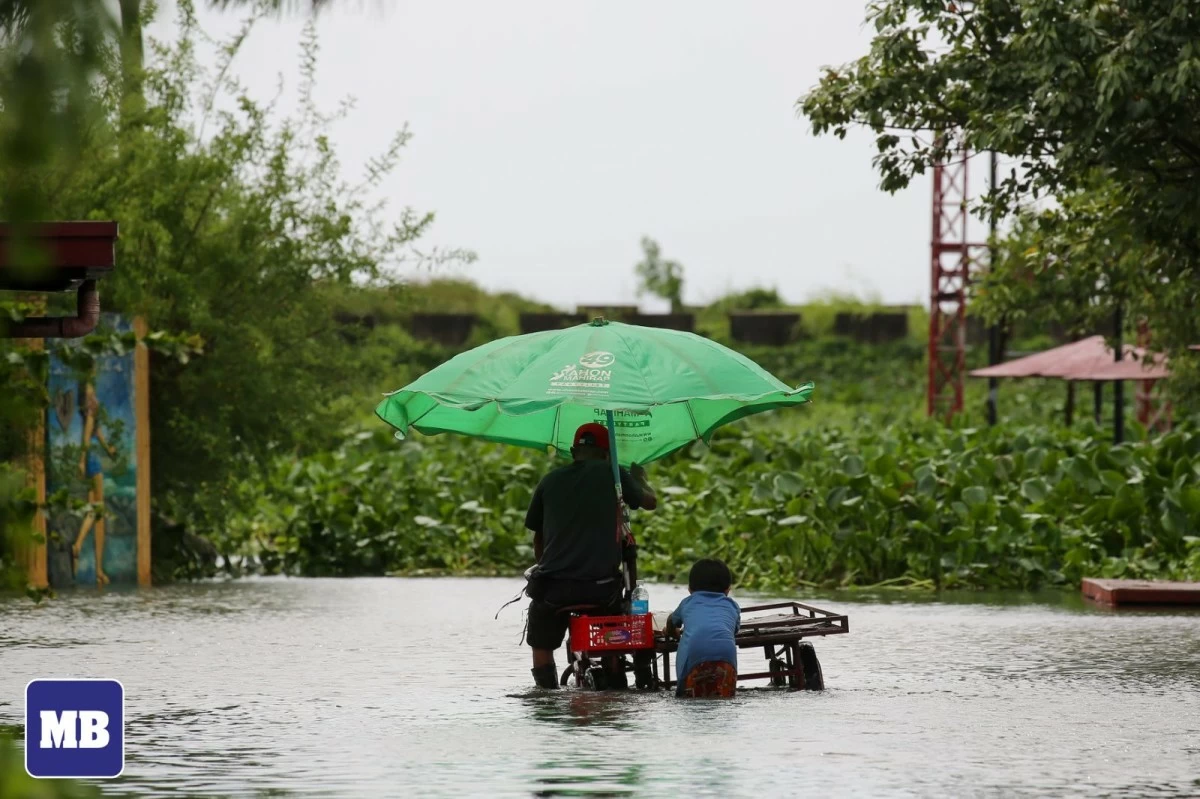
Residents of Angono, Rizal wade through knee-to-waist-deep floodwaters on Nov. 10, 2025 as Super Typhoon Uwan brings heavy rains to the area. Locals said it may take one to two months before the floodwaters fully subside. (Photo: John Louie Abrina / MANILA BULLETIN)
Multilateral development banks (MDBs) have renewed their commitment to help countries boost livelihoods and job creation to strengthen community and business resilience amid worsening climate shocks and environmental degradation.
“Working together as a system, they call for resilient, economically sound development that is rooted in trust and built to last, focusing on stable institutions, reliable infrastructure, employment opportunities, adaptation to the impacts of climate shocks, and the capacity to grow within each country’s context,” MDBs said in a joint statement, which the Manila-based Asian Development Bank (ADB) published on its website on Tuesday, Nov. 11.
The joint statement highlighted that MDBs reaffirmed their commitment during the 30th United Nations Framework Convention on Climate Change (UNFCCC) Conference (COP30) in Belém, Brazil.
The statement emphasized that MDBs are taking several steps to better support their clients, including improving the risk profile of investments and attracting more private-sector funding; enhancing how results are measured to track the impact of their projects; streamlining financing processes to increase adaptation and mitigation outcomes; and advancing the joint MDB long-term strategy program to help countries plan for climate action and implement locally led, country-driven initiatives.
“In 2024, MDBs provided $137 billion in climate finance for adaptation and mitigation and mobilized an additional $134 billion from private capital. Of these amounts, $85 billion and $33 billion were directed to low- and middle-income economies, respectively, putting MDBs on track to reach $120 billion from their own accounts and $65 billion in private capital mobilization by 2030,” the statement noted.
Last September, 10 MDBs reported that their combined climate finance last year hit a new record high and was 10-percent more than the previous year’s global financing.
This latest joint report compiled data from the following MDBs: the ADB, the African Development Bank (AfDB), the Asian Infrastructure Investment Bank (AIIB), the Council of Europe Development Bank (CEB), the European Bank for Reconstruction and Development (EBRD), the European Investment Bank (EIB), the Inter-American Development Bank Group (IDB), the Islamic Development Bank (IsDB), the New Development Bank (NDB), and the World Bank Group (WBG).
“Since 2019, MDBs have doubled their support for adaptation and resilience, delivering over $26 billion to low- and middle-income economies in 2024. Based on this experience—not only financing programs and policies, but also linking finance with policy dialogue, strategic planning, and institutional capacity building—they launched at COP30 the technical paper ‘From Innovation to Impact: Building Resilience for People and Planet,’ a new report that showcases more than 100 best practices for delivering resilience, including several pioneering instruments that are expanding resources, mobilizing private capital, and strengthening systemic resilience,” the statement added.
Meanwhile, the statement noted that MDBs are united in their commitment to support countries’ priorities—boosting economic growth, improving livelihoods, creating jobs, and strengthening the resilience of communities and businesses amid escalating climate shocks and environmental degradation.
In Belém, MDBs said they are ready to build on progress made over the past year, working together to better support countries by strengthening long-term development foundations—including stable institutions, reliable infrastructure, employment opportunities, adaptation to climate shocks, and the capacity for sustainable growth. The banks described this approach as “climate-smart development”: resilient, economically sound, rooted in trust, and designed to last.
“We are also enhancing transparency and accountability by digitizing reporting and continuing to apply our joint methodology to ensure consistent measurement and reporting across institutions,” MDBs said. “Our goal is to help countries deliver tangible adaptation outcomes that safeguard lives, livelihoods, and economic infrastructure in a resource-efficient way.”
MDBs added that they are helping countries scale up nature-positive investments by improving metrics, methodologies, and the design of financial products. They said that in Belém, the banks are launching a new framework for nature finance, which includes the “Common Principles for Tracking Nature Finance” and “A Practitioner’s Guide to Results Metrics Selection.”
The banks reaffirmed their collective ambition to accelerate and scale climate-smart development in line with country priorities, focusing on delivering long-term benefits for people. They emphasized that durable jobs and sustainable, resilient livelihoods remain key drivers of development, providing dignity, stability, and opportunity.
MDBs also called on all stakeholders to partner with them to achieve these results at the necessary speed and scale, aiming to turn ambition into resilient, inclusive, and sustainable development for all.
(Ricardo M. Austria)