






Manila Bulletin
 Philippines
Super Typhoon 'Uwan' leaves 2 dead, trail of destruction across Luzon, Visayas
Philippines
Super Typhoon 'Uwan' leaves 2 dead, trail of destruction across Luzon, Visayas
Philippines
Super Typhoon 'Uwan' leaves 2 dead, trail of destruction across Luzon, Visayas
Super Typhoon 'Uwan' leaves 2 dead, trail of destruction across Luzon, Visayas
Published Nov 10, 2025 10:58 am
|
Updated Nov 10, 2025 01:24 pm


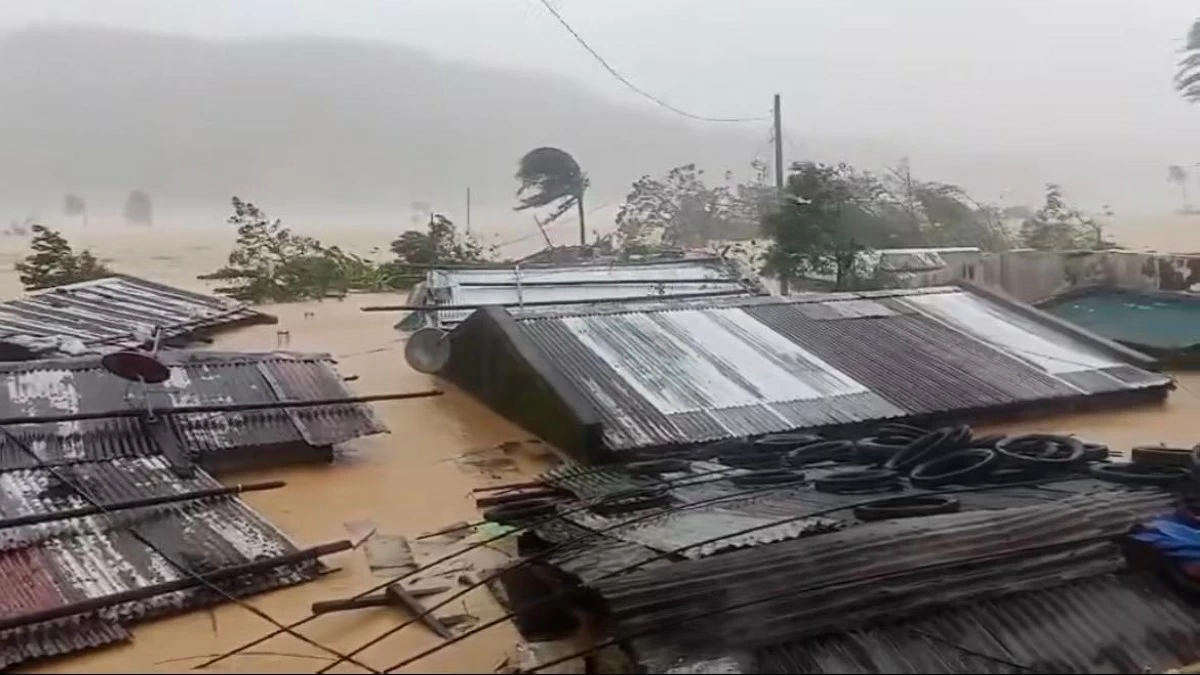
Houses in Barangay District 3, San Miguel, Catanduanes, are submerged in severe flood due to heavy rains caused by Super Typhoon Uwan on Nov. 9, 2025. Disaster officials along with personnel from the Philippine Army immediately conducted a rescue operation to save residents in the affected area. (Photo: MDRRMO San Miguel/ Radyo Pilipinas Virac)
(UPDATED)
Super Typhoon “Uwan” battered large parts of Luzon and Visayas, triggering widespread flooding, landslides, and power outages that left at least two people dead and 830,000 individuals affected, the Office of Civil Defense (OCD) reported on Monday, Nov. 10.
One fatality was recorded in Viga, Catanduanes due to drowning while another one was in Catbalogan City, Samar due to a collapsed structure, said OCD Assistant Secretary Bernardo Rafaelito Alejandro IV, civil defense deputy administrator for administration.
Two persons were also reported injured in Bicol (Region 5) and Eastern Visayas (Region 8).
“These are still subject for validation,” Alejandro said.
The death toll is feared to further increase as twins aged five were reportedly killed in a landslide that occurred in Brgy. Balangabang, Kayapa, Nueva Vizcaya, according to the Philippine National Police (PNP).
"Regarding the reported casualties, these were from the landslide that occurred early this morning (Monday). However, I have referred the matter to the DILG [Department of the Interior and Local Government] since the announcement of deaths and missing persons falls under their jurisdiction. The PNP is assisting and verifying the reports. We have already extended assistance and submitted our reports to the DILG, so yes, the landslide incident did happen early this morning," Police Colonel Esmeraldo Osia Jr. said in a press briefing hosted by the OCD at Camp Aguinaldo in Quezon City.
But the casualties were not as grim as Typhoon Tino’s, where the death toll already reached 224.
Part of the reason could be the preemptive evacuation of more than 1.4 million individuals or 426,000 families in the National Capital Region (NCR), Cordillera Administrative Region (CAR), Ilocos (Region 1), Cagayan Valley (Region 2), Central Luzon (Region 3), Calabarzon (Region 4A), Mimaropa (Region 4B), Bicol (Region 5), Western Visayas (Region 6), Negros Island Region (NIR), Central Visayas (Region 7), and Eastern Visayas (Region 8), with the bulk coming from Bicol, Eastern Visayas, and Calabarzon.
In its latest situational report, the National Disaster Risk Reduction and Management Council (NDRRMC) said 230,955 families or 836,572 persons have been affected across 2,710 barangays in Regions 2, 4A, 5, 6, 8, Zamboanga Peninsula (Region 9), Northern Mindanao (Region 10), and Caraga (Region 13).
A total of 6,069 evacuation centers were sheltering 317,691 individuals or 91,675 families while 164,923 individuals or 49,593 families were staying with relatives or in makeshift shelters.
An initial 1,085 houses were reported damaged, including 89 homes that were totally destroyed and 996 partially damaged, mostly in Regions 6, 9, and 13. The validation of agricultural and infrastructure damage is ongoing.
“We don’t have data yet on damage to infrastructure and agriculture, but we have been receiving reports of destroyed infrastructure, and these will undergo validation to determine the extent of the damage and its cost,” Alejandro said.
Although Uwan has exited the Luzon landmass, Alejandro warned that lingering rains may still trigger flooding and landslides in Central Luzon and Northern Luzon as well as Metro Manila.
“Hindi pa po tapos ang bagyong Uwan bagamat lumampas na po siya. May panganib pa rin ng mga ulan sa ilang lugar (Typhoon Uwan is not yet over even though it has already passed. There is still a threat of rain in some areas),” he said.
Flooding and infrastructure damage
In fact, at least 132 barangays in Regions 4B, 5, 6, 9, 10, and 13 experienced flooding while several areas also reported storm surges and landslides.
Alejandro said the municipalities of Dipaculao, Dinalungan, Casiguran, and Dilasag in Aurora Province were isolated due to landslides following Uwan’s landfall in Casiguran on Sunday.
“They were isolated due to landslides but these are now subject to immediate clearing this morning. We have also advised the DPWH [Department of Public Works and Highways] to work closely with our local government units (LGUs) to expedite the clearing operations,” Alejandro said.
The DPWH has deployed 165 personnel and 10 units of heavy equipment across NCR, Regions 1, 2, 3, 5, and 8 to clear 15 road networks rendered impassable by the typhoon.
A total of 87 roads and 29 bridges were also affected due to flooding or damage, according to the NDRRMC.
Power, water, and communication disruptions
Power outages hit 170 cities and municipalities in Regions 1, 3, 4A, 4B, 5, 6, 9, and 13.
“There were 155 LGUs that experienced power disruptions, which are now gradually being restored, with power already restored in 15 LGUs,” Alejandro said.
Meanwhile, water supply interruptions were recorded in 15 localities in Regions 4A and 5, but two areas have already restored water supply.
Communication lines were also disrupted in 14 municipalities in Region 5.
Search, rescue, and relief operations
Alejandro said 894 composite search and rescue teams from the Armed Forces of the Philippines (AFP), Philippine National Police (PNP), Philippine Coast Guard (PCG), and Bureau of Fire Protection (BFP) have been deployed to conduct search and rescue, as well as disaster relief operations.
These were supported by 190 search and rescue assets while an additional 3,497 teams and 7,308 assets were on standby and ready for deployment as needed.
He said relief operations were in full swing with P2.6 billion in standby funds and stockpiles from the Department of Social Welfare and Development (DSWD) and OCD.
Around P6.4 million worth of food items have already been distributed, including 4,776 family food packs sent to Regions 4A, 5, NIR, and 13.
The Department of Health (DOH) also mobilized P156 million worth of medical logistics, with an additional P10 million distributed to regional offices to support health response efforts.
Transport and ports
On the other hand, the Philippine Coast Guard (PCG) reported 7,213 passengers and truck drivers, 3,663 rolling cargoes, 171 vessels, and 28 motorbancas stranded across 156 ports. Of this number, more than 2,000 passengers were stuck in Bicol.
Another 541 vessels and 185 motorbancas remained docked for safety.
“In Davao del Sur, Tabaco Ciity and San Vicente, Palawan, there were small motorbancas that still sailed despite the issuance of advisories on the possible impact of Uwan because we have experienced big waves and strong winds. Three motorbancas in these areas capsized and fortunately we were able to rescue 11 individuals,” PCG spokesperson Captain Noemie Cayabyab.
“Even if Uwan has already left their respective areas, we continue to appeal to the residents to keep safe and avoid taking risks by leaving their homes or sailing because we still have gale force advisories and the waves could still be devastating in the middle of the seas,” she added.