

ADVERTISEMENT

Rybakina outlasts No. 1-ranked Sabalenka to win WTA Finals

Published Nov 10, 2025 11:55 am  |  Updated Nov 10, 2025 01:02 pm

At A Glance

  • RIYADH, Saudi Arabia (AP) — Elena Rybakina won the WTA Finals after producing a nearly flawless performance to beat No. 1-ranked Aryna Sabalenka, 6-3, 7-6 (0), on Saturday, Nov. 8.
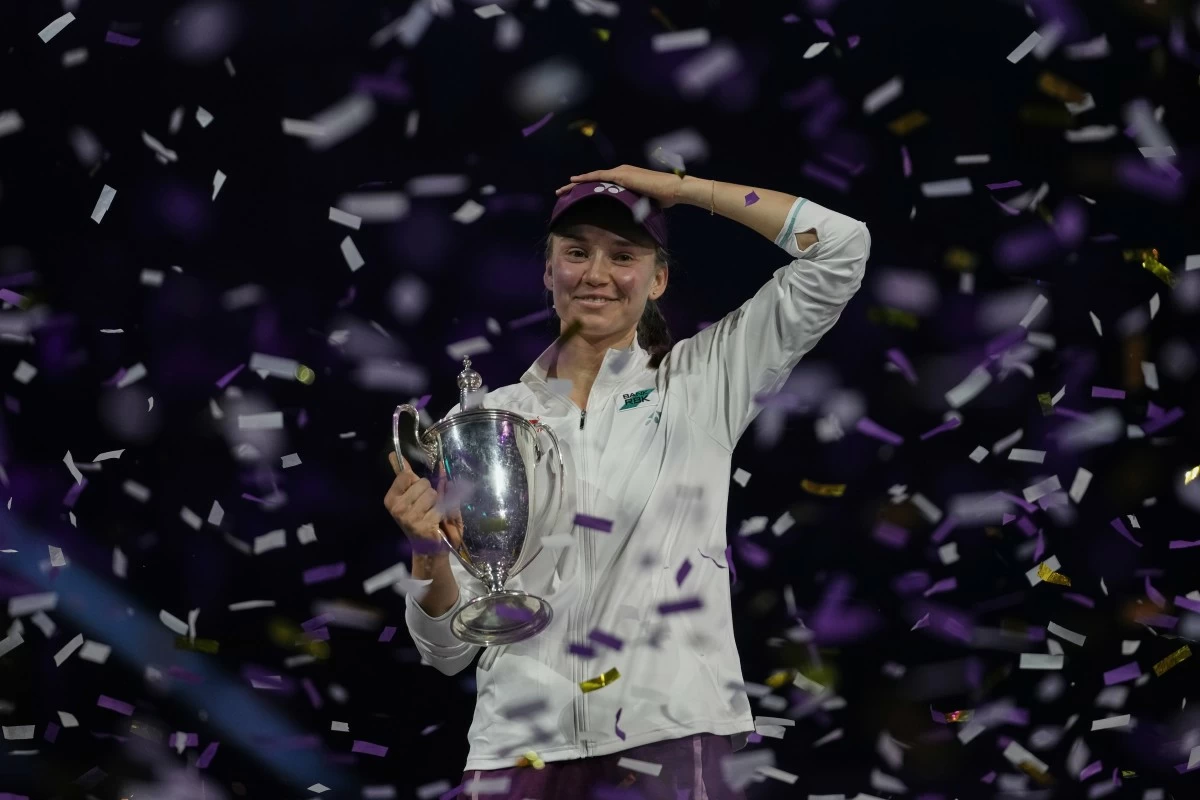
Elena Rybakina of Kazakhstan celebrates with her trophy after defeating Aryna Sabalenka of Belarus in the women's final singles match of the WTA finals in Riyadh, Saudi Arabia, Saturday, Nov. 8, 2025. (AP Photo/ Fatima Shbair)
RIYADH, Saudi Arabia (AP) — Elena Rybakina won the WTA Finals after producing a nearly flawless performance to beat No. 1-ranked Aryna Sabalenka, 6-3, 7-6 (0), on Saturday, Nov. 8.
The sixth-ranked Rybakina struck eight aces and converted the sole break of the match on the indoor hardcourt in Riyadh.
“It’s been an incredible week. I honestly didn’t expect any result and to go so far is just incredible,” Rybakina said about a title run that included wins over No. 2-seeded Iga Swiatek, Amanda Anisimova and Jessica Pegula.
It was a second loss in the final of the season-ending tournament for Sabalenka after the four-time Grand Slam winner lost to Caroline Garcia in the 2022 title match.
Rybakina, the 2022 Wimbledon champion, was playing her first title match in her third consecutive WTA Finals appearance.
She collected $5.23 million after going 5-0 at the event featuring the top eight women. The WTA said that was the largest payout in the history of women’s sports. Sabalenka earned $2.7 million as runner-up.
Rybakina broke for a 4-2 lead in the first set, and Sabalenka then saved four break points in the second to force the tiebreaker. The Belarusian entered the match with a 22–2 record in tiebreakers this year, but was shut out in this one — hitting a backhand return long on match point.
Rybakina recorded her tour-best 45th hardcourt win of the season. The 26-year-old Kazakhstani became the 10th straight first-time winner of the WTA Finals. She will finish the year at a career-high No. 5 in the rankings after a 58–19 record that included three titles.
Sabalenka will finish ranked No. 1 for a second straight season. This year, she won four titles, including the U.S. Open, and had 63 match wins. She also reached the finals of the French Open and Australian Open.
“She played incredible,” Sabalenka said about Rybakina. “I feel like I did my best today. It didn’t work, but I think so many things I have to be proud of. And yeah, I’m leaving this tournament without any disappointment."

Related Tags

Elena Rybakina Aryna Sabalenka
ADVERTISEMENT
.most-popular .layout-ratio{ padding-bottom: 79.13%; } @media (min-width: 768px) and (max-width: 1024px) { .widget-title { font-size: 15px !important; } }

{{ articles_filter_1561_widget.title }}

.most-popular .layout-ratio{ padding-bottom: 79.13%; } @media (min-width: 768px) and (max-width: 1024px) { .widget-title { font-size: 15px !important; } }

{{ articles_filter_1562_widget.title }}

.most-popular .layout-ratio{ padding-bottom: 79.13%; } @media (min-width: 768px) and (max-width: 1024px) { .widget-title { font-size: 15px !important; } }

{{ articles_filter_1563_widget.title }}

{{ articles_filter_1564_widget.title }}

.mb-article-details { position: relative; } .mb-article-details .article-body-preview, .mb-article-details .article-body-summary{ font-size: 17px; line-height: 30px; font-family: "Libre Caslon Text", serif; color: #000; } .mb-article-details .article-body-preview iframe , .mb-article-details .article-body-summary iframe{ width: 100%; margin: auto; } .read-more-background { background: linear-gradient(180deg, color(display-p3 1.000 1.000 1.000 / 0) 13.75%, color(display-p3 1.000 1.000 1.000 / 0.8) 30.79%, color(display-p3 1.000 1.000 1.000) 72.5%); position: absolute; height: 200px; width: 100%; bottom: 0; display: flex; justify-content: center; align-items: center; padding: 0; } .read-more-background a{ color: #000; } .read-more-btn { padding: 17px 45px; font-family: Inter; font-weight: 700; font-size: 18px; line-height: 16px; text-align: center; vertical-align: middle; border: 1px solid black; background-color: white; } .hidden { display: none; }
function initializeAllSwipers() { // Get all hidden inputs with cms_article_id document.querySelectorAll('[id^="cms_article_id_"]').forEach(function (input) { const cmsArticleId = input.value; const articleSelector = '#article-' + cmsArticleId + ' .body_images'; const swiperElement = document.querySelector(articleSelector); if (swiperElement && !swiperElement.classList.contains('swiper-initialized')) { new Swiper(articleSelector, { loop: true, pagination: false, navigation: { nextEl: '#article-' + cmsArticleId + ' .swiper-button-next', prevEl: '#article-' + cmsArticleId + ' .swiper-button-prev', }, }); } }); } setTimeout(initializeAllSwipers, 3000); const intersectionObserver = new IntersectionObserver( (entries) => { entries.forEach((entry) => { if (entry.isIntersecting) { const newUrl = entry.target.getAttribute("data-url"); if (newUrl) { history.pushState(null, null, newUrl); let article = entry.target; // Extract metadata const author = article.querySelector('.author-section').textContent.replace('By', '').trim(); const section = article.querySelector('.section-info ').textContent.replace(' ', ' '); const title = article.querySelector('.article-title h1').textContent; // Parse URL for Chartbeat path format const parsedUrl = new URL(newUrl, window.location.origin); const cleanUrl = parsedUrl.host + parsedUrl.pathname; // Update Chartbeat configuration if (typeof window._sf_async_config !== 'undefined') { window._sf_async_config.path = cleanUrl; window._sf_async_config.sections = section; window._sf_async_config.authors = author; } // Track virtual page view with Chartbeat if (typeof pSUPERFLY !== 'undefined' && typeof pSUPERFLY.virtualPage === 'function') { try { pSUPERFLY.virtualPage({ path: cleanUrl, title: title, sections: section, authors: author }); } catch (error) { console.error('ping error', error); } } // Optional: Update document title if (title && title !== document.title) { document.title = title; } } } }); }, { threshold: 0.1 } ); function showArticleBody(button) { const article = button.closest("article"); const summary = article.querySelector(".article-body-summary"); const body = article.querySelector(".article-body-preview"); const readMoreSection = article.querySelector(".read-more-background"); // Hide summary and read-more section summary.style.display = "none"; readMoreSection.style.display = "none"; // Show the full article body body.classList.remove("hidden"); } document.addEventListener("DOMContentLoaded", () => { let loadCount = 0; // Track how many times articles are loaded const offset = [1, 2, 3, 4, 5, 6, 7, 8, 9, 10]; // Offset values const currentUrl = window.location.pathname.substring(1); let isLoading = false; // Prevent multiple calls if (!currentUrl) { console.log("Current URL is invalid."); return; } const sentinel = document.getElementById("load-more-sentinel"); if (!sentinel) { console.log("Sentinel element not found."); return; } function isSentinelVisible() { const rect = sentinel.getBoundingClientRect(); return ( rect.top < window.innerHeight && rect.bottom >= 0 ); } function onScroll() { if (isLoading) return; if (isSentinelVisible()) { if (loadCount >= offset.length) { console.log("Maximum load attempts reached."); window.removeEventListener("scroll", onScroll); return; } isLoading = true; const currentOffset = offset[loadCount]; window.loadMoreItems().then(() => { let article = document.querySelector('#widget_1690 > div:nth-last-of-type(2) article'); intersectionObserver.observe(article) loadCount++; }).catch(error => { console.error("Error loading more items:", error); }).finally(() => { isLoading = false; }); } } window.addEventListener("scroll", onScroll); });

Sign up by email to receive news.