






Manila Bulletin
 Business
The Economy
OECD: Philippine disaster laws solid, but local execution failing
Business
The Economy
OECD: Philippine disaster laws solid, but local execution failing
Business
The Economy
OECD: Philippine disaster laws solid, but local execution failing
OECD: Philippine disaster laws solid, but local execution failing
Report says private sector key to stronger disaster warnings
Published Nov 10, 2025 03:30 pm
|
Updated Nov 10, 2025 01:27 pm


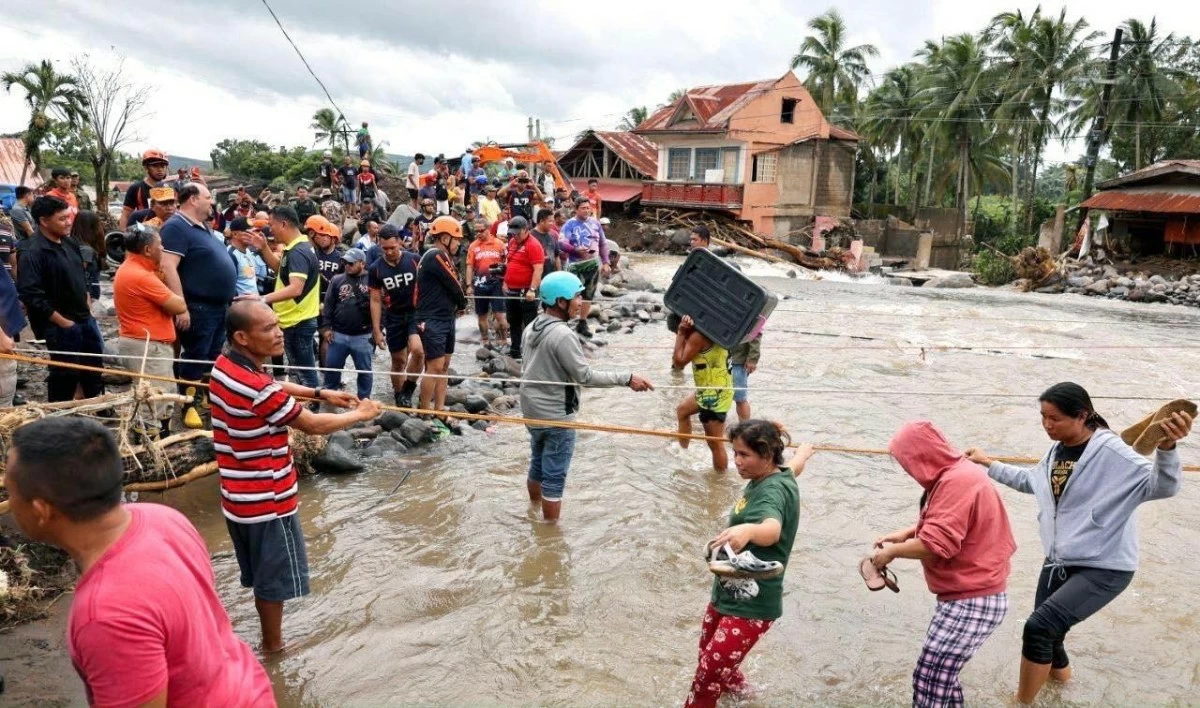
SEARCH and retrieval operations for missing individuals due to typhoon ‘Tino’ was suspended in Canlaon City, Negros Oriental on Sunday, Nov. 9, as super typhoon ‘Uwan’ nears. (Negros Oriental LGU/PIO)
Amid the series of weather disturbances battering the country, identifying the gaps and challenges in the Philippines’ early warning systems has become crucial, the Organization for Economic Cooperation and Development (OECD) said.
“The Philippines shows that a well-designed early warning system requires not only appropriate technical sophistication, but also robust legal and regulatory frameworks, finance, multi-stakeholder cooperation, and community engagement,” the OECD said in a development policy paper titled “Disaster early warning systems and private sector participation in Association of Southeast Asian Nations (ASEAN): Focus on the Philippines,” published on Monday, Nov. 10.
The new OECD paper highlighted that strong institutional mandates are key to effective early warning systems, citing the Philippines as a regional benchmark through Republic Act (RA) No. 10121 or the Philippine Disaster Risk Reduction and Management (DRRM) Act, and RA 10639 or the Free Mobile Disaster Alerts Act of 2014, which define agency roles and require use of technology for public warnings.
It noted that under this framework, RA 10121 decentralizes disaster management and provides funding for local offices, while RA 10639 requires telecommunications companies to deliver free, real-time, geo-targeted alerts to the public.
“These laws collectively establish a framework that is both legally robust and institutionally comprehensive, embedding disaster preparedness into national and local governance structures,” the OECD added.
Despite a strong legal framework, the OECD reported that implementation of disaster risk reduction in the Philippines remains uneven, with only 65 percent of local government units (LGUs) having updated DRRM plans. While over 95 million Filipinos received alerts in 2022 under RA 10639, their effectiveness is limited by poor coverage in remote areas and weak coordination with local protocols.
The OECD also noted that real-time data and technology are improving early warning and disaster recovery in the Philippines. Project Nationwide Operational Assessment of Hazards (NOAH) and GeoRiskPH provide hazard maps, flood forecasts, and earthquake data for LGUs and communities.
However, data fragmentation between agencies like the Philippine Atmospheric, Geophysical, and Astronomical Services Administration (PAGASA) and the Philippine Institute of Volcanology and Seismology (PHIVOLCS) limits alert accuracy, and many LGUs still lack trained staff and tools to fully utilize these systems.
The OECD stressed that despite RA 10121 mandating five percent of local revenues for disaster risk reduction, Philippine LGUs still spend most of these funds on response rather than preparedness. Limited expertise, unclear guidelines, and financial barriers for small and medium enterprises (SMEs) hinder proactive measures, prompting calls for market-based financing such as green bonds and municipal instruments to strengthen early warning systems.
“Institutional frameworks must be complemented by robust partnerships with the private sector, especially telecom companies, tech platforms, and data service providers,” the OECD said, noting that the private sector provides advanced tools and infrastructure for mass communication, such as SMS alerts, mobile applications, artificial intelligence (AI)-powered warning systems, and social media platforms. It added that including the private sector in national frameworks improves real-time alerts and supports innovation and funding for scalable early warning systems.
The OECD further stressed that early warning systems are only effective when they reach and engage local communities, noting that subnational disaster management offices with clear mandates, dedicated funding, and trained staff help translate alerts into rapid, context-specific responses.
“These offices can serve as intermediaries between national agencies and communities, tailoring communication to local languages, customs, and risk profiles. Local ownership and integration into policy design also build public trust and encourage community-based preparedness and feedback loops,” it added.
Beyond the Philippines, the OECD recommended that ASEAN countries strengthen governance alignment, create incentive frameworks, invest in data sharing and interoperability, develop public-private protocols, and promote localized, inclusive community engagement for more effective disaster risk management.
The OECD also advised private firms to play a larger role in early warning systems, not only to safeguard their own operations but also to strengthen community resilience and inclusiveness. Beyond technology firms, a broader cross-section of the private sector could also actively contribute to early warning systems.
Policymakers are likewise urged to encourage the participation of SMEs, given their prevalence in ASEAN and significant influence at the community level.
(Ricardo M. Austria)