







'Uwan' about to make landfall over Aurora — PAGASA
Published Nov 9, 2025 08:30 pm


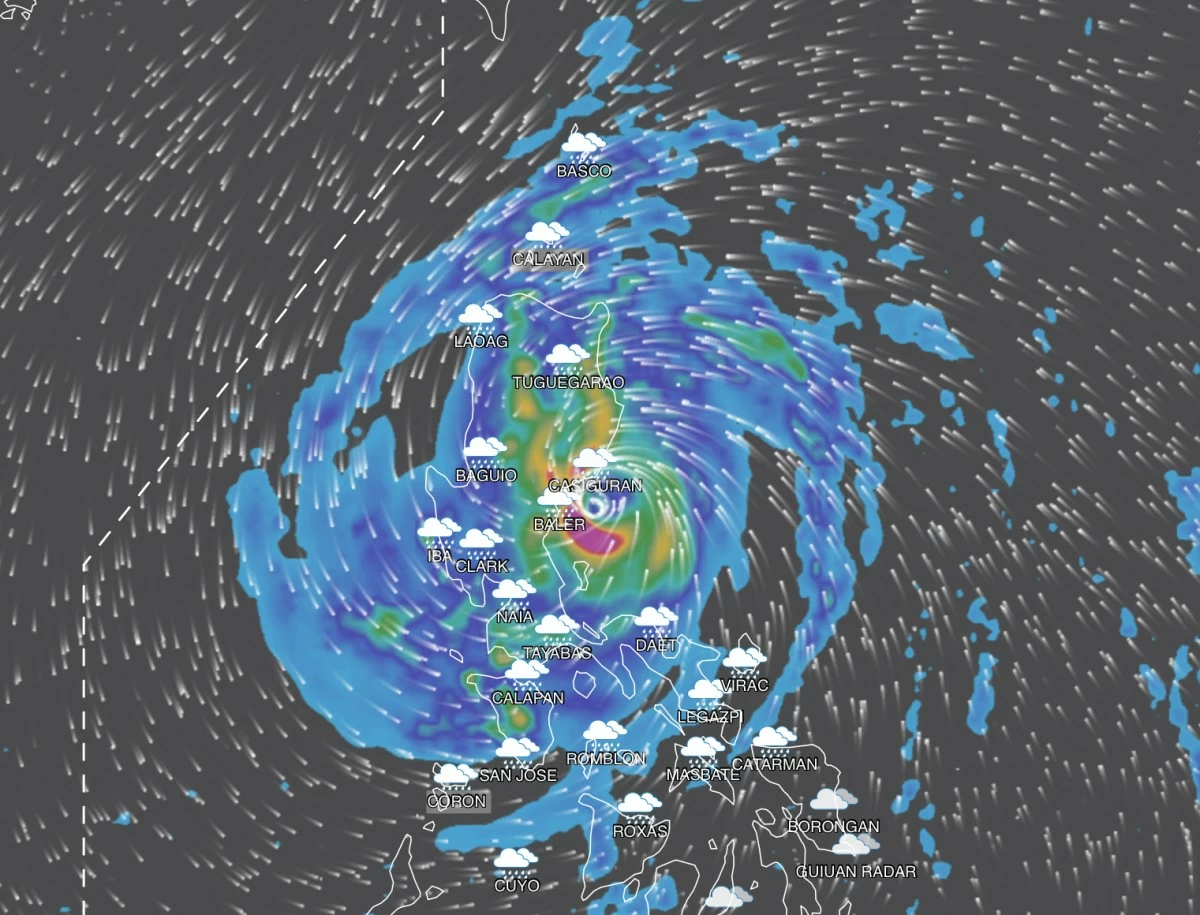
Screengrab from PAGASA’s live satellite imagery of Super Typhoon Uwan (Panahon.gov.ph)
Super Typhoon Uwan (international name: Fung-wong) is about to make landfall over the central or northern portion of Aurora as it continued to bring destructive winds and torrential rains over Luzon, said the Philippine Atmospheric, Geophysical and Astronomical Services Administration (PAGASA) on Sunday evening, Nov. 9.
As of 7 p.m., the center of the eye of Uwan was located 125 kilometers northeast of Infanta, Quezon, or 85 kilometers east-southeast of Baler, Aurora.
It maintained its maximum sustained winds of 185 kilometers per hour (kph) near the center and gustiness of up to 230 kph.
PAGASA said that if Uwan maintains its northwestward movement at 30 kph, the typhoon will make landfall over the central or northern portion of Aurora, most likely over Baler or Casiguran, within the next few hours.
After landfall, Uwan will cross the mountainous terrain of Northern Luzon and emerge over Lingayen Gulf or the coastal waters of Pangasinan or La Union on Monday morning, Nov. 10.
Interaction with the rugged terrain of Luzon will cause Uwan to weaken considerably, although it is expected to remain at typhoon strength while crossing the landmass, PAGASA said.
Tropical Cyclone Wind Signal No. 5 remains hoisted over the southern portion of Quirino (Nagtipunan); southeastern portion of Nueva Vizcaya (Alfonso Castañeda, Dupax del Norte, Dupax del Sur); northeastern portion of Nueva Ecija (Bongabon, Carranglan, Pantabangan); and northern and central portions of Aurora (San Luis, Baler, Maria Aurora, Dipaculao, Dinalungan, Casiguran).
Signal No. 4 also remains in effect over the southern portion of Isabela (San Agustin, Jones, Echague, Dinapigue, San Guillermo, Cordon, City of Santiago, Ramon, San Isidro, Angadanan); the rest of Quirino; the rest of Nueva Vizcaya; southern portion of Mountain Province (Tadian, Bauko, Sabangan); southern portion of Ifugao (Tinoc, Asipulo, Lamut, Kiangan, Lagawe, Hingyon, Hungduan); Benguet; southern portion of Ilocos Sur (Sugpon, Alilem, Cervantes, City of Candon, Santa Lucia, Suyo, Sigay, Galimuyod, Tagudin, Santa Cruz, Salcedo, San Esteban, Santiago); La Union; Pangasinan; the rest of Aurora; the rest of Nueva Ecija; northernmost portion of Zambales (Santa Cruz); northeastern portion of Tarlac (Camiling, San Clemente, Paniqui, Gerona, Victoria, Pura, Ramos, Moncada, San Manuel, Anao, La Paz, City of Tarlac, Santa Ignacia); easternmost portion of Pampanga (Candaba); eastern portion of Bulacan (Doña Remedios Trinidad, San Miguel, San Ildefonso, Norzagaray, San Rafael); northern portion of Rizal (Rodriguez); and northern portion of Quezon (Infanta, General Nakar, Real), including Polillo Islands.
Signal No. 3 is up over the southern portion of mainland Cagayan (Tuao, Enrile, Solana, Tuguegarao City, Peñablanca, Iguig, Piat, Amulung, Santo Niño, Alcala, Rizal); the rest of Isabela; northwestern, central, and southern portions of Apayao (Conner, Kabugao, Calanasan); Abra; Kalinga; the rest of Mountain Province; the rest of Ifugao; Ilocos Norte; the rest of Ilocos Sur; the rest of Zambales; Bataan; the rest of Tarlac; the rest of Pampanga; the rest of Bulacan; Metro Manila; Cavite; Batangas; the rest of Rizal; Laguna; the rest of Quezon; Marinduque; Camarines Norte; Camarines Sur; and Catanduanes.
Meanwhile, Signal No. 2 remains hoisted over Babuyan Islands; the rest of mainland Cagayan; the rest of Apayao; Occidental Mindoro; Oriental Mindoro; Romblon; Albay; Sorsogon; and northern and western portions of Masbate (City of Masbate, Mobo, Aroroy, Balud, Mandaon, Milagros, Baleno, Uson), including Ticao and Burias Islands.
Areas under Signal No. 1 include Batanes; the rest of Masbate; northern portion of Palawan (Taytay, Dumaran, El Nido, Araceli, Roxas, San Vicente), including Calamian, Cuyo, and Cagayancillo Islands; Northern Samar; Eastern Samar; Samar; Biliran; Leyte; Southern Leyte; Bohol; Cebu; Siquijor; Negros Oriental; Negros Occidental; Guimaras; Iloilo; Capiz; Aklan; and Antique.