






Manila Bulletin
 Philippines
National
PBBM orders adjusted rice import tariffs, creates inter-agency group for price stability
Philippines
National
PBBM orders adjusted rice import tariffs, creates inter-agency group for price stability
Philippines
National
PBBM orders adjusted rice import tariffs, creates inter-agency group for price stability
PBBM orders adjusted rice import tariffs, creates inter-agency group for price stability
Published Nov 9, 2025 12:20 pm


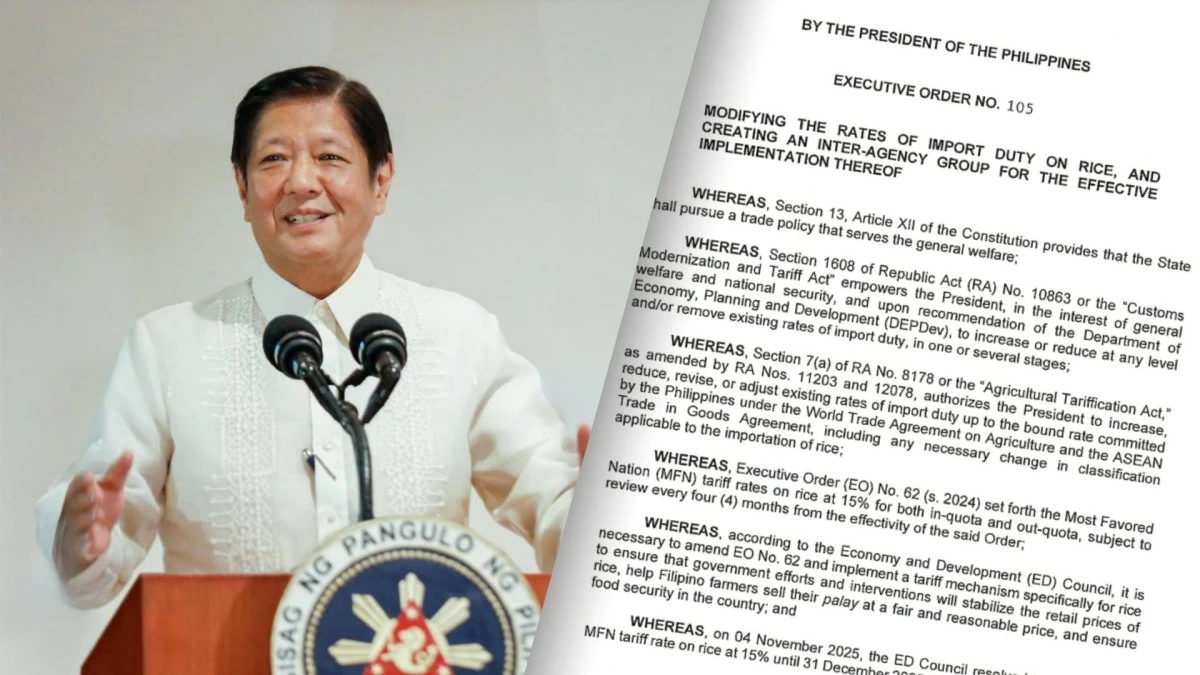
President Marcos has issued Executive Order (EO) No. 105, which maintains the 15 percent tariff rate on imported rice until the end of 2025 and introduces a mechanism to adjust rates based on international market prices starting next year.
The EO, signed by Executive Secretary Lucas Bersamin on Nov. 7 by authority of the President, aims to stabilize rice prices, protect Filipino farmers, and ensure national food security amid volatile global market conditions.
Under EO 105, the Most Favored Nation (MFN) tariff rate on rice imports — both in-quota and out-quota — will remain at 15 percent until Dec. 31, 2025. Starting Jan. 1, 2026, tariff rates will be automatically adjusted depending on changes in international rice prices.
The order provides that tariffs will increase by five percentage points for every five percent drop in global rice prices and decrease by five percentage points for every five percent increase in prices. However, the MFN tariff rate cannot go below 15 percent or exceed 35 percent.
Malacañang said the flexible system would allow the government to respond more quickly to market shifts, balancing the need to keep rice affordable for consumers while protecting local farmers’ livelihoods.
New inter-agency group
The new order modifies EO No. 62 issued in 2024 and establishes an Inter-Agency Group on Rice Tariff Adjustment to oversee its implementation.
The group is composed of representatives from the Department of Economy, Planning and Development (DEPDev), Department of Agriculture (DA), Department of Trade and Industry (DTI), Department of Finance (DOF), and the Office of the Special Assistant to the President for Investment and Economic Affairs.
It is tasked to formulate detailed guidelines for implementing the tariff adjustment mechanism, including how to determine international price thresholds, validate market movements, and certify when adjustments should take effect.
The group shall also monitor market trends and recommend appropriate responses to ensure a steady supply of rice while safeguarding domestic production.
Balancing needs
According to the Economic and Development Council, the adjustment mechanism was designed to “stabilize retail prices of rice, help Filipino farmers sell their palay at a fair price, and maintain sufficient supply across the country.”
The Palace emphasized that the EO is consistent with the Philippines’ commitments under the World Trade Organization (WTO) and the ASEAN Trade in Goods Agreement.
EO 105 will take effect 15 days after publication in the Official Gazette or in a newspaper of general circulation.