







Marcos signs EO extending full LGU devolution until 2028
Published Nov 9, 2025 08:04 am


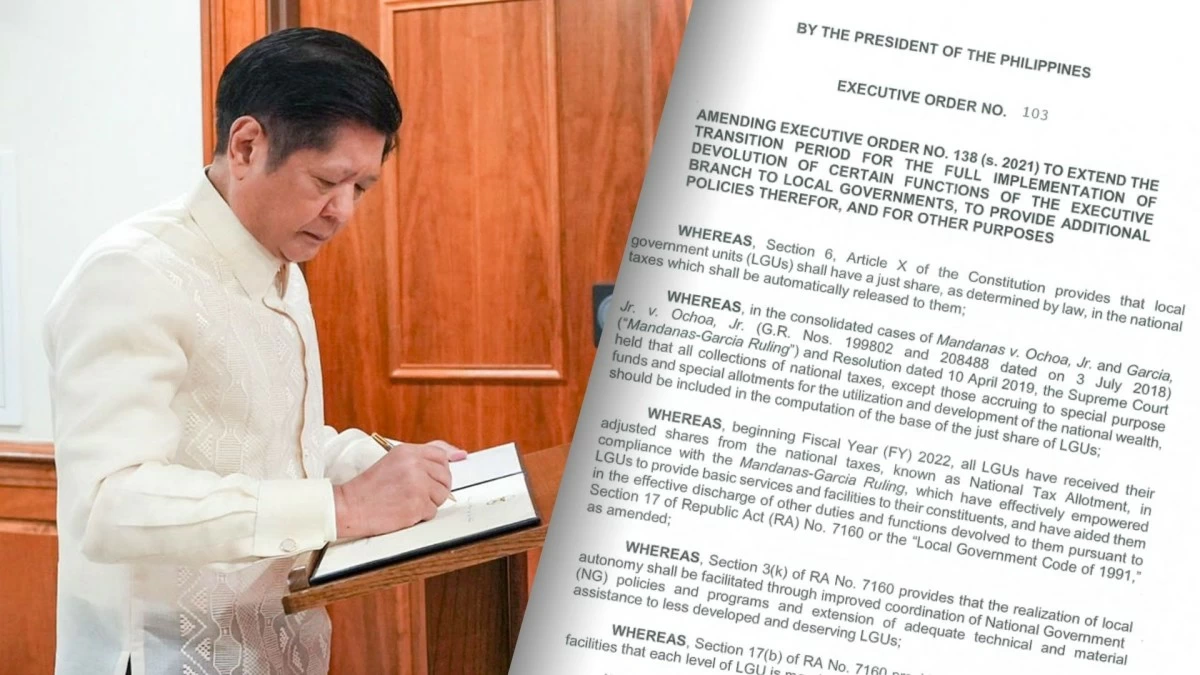
President Marcos has issued Executive Order (EO) No. 103, extending the transition period for the full devolution of government functions to local government units (LGUs) until 2028.
The order, signed by Executive Secretary Lucas Bersamin by authority of the President, grants LGUs additional time to strengthen their financial, technical, and administrative capacities to fully assume devolved responsibilities under the Mandanas-Garcia ruling and the Local Government Code of 1991.
Malacañang said the new directive amends Executive Order No. 138, issued in 2021, and introduces additional measures to ensure a smoother, phased transfer of functions from national to local governments, especially for poorer and less developed LGUs.
“In light of the varying financial, technical, and administrative capacities of LGUs, along with their unique circumstances, needs, and priorities, the functions, services, and facilities to be devolved from the national government may not be fully absorbed or implemented uniformly across all LGUs within the transition period mandated under EO No. 138,” the order stated.
It added that the transition period for full devolution has been officially extended until Fiscal Year 2028.
“All LGUs shall follow a phased implementation of the full devolution within the prescribed transition period as they continually improve their fiscal and institutional capacities,” the order said.
Provinces and municipalities are expected to complete the process no later than 2028, while cities are given until 2027 to fully implement devolved functions and services.
Priority assistance will be directed toward 4th- and 5th-class municipalities, as well as geographically isolated and disadvantaged areas with high poverty incidence.
LGU responsibility
Based on the EO, LGUs shall now bear primary responsibility for delivering direct services to their constituents, while ensuring that the quality of devolved functions remains aligned with national standards.
Despite this, national government agencies and LGUs are expected to collaborate closely in localizing national development goals consistent with the Philippine Development Plan 2023–2028, the AmBisyon Natin 2040, the 2030 Agenda for Sustainable Development, and the administration’s 8-Point Socioeconomic Agenda.
To prepare for full devolution, LGUs are directed to strengthen fiscal management and service delivery, institutionalize transparency and participatory governance, and enhance revenue generation.
The EO acknowledged that the scale of devolved functions requires “sufficient time for a smooth transition,” noting that an abrupt handover could disrupt basic services.
The extension allows LGUs to adjust their systems and resources for effective implementation, while the national government transitions toward a more strategic, policy-making role focused on addressing broader development issues.
Strengthening local governance
According to the Palace, the policy reinforces the constitutional commitment to decentralization, empowering LGUs to deliver essential services, promote local economic growth, and uphold accountability and transparency in governance.
“With full devolution, the national government can shift its focus to more strategic and steering functions that address persistent development challenges,” the EO noted.