ADVERTISEMENT

Typhoon 'Uwan' threatens 8.4 million individuals; 'Tino' death toll rises to 204

Published Nov 8, 2025 11:42 am
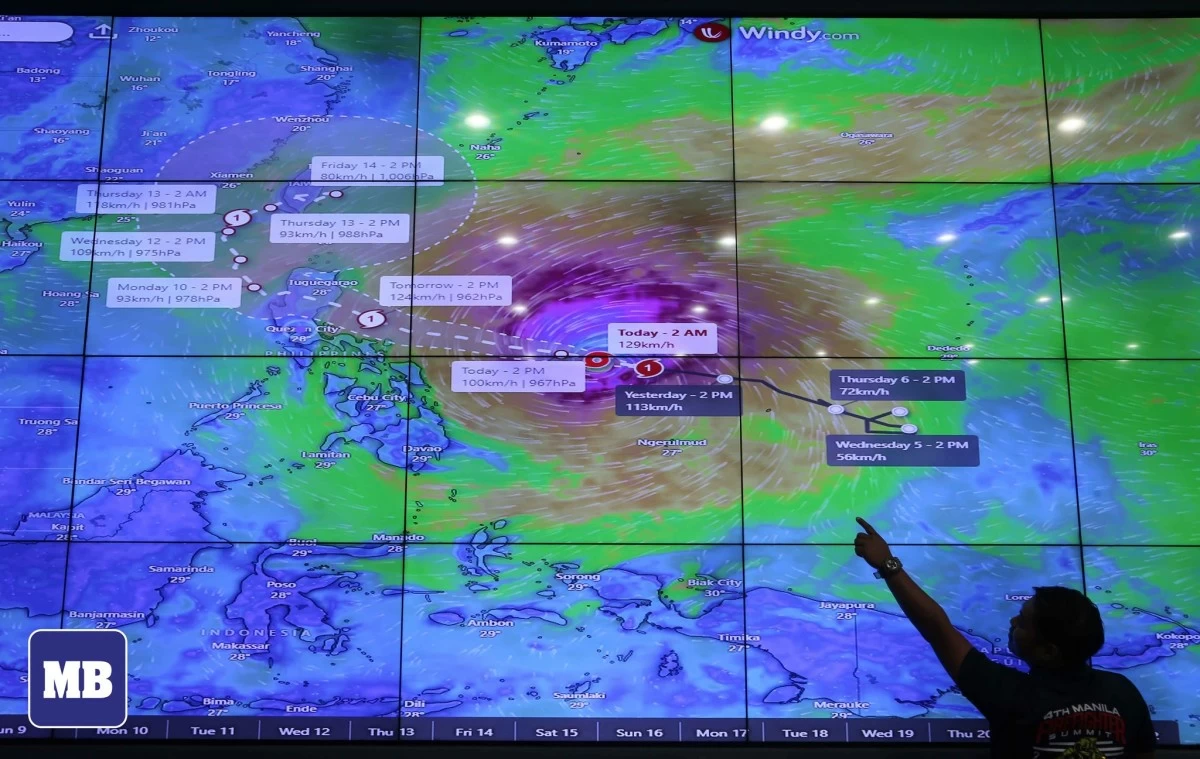
A personnel of the Manila Disaster Risk Reduction and Management Office (MDRRMO) monitors the movement of Typhoon Uwan as it enters the Philippine Area of Responsibility (PAR) on November 8, 2025. The weather bureau has warned of possible heavy rains and strong winds as the typhoon moves closer to Luzon. (Photo: Mark Balmores / MANILABULLETIN)
Authorities warned that as many as 8.4 million people across several regions could be affected as Typhoon “Uwan” moved closer to Northern Luzon with the potential to intensify into a super typhoon.
This, as Visayas and parts of Mindanao continued to reel from the effects of Typhoon “Tino, which has claimed the lives of 204 individuals while 109 others remained missing as of Saturday, Nov. 8, based on the latest data from the National Disaster Risk Reduction and Management Council (NDRRMC).
In a press briefing hosted by the Office of Civil Defense (OCD), the Department of Social Welfare and Development (DSWD) said that Uwan could impact 8.4 million individuals based on predictive analytics.
The potentially affected regions include Ilocos (Region 1), Cagayan Valley (Region 2), Central Luzon (Region 3), Cordillera Administrative Region (CAR), Calabarzon (Region 4A), and Bicol (Region 5). However, the typhoon’s rainbands could also reach Western Visayas (Region 6), Negros Island Region (NIR), Central Visayas (Region 7), and Eastern Visayas (Region 8) which have been devastated by Tino.
Those potentially affected include 5.7 million people in coastal communities, and about 466,000 poor families are among those most vulnerable particularly in CAR, Ilocos Region, and Cagayan Valley.
OCD Deputy Administrator for Administration, Asst. Sec. Bernardo Rafaelito Alejandro said the NDRRMC has raised a red alert status nationwide, mobilizing all regional and local disaster units for Uwan’s possible landfall.
“We have been preparing for Uwan for the past several days as it could become a super typhoon per the projection or forecast of PAGASA [Philippine Atmospheric Geophysical and Astronomical Services Administration]. We are preparing basically the entire northern Luzon island and Visayas for the possible impact of Typhoon Uwan,” he said.
“We’re urging local government units to enforce pre-emptive and even forced evacuations until Sunday, especially in flood- and landslide-prone communities,” he added.
Alejandro warned that Uwan’s massive size, with a radius of 700 kilometers, could cause heavy rainfall and destructive winds over wide areas. “Its diameter spans about 1,400 kilometers which could cover areas from Batanes down to Bohol. These areas could feel the typhoon’s effects,” he said.
The Mines and Geosciences Bureau (MGB) also identified 8,164 barangays that could experience rain-induced landslides and floods. The MGB warned that saturated soils caused by recent rains from Tino have made many areas more vulnerable particularly in Southern Leyte, Quezon, Sorsogon, Cebu, Capiz, Palawan, and Surigao.
It warned that residents should not return home without clearance from local governments as “landslides do not happen instantaneously, they can occur even after the rain stops.”
Tino death toll crosses 200-mark
As disaster teams prepare for Uwan, recovery operations continue in areas ravaged by Tino, which struck the Visayas earlier this week.
From the 204 reported dead, a total of 141 fatalities were recorded in Cebu. Other deaths were logged in Negros Occidental with 27, Negros Oriental with 20, Agusan del Sur with six, and Capiz with three. Southern Leyte had two deaths, while Antique, Iloilo, Guimaras, Bohol, and Leyte registered one death each.
There were 109 individuals also missing: 57 in Cebu, 42 in Negros Occidental, and 10 in Negros Oriental. Meanwhile, 156 people were injured in Cebu, Leyte, Negros Occidental, Surigao del Norte, and Surigao del Sur.
At least 823,977 families or 2.9 million individuals were affected in 6,720 barangays across eight regions: Calabarzon, Mimaropa, Bicol, Western Visayas, Negros Island Region, Central Visayas, Eastern Visayas, and Caraga.
Damage assessments showed 118 road sections and 14 bridges were affected; 162 towns and cities experienced power outages; 11 municipalities lost water supply; and 86 localities suffered communication interruptions.
At least 29,949 houses were damaged, while P40.7 million in agricultural losses and P17.25 million in infrastructure damage were recorded.
Government assistance has reached P198 million, benefiting 133,170 families, or about 33 percent of those who need help.
Alejandro said OCD teams were still conducting rapid assessments in the Visayas. OCD Administrator Usec. Harold Cabreros went to Cebu to oversee relief operations.
“We are fast-tracking the setup of durable evacuation centers for those who lost their homes. We are also advising residents not to return to damaged houses yet, especially with Uwan approaching,” he said.

Related Tags

Typhoon Uwan Typhoon Tino NDRRMC OCD Bernardo Rafaelito Alejandro IV
ADVERTISEMENT
.most-popular .layout-ratio{ padding-bottom: 79.13%; } @media (min-width: 768px) and (max-width: 1024px) { .widget-title { font-size: 15px !important; } }

{{ articles_filter_1561_widget.title }}

.most-popular .layout-ratio{ padding-bottom: 79.13%; } @media (min-width: 768px) and (max-width: 1024px) { .widget-title { font-size: 15px !important; } }

{{ articles_filter_1562_widget.title }}

.most-popular .layout-ratio{ padding-bottom: 79.13%; } @media (min-width: 768px) and (max-width: 1024px) { .widget-title { font-size: 15px !important; } }

{{ articles_filter_1563_widget.title }}

{{ articles_filter_1564_widget.title }}

.mb-article-details { position: relative; } .mb-article-details .article-body-preview, .mb-article-details .article-body-summary{ font-size: 17px; line-height: 30px; font-family: "Libre Caslon Text", serif; color: #000; } .mb-article-details .article-body-preview iframe , .mb-article-details .article-body-summary iframe{ width: 100%; margin: auto; } .read-more-background { background: linear-gradient(180deg, color(display-p3 1.000 1.000 1.000 / 0) 13.75%, color(display-p3 1.000 1.000 1.000 / 0.8) 30.79%, color(display-p3 1.000 1.000 1.000) 72.5%); position: absolute; height: 200px; width: 100%; bottom: 0; display: flex; justify-content: center; align-items: center; padding: 0; } .read-more-background a{ color: #000; } .read-more-btn { padding: 17px 45px; font-family: Inter; font-weight: 700; font-size: 18px; line-height: 16px; text-align: center; vertical-align: middle; border: 1px solid black; background-color: white; } .hidden { display: none; }
function initializeAllSwipers() { // Get all hidden inputs with cms_article_id document.querySelectorAll('[id^="cms_article_id_"]').forEach(function (input) { const cmsArticleId = input.value; const articleSelector = '#article-' + cmsArticleId + ' .body_images'; const swiperElement = document.querySelector(articleSelector); if (swiperElement && !swiperElement.classList.contains('swiper-initialized')) { new Swiper(articleSelector, { loop: true, pagination: false, navigation: { nextEl: '#article-' + cmsArticleId + ' .swiper-button-next', prevEl: '#article-' + cmsArticleId + ' .swiper-button-prev', }, }); } }); } setTimeout(initializeAllSwipers, 3000); const intersectionObserver = new IntersectionObserver( (entries) => { entries.forEach((entry) => { if (entry.isIntersecting) { const newUrl = entry.target.getAttribute("data-url"); if (newUrl) { history.pushState(null, null, newUrl); let article = entry.target; // Extract metadata const author = article.querySelector('.author-section').textContent.replace('By', '').trim(); const section = article.querySelector('.section-info ').textContent.replace(' ', ' '); const title = article.querySelector('.article-title h1').textContent; // Parse URL for Chartbeat path format const parsedUrl = new URL(newUrl, window.location.origin); const cleanUrl = parsedUrl.host + parsedUrl.pathname; // Update Chartbeat configuration if (typeof window._sf_async_config !== 'undefined') { window._sf_async_config.path = cleanUrl; window._sf_async_config.sections = section; window._sf_async_config.authors = author; } // Track virtual page view with Chartbeat if (typeof pSUPERFLY !== 'undefined' && typeof pSUPERFLY.virtualPage === 'function') { try { pSUPERFLY.virtualPage({ path: cleanUrl, title: title, sections: section, authors: author }); } catch (error) { console.error('ping error', error); } } // Optional: Update document title if (title && title !== document.title) { document.title = title; } } } }); }, { threshold: 0.1 } ); function showArticleBody(button) { const article = button.closest("article"); const summary = article.querySelector(".article-body-summary"); const body = article.querySelector(".article-body-preview"); const readMoreSection = article.querySelector(".read-more-background"); // Hide summary and read-more section summary.style.display = "none"; readMoreSection.style.display = "none"; // Show the full article body body.classList.remove("hidden"); } document.addEventListener("DOMContentLoaded", () => { let loadCount = 0; // Track how many times articles are loaded const offset = [1, 2, 3, 4, 5, 6, 7, 8, 9, 10]; // Offset values const currentUrl = window.location.pathname.substring(1); let isLoading = false; // Prevent multiple calls if (!currentUrl) { console.log("Current URL is invalid."); return; } const sentinel = document.getElementById("load-more-sentinel"); if (!sentinel) { console.log("Sentinel element not found."); return; } function isSentinelVisible() { const rect = sentinel.getBoundingClientRect(); return ( rect.top < window.innerHeight && rect.bottom >= 0 ); } function onScroll() { if (isLoading) return; if (isSentinelVisible()) { if (loadCount >= offset.length) { console.log("Maximum load attempts reached."); window.removeEventListener("scroll", onScroll); return; } isLoading = true; const currentOffset = offset[loadCount]; window.loadMoreItems().then(() => { let article = document.querySelector('#widget_1690 > div:nth-last-of-type(2) article'); intersectionObserver.observe(article) loadCount++; }).catch(error => { console.error("Error loading more items:", error); }).finally(() => { isLoading = false; }); } } window.addEventListener("scroll", onScroll); });

Sign up by email to receive news.