






Manila Bulletin
 Business
The Stock Market
Meralco's billion bid to end Batangas' decades of darkness
Business
The Stock Market
Meralco's billion bid to end Batangas' decades of darkness
Business
The Stock Market
Meralco's billion bid to end Batangas' decades of darkness
Meralco's billion bid to end Batangas' decades of darkness
The power play for BATELEC 2:
Published Nov 8, 2025 09:17 am


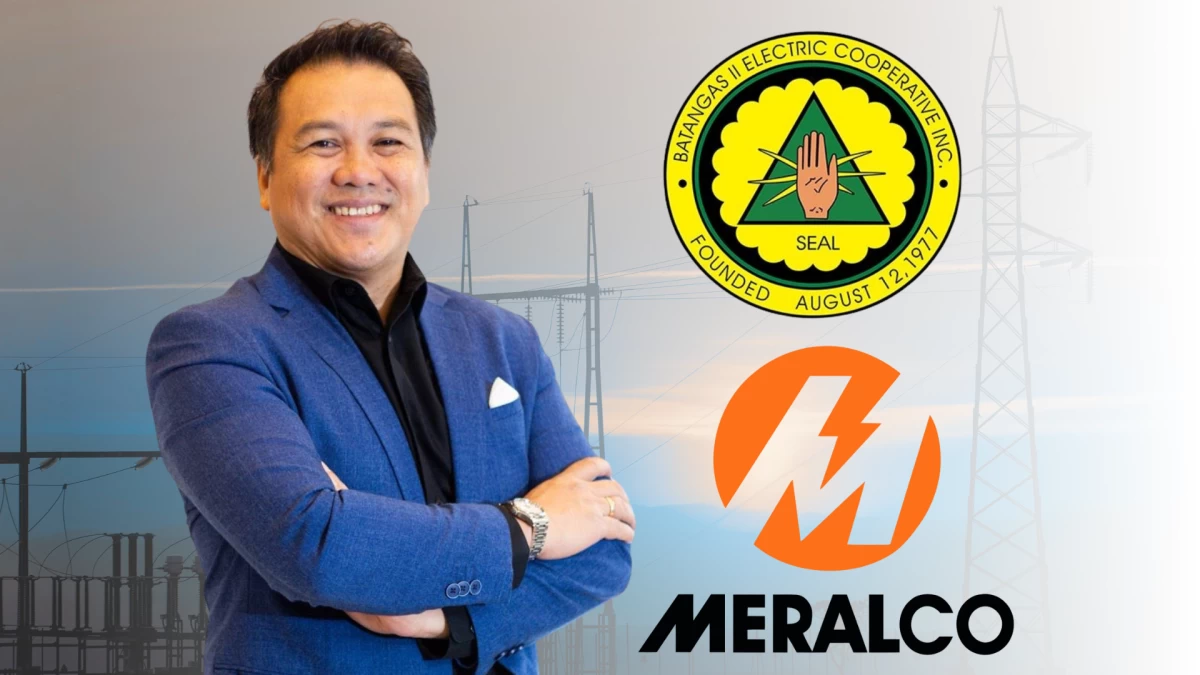
Meralco Senior Vice President and Chief for External and Government Affairs Arnel P. Casanova stresses the plan is fully laid out to equip BATELEC 2’s leadership with necessary capital and technical expertise.
After years of enduring brownouts stretching two to three hours on an oft-repeated cycle, consumers within the service domain of Batangas Electric Cooperative 2 (BATELEC 2) are no longer just frustrated; they’re demanding real and lasting change in how their electricity is delivered.
But there may be light at the end of Batangas’ blackout tunnel. Power utility giant Manila Electric Co. (Meralco) is willing and ready to step in—bringing with it the promise of not just reliable electricity service, but also competitive rates that could finally end decades of service gaps which have left BATELEC 2 consumers restless.
Arnel P. Casanova, Senior Vice President and Chief for External and Government Affairs of Meralco, clarified that the utility giant’s prospective entry won’t be a takeover but an effort to build a “tactical alliance” with the electric cooperative.
“Our approach is really to have a partnership with electric cooperatives. So to us, it’s not exactly franchise expansion, but more of empowering electric cooperatives by forming joint ventures with them,” he explained.
The power giant’s ace in the deck is clear: deep pockets and proven technical know-how. “We can infuse capital and technical expertise to help them greatly improve their service,” Casanova said, adding that, “Meralco is actually a friend of the electric cooperatives because our thrust is to empower the electric coops by infusing capital and technical capabilities.”
The Meralco executive qualified, “we already have a full plan to upgrade and modernize BATELEC 2’s facilities and services... it’s all laid out in the proposal that we submitted to them.”
Casanova stressed, “we don’t have a problem with the management of BATELEC 2, we just want to equip the present leadership with capital,” explaining that the core issue lies in the fact that their technical capacity is being affected by a rate-setting framework that puts cooperatives at a disadvantage compared to their counterpart private distribution utilities.
He expounded: “The problem with electric cooperatives is that their rate-setting is tied to cash flow, so they can only spend what they collect, leaving little room to invest in service improvements.”
Casanova articulated that Batangas’ industrial growth demands serious upfront capital. “With BATELEC 2’s cash constraints, prospective investors in the area are forced to pay for substations and transformers themselves, making it far easier to take their business to areas with reliable electricity than shoulder infrastructure that should be the utility’s responsibility.”
Bid for transparent, fair evaluation process
“We already submitted our proposal for BATELEC 2 through the General Manager,” Casanova said, leaving the ball squarely in the local utility’s court for a final decision.
The expected next processes will be a referendum among consumer-members, followed by government approval that will likely be anchored by a go-signal from the National Electrification Administration (NEA).
Casanova asserted, “right now, we are actually asking BATELEC 2 to come up with very defined process and evaluation criteria for the evaluation of any proposal. We want it to be a very fair and transparent process because we understand there are also other interested parties.”
If Meralco succeeds in this undertaking, part of its proposal—which was submitted last year—is to operate under BATELEC 2’s current franchise. This move is fully safeguarded by the Electric Power Industry Reform Act (EPIRA) and its implementing rules and regulations (IRR), which allow cooperatives converting to stock corporations to retain their franchise rights.
Consumer dissatisfaction on service gaps

A recent Capstone-Intel survey of 1,200 residents across all 34 Batangas cities and towns uncovered widespread distress over unreliable electricity services, hitting not just BATELEC 2’s territory but also neighboring Batangas Electric Cooperative 1 (BATELEC 1).
“The findings show that frequent outages have been eroding public confidence in the province’s two largest electric cooperatives, with many residents now considering alternative providers,” the Capstone-Intel survey stipulated.
The research firm emphasized that its use of ‘probability proportional to size sampling’ ensures that the survey accurately mirrors the perspectives of consumers across the electric cooperatives studied.
Undoubtedly, the survey result underscores chronic unreliability: service disruptions strike the majority one to two times a month, while others reported as many as 10 instances of outages.
The survey similarly unmasked that BATELEC 2 consumers are among the hardest hit, with 93% enduring multiple outages, while 81 percent of BATELEC 1 customers face similar disruptions. As reported, the brownout occurrences usually last one to two hours, and sometimes, it could stretch to three.
Dr. Guido David, chief data scientist at Capstone-Intel, fundamentally highlighted that the survey exposes a growing chasm, or a “widening gap in electricity service across the province,” stressing that “reliable electricity is not just a convenience—it’s a prerequisite for economic growth and quality of life.”
To a degree, the research similarly documented that “residents in areas served by other distribution utilities reported fewer disruptions, highlighting a significant difference in service reliability.”
Inside the numbers: Service ratings revealed
The study likewise put consumer satisfaction ratings under the microscope, exposing that many residents are eager to switch providers—with BATELEC 2 customers showing the strongest appetite for change.
“Many residents expressed a desire to switch providers. Among respondents served by BATELEC 2, the willingness to transfer was particularly strong,” Capstone-Intel stated.
When it comes to customer satisfaction, both BATELEC 1 and 2 are underperforming, slipping beneath the provincial average of 4.09. BATELEC 2 hit the lowest mark at 3.90.
“Their customer service ratings lagged, with scores of 3.80 and 3.90 respectively, compared to the average of 4.04,” Capstone-Intel pointed out.
The study accentuated that reliable electricity isn’t optional for Batangas; it’s a major requirement given its strategic stature as a hub for industrial zones, ports, and burgeoning towns.
David thus noted, “this survey is a wake-up call—not just for utilities, but for government leaders as well. The people of Batangas are demanding dependable power, and they’re paying attention to who delivers it.”
Strategic targets for service improvements
“The main priorities that we have for BATELEC 2 is really to make power service reliable because that’s the main complaint of Batangueños – that they have frequent brownouts and these have also been dragging down the province’s economic growth,” the Meralco executive conveyed.
What has also been manifesting, according to Casanova, is that “the economy of that part in Batangas appears to be ‘suppressed’ because of lack of reliable power.”
With many parts of Batangas province already thriving as industrial powerhouses—primarily those that are under the current service domain of Meralco—the utility firm indicated that it intends to bring that same level of service efficiency and reliability to BATELEC 2.
“Industries aren’t the only ones suffering,” he said, adding that “tourism hubs, like those along the coasts of San Juan, Nasugbu, and Laiya, demand stable electricity, as persistent outages are disrupting their operations and have been undermining the quality of stay that guests expect and deserve.”
Casanova elaborated: “Many manufacturing facilities want to set up in Batangas, but frequent power disruptions are a roadblock, and that not only drains opportunities for Batangas, it could also be hurting the Philippine economy as a whole.”
“That’s precisely why Meralco aims to enter the area: to help BATELEC 2 stabilize and modernize service. Once reliable electricity is in place, industrial investors will be drawn in, igniting the economic surge Batangas has long been waiting for,” he stressed.
Ultimately, Meralco envisions a bright future for Batangas: a successful entry into BATELEC 2 could pave the way for BATELEC 1, while plans for a submarine cable linking Batangas to Mindoro further hold a promise to expand and reinforce electricity service options for consumers across the province.