






Manila Bulletin
 Business
The Economy
Worse than expected: Philippine economic growth plunges to 4% in Q3
Business
The Economy
Worse than expected: Philippine economic growth plunges to 4% in Q3
Business
The Economy
Worse than expected: Philippine economic growth plunges to 4% in Q3
Worse than expected: Philippine economic growth plunges to 4% in Q3
Marks sharpest slowdown since Covid-19 recession
Published Nov 7, 2025 09:29 am
|
Updated Nov 7, 2025 01:39 pm


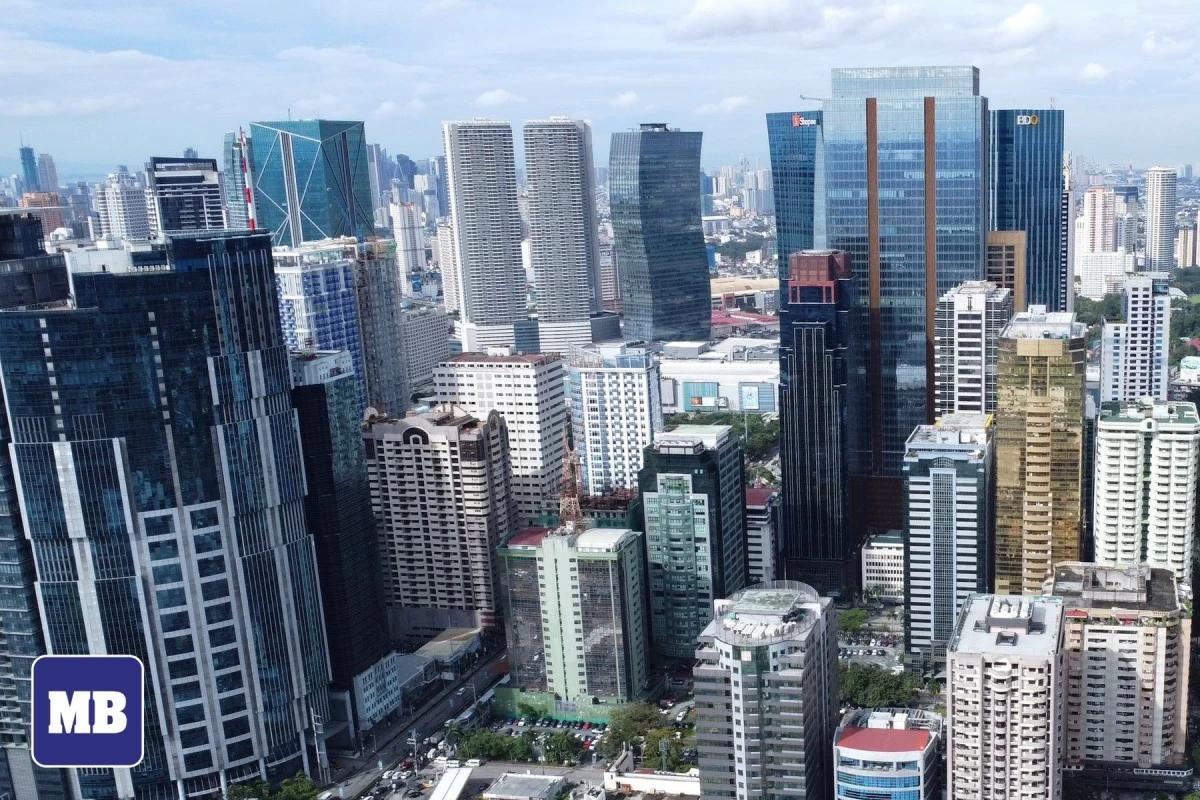
High-rise buildings in the Ortigas Business Center are seen on Wednesday, Nov. 5. In a report by Bloomberg, the Philippine Stock Exchange Index has dropped 20 percent over the past decade, ranking as the worst performer among major global benchmarks. In contrast, Asia-Pacific stocks climbed 72 percent, while Indonesia’s Jakarta Composite Index soared 82 percent. Photo by Santi San Juan | MB
Philippine economic expansion slowed sharply to four percent in the third quarter of 2025, as floods, corruption scandals, and weather disruptions heavily weighed on growth.
Data from the Philippine Statistics Authority (PSA) on Friday, Nov. 7, showed that the third-quarter gross domestic product (GDP) performance marked the steepest slowdown in more than four years, the weakest since the 3.8 percent contraction recorded in the first quarter of 2021, during the lockdowns brought about by the Covid-19 pandemic.
PSA data showed that the latest figure also missed the government’s 2025 growth target range of 5.5 to 6.5 percent and was lower than the 5.5 percent recorded in the second quarter and 5.4 percent in the first.
“The third quarter’s performance reminds us of the urgent need to address key challenges and strengthen our foundations for rapid, sustained, and inclusive growth,” said Department of Economy, Planning, and Development (DEPDev) Secretary Arsenio M. Balisacan during the Nov. 7 press briefing, stressing the importance of understanding the factors behind the slowdown.
He emphasized that the country’s productive capacity had been “muted” by the impact of corruption.
Balisacan noted that much of the third-quarter slowdown was due to widespread disruptions, including the cancellation of work, classes, and travel. He added that similar weather-related disturbances are expected before the year ends, based on forecasts from Philippine Atmospheric, Geophysical and Astronomical Services Administration (PAGASA).
Balisacan stressed that the government has no choice but to channel more resources toward strengthening the resilience of the country’s key economic sectors.
He underscored the importance of ramping up and improving government spending, noting that recent scandals have highlighted the need to enhance the quality and efficiency of public expenditures.
“Even if we have to reduce the overall level of spending—if it’s going to the right areas, right sectors, right priorities that we are working on, the impact of that on the overall economy and the inclusivity of the growth will be even greater,” Balisacan added.
PSA Chief Claire Dennis S. Mapa reported that despite the slowdown, the main drivers of the country’s 2025 third-quarter growth were wholesale and retail trade, including the repair of motor vehicles and motorcycles, which grew by five percent year-on-year; financial and insurance activities (5.5 percent); and professional and business services (6.2 percent).
He added that all major economic sectors posted growth in the third quarter of 2025, with agriculture, forestry, and fishing expanding by 2.8 percent; industry by 0.7 percent; and services by 5.5 percent.
On the demand side, household final consumption expenditure rose by 4.1 percent year-on-year in the third quarter of 2025.
Government spending, exports, and imports of goods and services also recorded increases of 5.8 percent, seven percent, and 2.6 percent, respectively, while gross capital formation declined by 2.8 percent.
Balisacan, meanwhile, noted that there has been significant underspending in key government priority areas this year. He said the Marcos Jr. administration is working to ensure that projects and programs untainted by corruption are allowed to proceed and implemented swiftly. He added that completed 2025 projects with no red flags should also be promptly paid.
Balisacan expressed optimism about the country’s growth prospects for next year, noting that the external sector performed well in the third quarter, with exports growing faster than imports.
“So we hope that our performance in the external front will be as favorable as in the third quarter moving forward,” he said.
He emphasized the need to move beyond merely adapting to climate change by strengthening the resilience of key sectors such as agriculture, industry, and services. He added that this resilience should also cover technological disruptions, including those driven by artificial intelligence (AI).
“If we are able to gain lessons from 2025 and strengthen our institutions towards better governance and improve our accountability in our systems, we should be able to recover lost grounds as well as the tomorrow's best of confidence, which will lead our growth in 2025 and beyond,” he added.
Amid the third-quarter slowdown, Balisacan said that the economy will regain momentum, saying the government is taking steps to recover lost ground. He said these efforts are expected to be reflected in the fourth-quarter performance.
“I would expect that the fourth-quarter performance will be better than the third quarter and that will enable us at least to hit the fives [five-percent GDP growth level]—I don’t know when in the fives, but definitely we would want to,” he said.
Balisacan added that reaching the upper end of the range appears unlikely. He explained that achieving 6.5 percent would require the economy to expand by around 6.8 to 6.9 percent in the fourth quarter—a challenging feat given the current and lingering economic shocks.
“If we can get at least to the five [percent], that would be a very good achievement, given the shocks that were not anticipated,” he said.
(Ricardo M. Austria)