






Manila Bulletin
 Philippines
National
What PAGASA's storm surge warnings mean for coastal communities
Philippines
National
What PAGASA's storm surge warnings mean for coastal communities
Philippines
National
What PAGASA's storm surge warnings mean for coastal communities
What PAGASA's storm surge warnings mean for coastal communities
Published Nov 7, 2025 09:04 pm


PAGASA
As Severe Tropical Storm Uwan (Fung-wong) nears the country, one of its major hazards is storm surge, locally called “daluyong ng bagyo.”
The Philippine Atmospheric, Geophysical and Astronomical Services Administration (PAGASA) defines a storm surge as the abnormal rise in sea level that occurs during tropical cyclones or “bagyo.”
It is caused by the combined effects of strong winds and low atmospheric pressure associated with these systems.
As a tropical cyclone approaches land, powerful winds push seawater inland over low-lying coastal areas, resulting in potentially widespread flooding. This makes storm surges among the most dangerous hazards during a tropical cyclone.
On Friday, Nov. 7, PAGASA warned that storm surges could affect coastal areas along the projected path of Uwan.
“There is a high risk of life-threatening storm surge and related coastal flooding, especially in Northern Luzon and the east coast of Central and Southern Luzon. Storm surge warnings may be issued as early as Friday evening,” PAGASA said.
The danger increases when a storm surge coincides with high tide, allowing seawater to reach farther inland and inundate areas that are normally dry.
The phenomenon was among the deadliest hazards during Super Typhoon Yolanda (Haiyan) in 2013, when storm surges as high as six meters swept through coastal towns in Eastern Visayas and caused thousands of deaths.
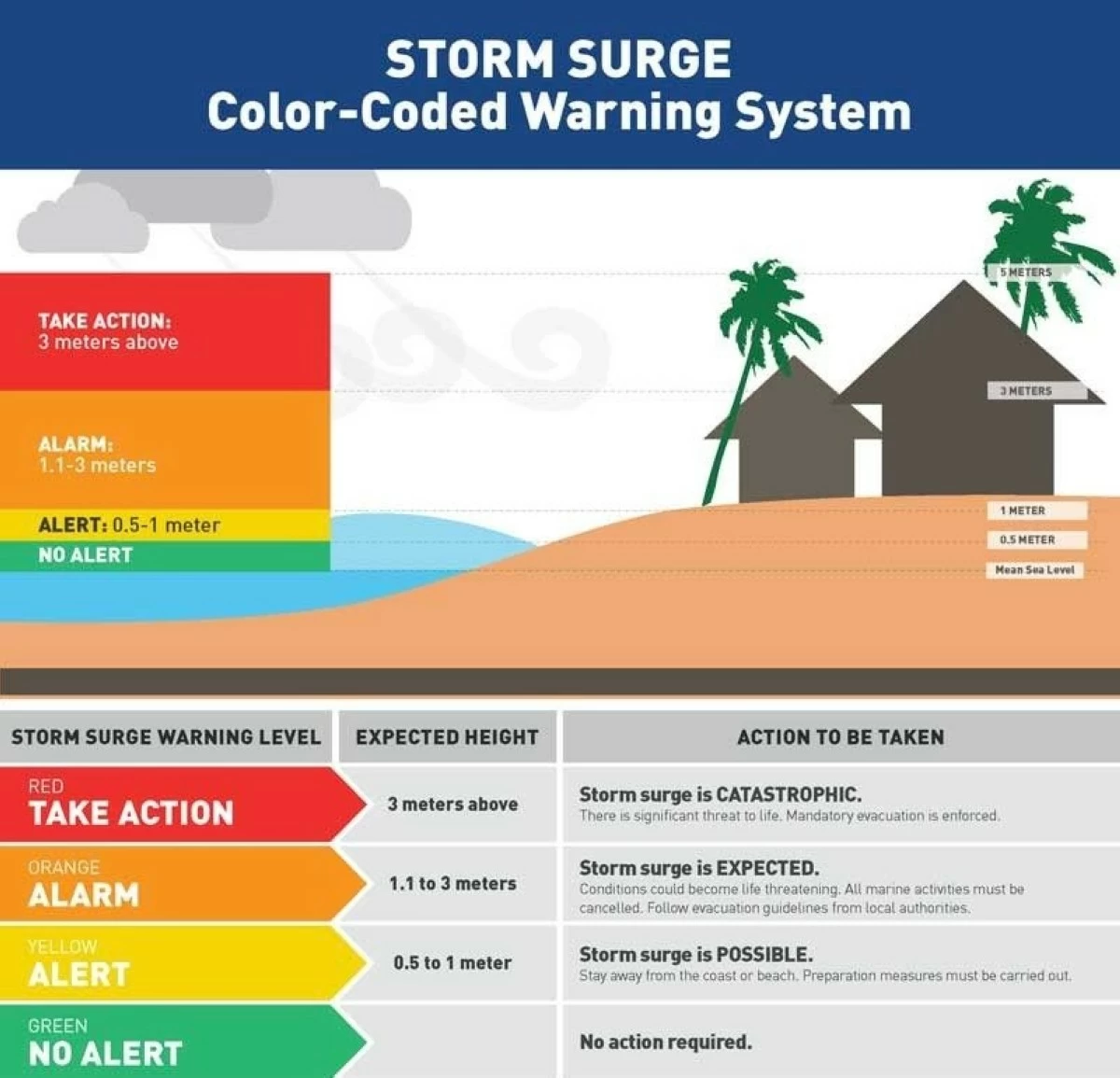
To help the public better understand the threat, PAGASA uses a color-coded storm surge warning system based on expected water levels and corresponding actions:
* Yellow alert: Possible surge of 0.5 to 1 meter. Residents are advised to stay away from beaches and low-lying coasts and begin preparation measures.
* Orange alert: Surge of 1.1 to 3 meters expected. This level could already threaten lives and property. All marine activities must be cancelled, and evacuation to higher ground should begin.
* Red alert: Surge exceeding 3 meters. This is considered catastrophic and life-threatening, prompting mandatory evacuation.
* Green alert: No current threat; no action is required.