

ADVERTISEMENT

Smarter logistics to move the world

Isuzu at the 2025 Japan Mobility Show

Published Nov 7, 2025 10:03 am

At A Glance

  • Isuzu is innovating new ways to reduce if not completely eliminate emissions from the trucks that serve as the backbone of our logistics industry.
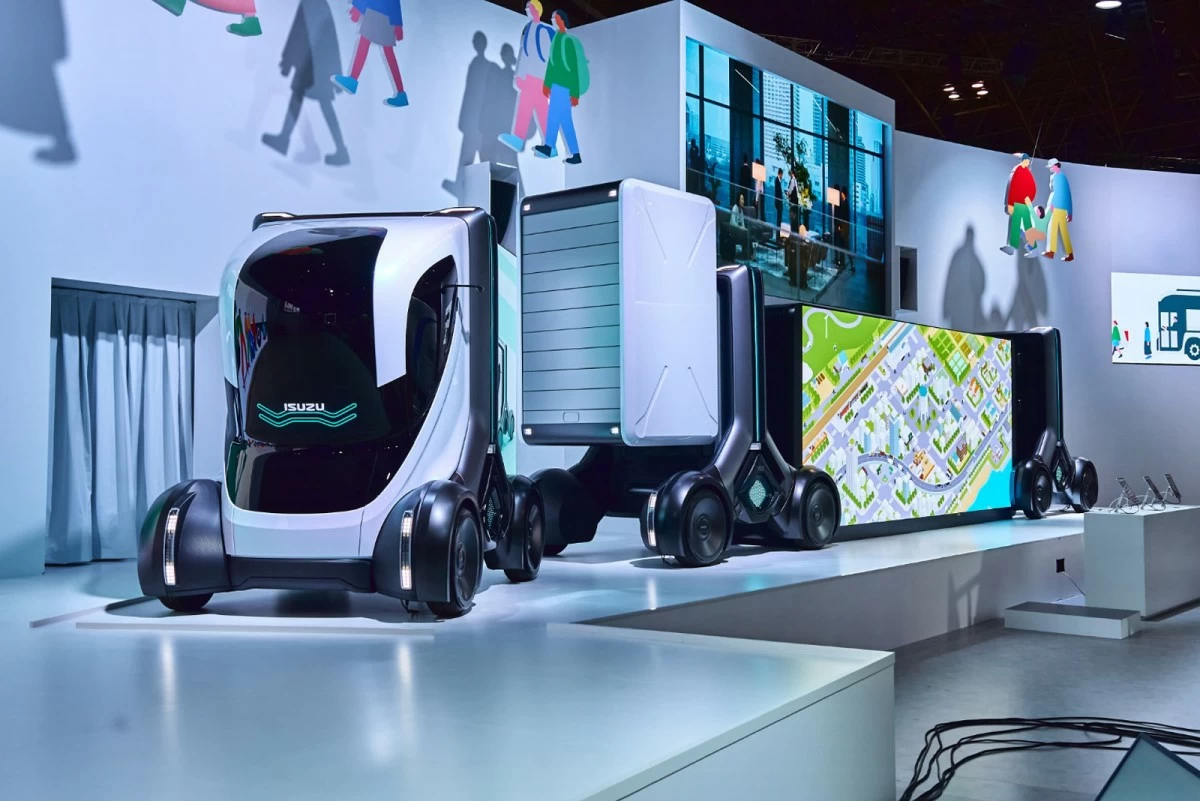
 The Vehicle Carbon-Control Concept (VCCC), built with a modular powertrain architecture to adapt to various kinds of loads.
The Vehicle Carbon-Control Concept (VCCC), built with a modular powertrain architecture to adapt to various kinds of loads.
Isuzu is innovating new ways to reduce if not completely eliminate emissions from the trucks that serve as the backbone of our logistics industry. These innovations were on full display at this year’s 2025 Japan Mobility Show (JMS).
Isuzu Philippines Corporation (IPC) invited us to attend the event to see what’s in the pipeline and what might be just around the corner. Their theme this year is, “Move the World, Envision a Colorful Future,” and Isuzu certainly showed what could soon move the world.
Highly flexible
Their main display was the prototype Vehicle Carbon-Control Concept (VCCC), demonstrating how commercial vehicles can be rugged and still be earth friendly. It has a modular architecture, which at the core is its innovative vertical frame. Equipped with advanced sensors, telematics, and a modular powertrain architecture, this modular concept allows vehicles to be rearranged in units consisting of key components, enabling highly flexible and efficient operation. Its flexible platform allows for a wide range of configurations and varied powertrains.
Multi-fuel engine
With simple modifications to the fuel injection and ignition systems, Isuzu's Multi-fuel engine can be used not just for diesel, but also carbon-neutral compatible fuels like synthetic fuels, biofuels, hydrogen, and natural gas.
Isuzu introduced the Multi-Fuel Engine, which shows that Carbon-neutrality is more than just going electric, but also sustainability. Isuzu believes a multi-path approach is important. Its next-generation internal combustion engine, offers ease of configuration and cost efficiency to attain carbon neutrality.
The multi-fuel engine platform will have shared key components like the crankshaft and cylinder block, configured to application and fuel to be used. With simple modifications to the fuel injection and ignition systems, fuels used are not just limited to diesel, but also carbon-neutral compatible fuels like synthetic fuels, biofuels, hydrogen, and natural gas.
Next generation safety
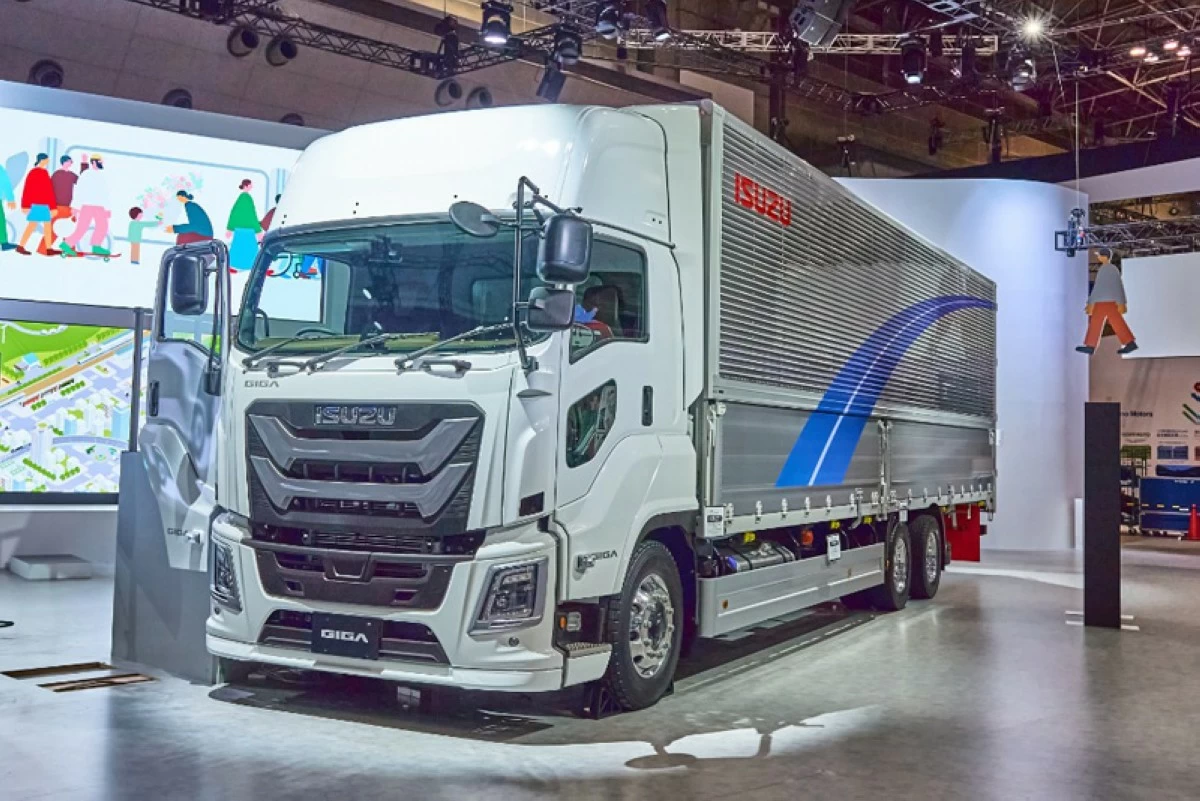
The Next-Generation Isuzu Giga, Isuzu’s flagship, heavy-duty truck is now safer, equipped with an Advanced Driver Assist System (ADAS) with dual front facing cameras, radar and sensors, especially for truck applications.
The next important reveal was of the Next-Generation Isuzu Giga, Isuzu’s flagship, heavy-duty truck. Aside from it’s redesigned exterior, higher payload capacity and improved fuel efficiency. It is now safer, equipped with an Advanced Driver Assist System (ADAS) with dual front facing cameras, radar and sensors, especially for truck applications, with features that include Wheel Detachment Prediction Detection System equipped as standard on all variants, Pre-Crash Brake (PCB) system for detecting pedestrians when turning, Brake function to prevent inside-turn collisions involving cyclists moving in the same direction and Lane Keep Assist (LKA) that comes with a new side collision avoidance.
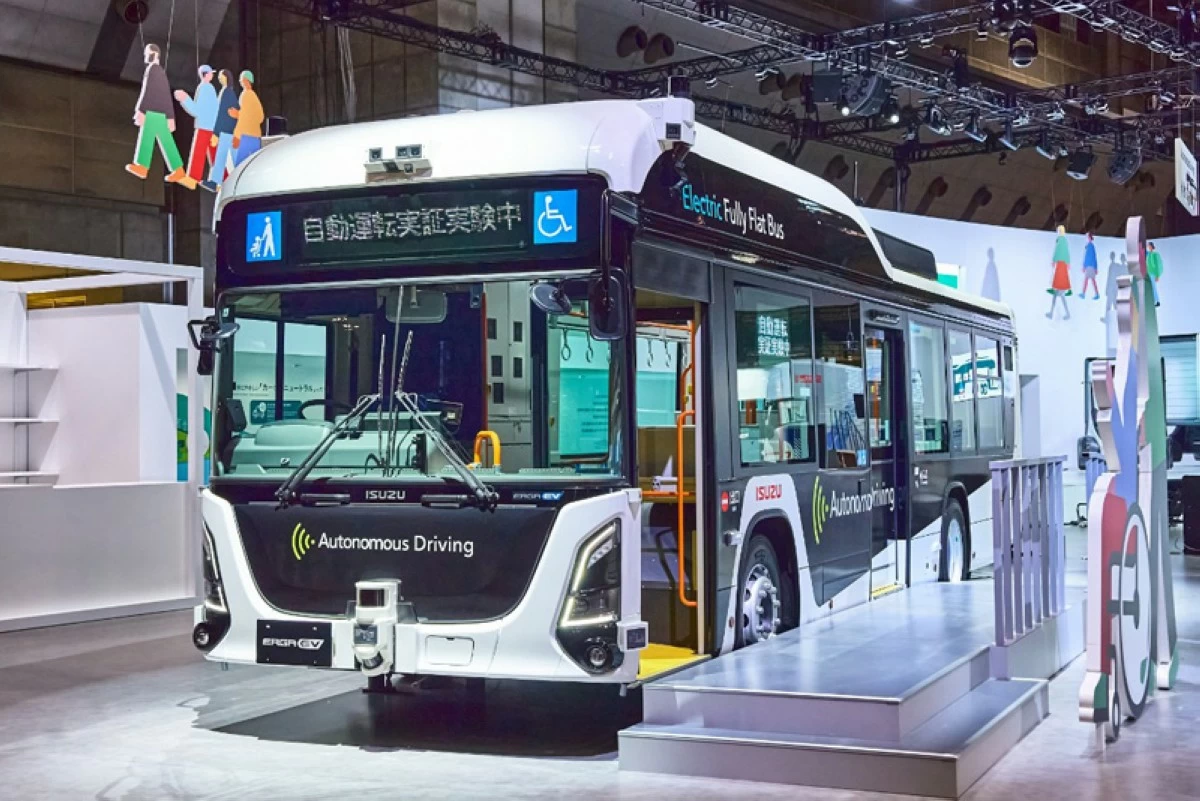
The ERGA EV Autonomous Driving Bus is based on Japan’s first flat-floor battery-electric vehicle (BEV) city bus.
The ERGA EV Autonomous Driving Bus, was teased at JMS. Based on Japan’s first flat-floor battery-electric vehicle (BEV) city bus, the ERGA EV, launched at JMS back in 2023. Currently under development, utilizing vehicle-integrated control technology, using a sensor suite of cameras, millimeter-wave radar, and LiDAR, Isuzu commits this bus will soon offer safe, stable, driverless operation.
Coming soon
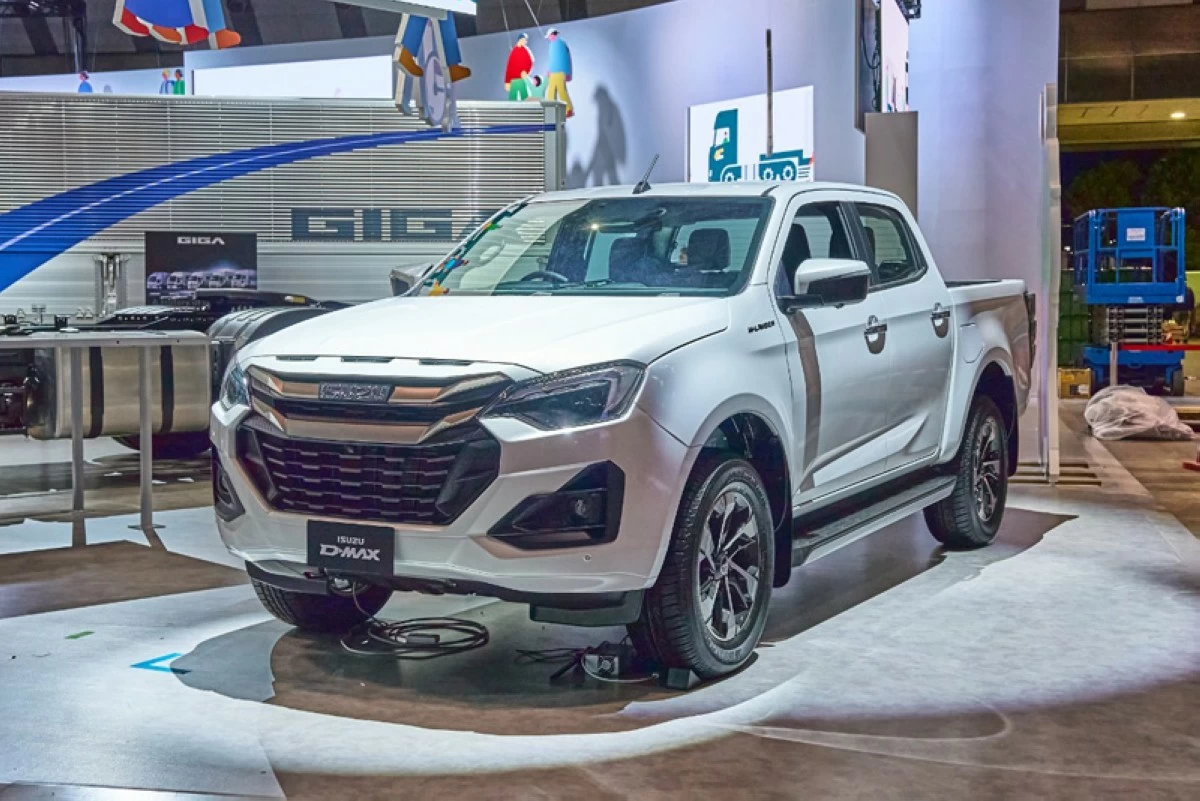
The Isuzu D-Max gets a mild refresh, and aside from a full electric variant, a new engine is now also available, the RZ4F-TC, a 2.2 liter diesel with a Electronic Variable Geometry Turbo (e-VGS).
The Isuzu D-Max is a vehicle that's no stranger to the Filipino, Isuzu’s tough and dependable pickup. The one displayed at JMS gets a mild refresh, and aside from a full electric variant, a new engine is now also available, the RZ4F-TC, a 2.2 liter diesel with a Electronic Variable Geometry Turbo (e-VGS), puts out 160Hp at 3600rpm with 400Nm of torque between 1600-2400rpm with the option of being mated to a new 8-speed automatic or a 6-speed manual transmission. Perhaps this is a sign of things to come.
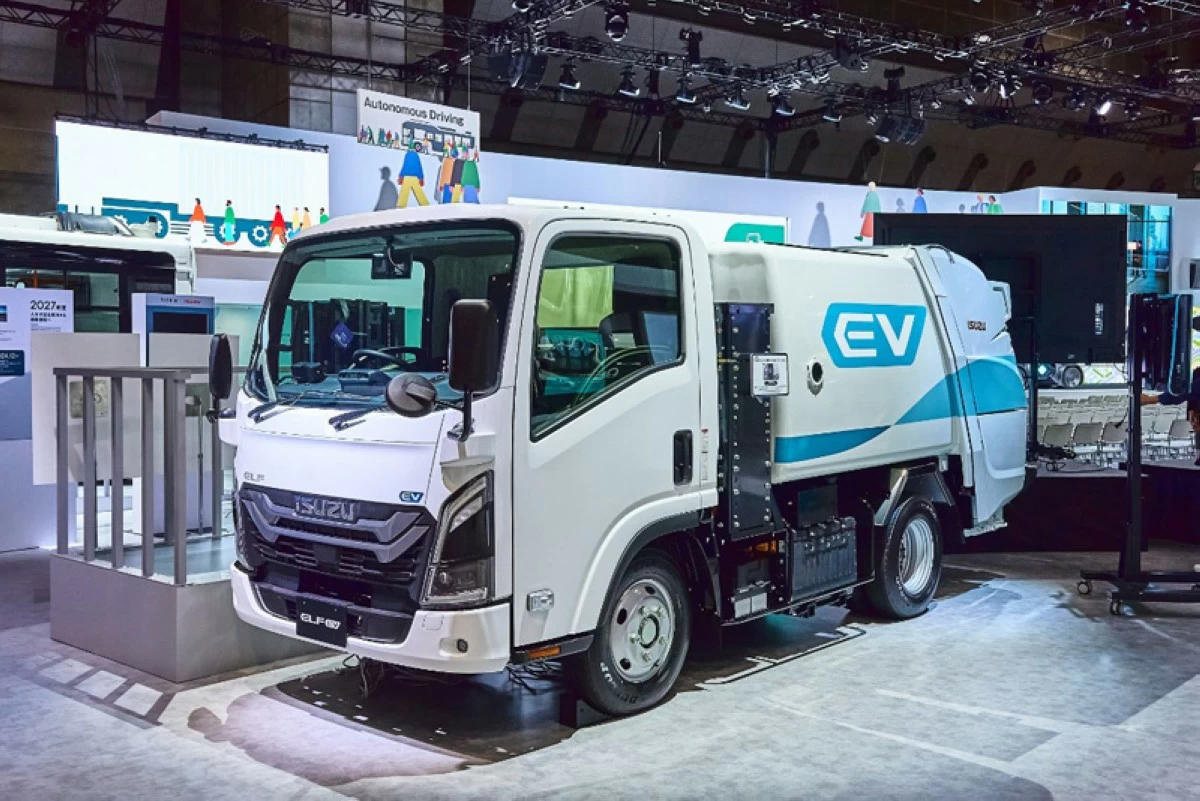
The ELF (N-series) EV Garbage Truck ensures silent operation compared to its diesel counterpart, but is still compatible with all applications the conventional ICE is capable of.
The ELF EV Garbage Truck was an interesting display. This model this is based on is better known as the light duty N-Series here the Philippines. Powered by a 66kW battery, it ensures silent operation compared to its diesel counterpart. It even has a Power Take-Off (PTO) unit, which runs the auxiliary equipment, that traditionally used to run off the engine, but is now electric. Now garbage collection can be quiet without disturbing residents. This electric garbage truck has V2L function and can power appliances too. Performance is no different from Isuzu’s conventionally powered diesel ELF trucks but this one has zero emissions.
Isuzu’s JMS booth showed that commercial vehicles with autonomous driving, are just on the horizon, ADAS is a valuable addition to all vehicles and electrification is not the be-all, end-all, to attain Carbon Neutrality. Isuzu’s multi-fuel engine offers customers more choices, so they can start thinking of sustainable options which suit them best and for where they are in the world. This shows that Isuzu is still a leader in the CV segment.

Related Tags

Isuzu Philippines Corp. (IPC) Japan Mobility Show
ADVERTISEMENT
.most-popular .layout-ratio{ padding-bottom: 79.13%; } @media (min-width: 768px) and (max-width: 1024px) { .widget-title { font-size: 15px !important; } }

{{ articles_filter_1561_widget.title }}

.most-popular .layout-ratio{ padding-bottom: 79.13%; } @media (min-width: 768px) and (max-width: 1024px) { .widget-title { font-size: 15px !important; } }

{{ articles_filter_1562_widget.title }}

.most-popular .layout-ratio{ padding-bottom: 79.13%; } @media (min-width: 768px) and (max-width: 1024px) { .widget-title { font-size: 15px !important; } }

{{ articles_filter_1563_widget.title }}

{{ articles_filter_1564_widget.title }}

.mb-article-details { position: relative; } .mb-article-details .article-body-preview, .mb-article-details .article-body-summary{ font-size: 17px; line-height: 30px; font-family: "Libre Caslon Text", serif; color: #000; } .mb-article-details .article-body-preview iframe , .mb-article-details .article-body-summary iframe{ width: 100%; margin: auto; } .read-more-background { background: linear-gradient(180deg, color(display-p3 1.000 1.000 1.000 / 0) 13.75%, color(display-p3 1.000 1.000 1.000 / 0.8) 30.79%, color(display-p3 1.000 1.000 1.000) 72.5%); position: absolute; height: 200px; width: 100%; bottom: 0; display: flex; justify-content: center; align-items: center; padding: 0; } .read-more-background a{ color: #000; } .read-more-btn { padding: 17px 45px; font-family: Inter; font-weight: 700; font-size: 18px; line-height: 16px; text-align: center; vertical-align: middle; border: 1px solid black; background-color: white; } .hidden { display: none; }
function initializeAllSwipers() { // Get all hidden inputs with cms_article_id document.querySelectorAll('[id^="cms_article_id_"]').forEach(function (input) { const cmsArticleId = input.value; const articleSelector = '#article-' + cmsArticleId + ' .body_images'; const swiperElement = document.querySelector(articleSelector); if (swiperElement && !swiperElement.classList.contains('swiper-initialized')) { new Swiper(articleSelector, { loop: true, pagination: false, navigation: { nextEl: '#article-' + cmsArticleId + ' .swiper-button-next', prevEl: '#article-' + cmsArticleId + ' .swiper-button-prev', }, }); } }); } setTimeout(initializeAllSwipers, 3000); const intersectionObserver = new IntersectionObserver( (entries) => { entries.forEach((entry) => { if (entry.isIntersecting) { const newUrl = entry.target.getAttribute("data-url"); if (newUrl) { history.pushState(null, null, newUrl); let article = entry.target; // Extract metadata const author = article.querySelector('.author-section').textContent.replace('By', '').trim(); const section = article.querySelector('.section-info ').textContent.replace(' ', ' '); const title = article.querySelector('.article-title h1').textContent; // Parse URL for Chartbeat path format const parsedUrl = new URL(newUrl, window.location.origin); const cleanUrl = parsedUrl.host + parsedUrl.pathname; // Update Chartbeat configuration if (typeof window._sf_async_config !== 'undefined') { window._sf_async_config.path = cleanUrl; window._sf_async_config.sections = section; window._sf_async_config.authors = author; } // Track virtual page view with Chartbeat if (typeof pSUPERFLY !== 'undefined' && typeof pSUPERFLY.virtualPage === 'function') { try { pSUPERFLY.virtualPage({ path: cleanUrl, title: title, sections: section, authors: author }); } catch (error) { console.error('ping error', error); } } // Optional: Update document title if (title && title !== document.title) { document.title = title; } } } }); }, { threshold: 0.1 } ); function showArticleBody(button) { const article = button.closest("article"); const summary = article.querySelector(".article-body-summary"); const body = article.querySelector(".article-body-preview"); const readMoreSection = article.querySelector(".read-more-background"); // Hide summary and read-more section summary.style.display = "none"; readMoreSection.style.display = "none"; // Show the full article body body.classList.remove("hidden"); } document.addEventListener("DOMContentLoaded", () => { let loadCount = 0; // Track how many times articles are loaded const offset = [1, 2, 3, 4, 5, 6, 7, 8, 9, 10]; // Offset values const currentUrl = window.location.pathname.substring(1); let isLoading = false; // Prevent multiple calls if (!currentUrl) { console.log("Current URL is invalid."); return; } const sentinel = document.getElementById("load-more-sentinel"); if (!sentinel) { console.log("Sentinel element not found."); return; } function isSentinelVisible() { const rect = sentinel.getBoundingClientRect(); return ( rect.top < window.innerHeight && rect.bottom >= 0 ); } function onScroll() { if (isLoading) return; if (isSentinelVisible()) { if (loadCount >= offset.length) { console.log("Maximum load attempts reached."); window.removeEventListener("scroll", onScroll); return; } isLoading = true; const currentOffset = offset[loadCount]; window.loadMoreItems().then(() => { let article = document.querySelector('#widget_1690 > div:nth-last-of-type(2) article'); intersectionObserver.observe(article) loadCount++; }).catch(error => { console.error("Error loading more items:", error); }).finally(() => { isLoading = false; }); } } window.addEventListener("scroll", onScroll); });

Sign up by email to receive news.