






Manila Bulletin
 Philippines
National
OCD ramps up preparations for 'Uwan' as death toll from 'Tino' climbs to 188
Philippines
National
OCD ramps up preparations for 'Uwan' as death toll from 'Tino' climbs to 188
Philippines
National
OCD ramps up preparations for 'Uwan' as death toll from 'Tino' climbs to 188
OCD ramps up preparations for 'Uwan' as death toll from 'Tino' climbs to 188
Published Nov 7, 2025 12:25 pm
|
Updated Nov 7, 2025 01:06 pm


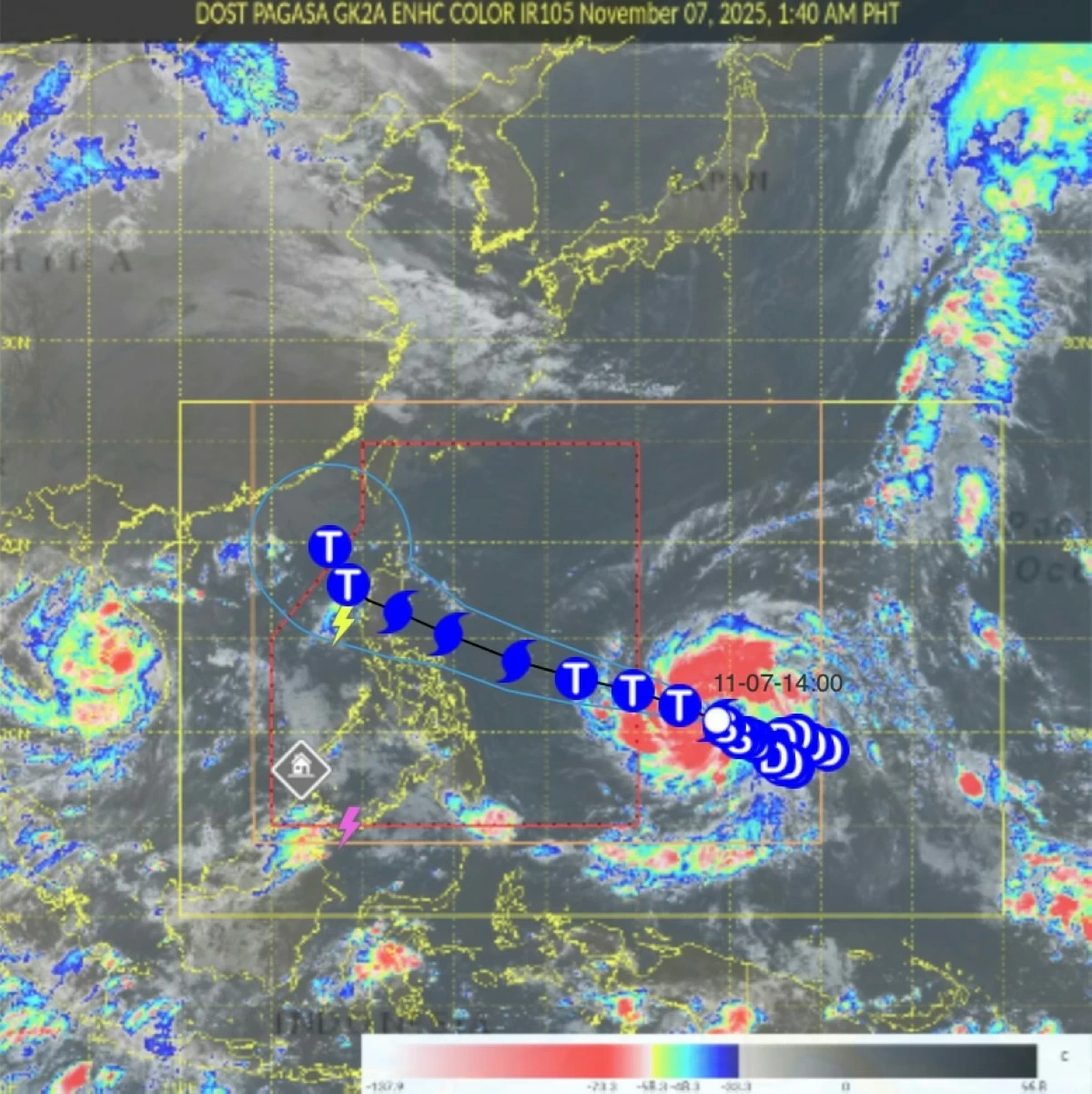
Severe Tropical Storm Fung-wong is estimated based on all available data at 1,315 km. east of Eastern Visayas (outside Philippine Area of Responsibility) as of Nov. 7, 2025. It will be named Tropical Cyclone "Uwan" when it enters PAR on Nov. 8 or 9. It has maximum sustained winds of 100 km/h near the center, gustiness of up to 125 km/h, and central pressure of 980 hPa. (Courtesy of PAGASA)
As the nation continues to reel from the devastation left by Typhoon Tino, which claimed the lives of at least 188 people as of Friday, Nov. 7, the Office of Civil Defense (OCD) has begun shifting its focus to brace for the impact of another powerful storm, the potential super typhoon “Uwan,” which is expected to bring heavy rains and strong winds this weekend.
OCD Administrator, Undersecretary Harold Cabreros said the government remains on full alert as Uwan (international name: Severe Tropical Storm Fung-wong) threatens Northern and Central Luzon, with possible effects extending to Metro Manila, Southern Luzon, and other regions.
“Starting Saturday (November 8) and Sunday (November 9), the country will begin to experience bad weather brought by Typhoon Uwan. It is expected to pass through Northern and Central Luzon but because of its wide reach of over a thousand kilometers, Metro Manila, Southern Luzon, and other regions should also prepare,” Cabreros said.
Severe Tropical Storm Fung-wong is estimated based on all available data at 1,315 kilometers east of Eastern Visayas, outside the Philippine Area of Responsibility or PAR, as of Friday. It will be named "Uwan" when it enters PAR on Nov. 8 or 9. It has maximum sustained winds of 100 kilometers per hour (kph) near the center, gustiness of up to 125 kph, and central pressure of 980 hPa (hectopascal).
Cabreros said the OCD will continue to intensify its preparations for the incoming typhoon even as they sustain ongoing response operations for Filipinos affected by Tino.
“Government agencies will keep working together to address the needs of affected communities. We are calling on everyone to stay informed about where, when, and how strong the winds and rains from Typhoon Uwan will be,” he said.
Cabreros said the National Disaster Risk Reduction and Management Council (NDRRMC) has directed all regional offices and local disaster councils to activate contingency measures and ensure prepositioning of supplies and rescue assets.
Tino’s wrath
Meanwhile, Cabreros said Tino’s death toll rose to 188, with 135 persons missing and 96 others injured across Visayas and parts of Mindanao, as of 6 a.m. Friday.
Cebu was the hardest hit, recording 139 fatalities, 79 missing persons, and 84 injuries.
Other provinces that reported casualties include Negros Occidental with 24 dead, Negros Oriental with nine, Agusan del Sur with six, Capiz with three, Southern Leyte with two, and Antique, Iloilo, Guimaras, Bohol, and Leyte with one apiece.
The powerful typhoon left a trail of destruction across the Visayas and parts of Mindanao, prompting the government to place 62 areas under a state of calamity, including the entire Cebu province with 53 cities and municipalities; two in Eastern Visayas (Guiuan, Eastern Samar and Silago, Southern Leyte); and the entire Dinagat Islands in Caraga with seven municipalities.
In total, Tino affected 2,258,782 individuals or 635,565 families across 5,535 barangays in Calabarzon (Region 4A), Mimaropa (Region 4B), Bicol (Region 5), Western Visayas (Region 6), Negros Island Region (NIR), Central Visayas (Region 7), Eastern Visayas (Region 8), and Caraga (Region 13).
A total of 318,703 individuals or equivalent to 88,649 families remained sheltered in 3,050 evacuation centers while 78,931 individuals or 23,350 families were staying with relatives or friends outside evacuation sites.
Infrastructure and lifeline services were severely affected as a total of 74 road sections and 10 bridges were rendered impassable in several regions, while power interruptions were reported in 162 cities and municipalities. Water supply was disrupted in 11 localities, and communication lines went down in 22 areas.
The NDRRMC also recorded 9,585 damaged houses across Regions 6, 7, 8, 10, and 13. Initial estimates placed agricultural damage at P10.6 million in Region 6 and infrastructure damage at P6.3 million in Regions 4B and 13.
Government agencies and local government units have been extending emergency relief operations and as of Friday, P111.1 million worth of assistance has been provided to affected families. Out of the 203,164 families in need, 90,507 have so far received aid, representing about 44.55 percent of the total.
Authorities continued search, rescue, and retrieval operations particularly in Cebu and Negros Island where most of the missing individuals were last reported.
State of national calamity
Earlier, President Marcos Jr. approved the recommendation of the NDRRMC to declare a State of National Calamity to hasten the release of emergency funds and accelerate rehabilitation in affected areas.
“The purpose of the declaration is to expedite the delivery of additional assistance and rehabilitation efforts for affected communities,” Cabreros said.
“As we continue our response operations for Tino, we are simultaneously preparing for Uwan. Everyone is urged to stay alert, make the necessary preparations, and follow the advisories of authorities amid the threat of another typhoon. Let us all stay safe,” he added.