ADVERTISEMENT

'Fung-wong' strengthens into severe tropical storm — PAGASA

Published Nov 7, 2025 08:12 am
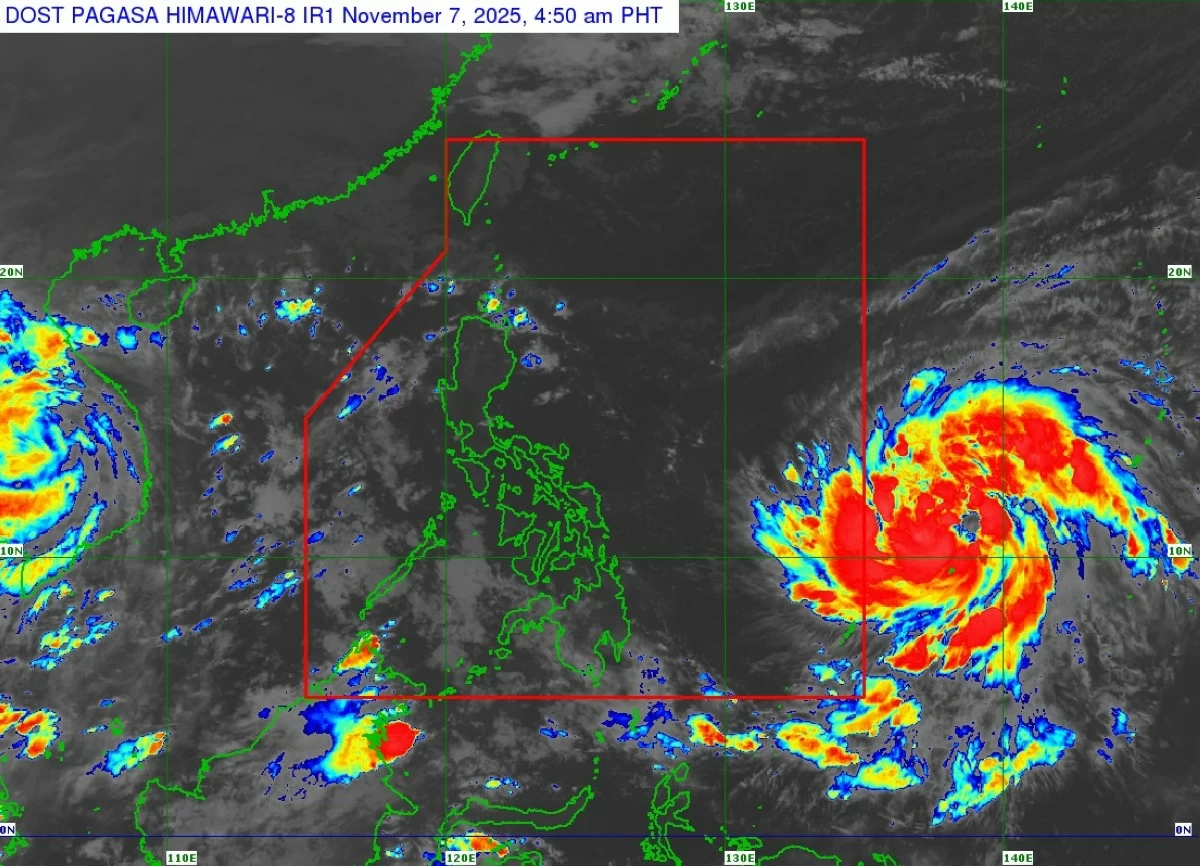
Satellite image of Severe Tropical Storm Fung-wong (Courtesy of PAGASA)
The tropical cyclone with the international name “Fung-wong” has strengthened into a severe tropical storm as it continues to intensify over the Pacific Ocean, the Philippine Atmospheric, Geophysical and Astronomical Services Administration (PAGASA) said on Friday, Nov. 7
As of 4 a.m., PAGASA weather specialist Loriedin de la Cruz-Galicia said Fung-wong was located 1,525 kilometers east of northeastern Mindanao, packing maximum sustained winds of 95 kilometers per hour (kph) near the center and gustiness of up to 115 kph. It was moving northwestward at 10 kph.
“May kabagalan ang pagkilos kung kaya may mataas pa ‘yung tyansa na mas lumakas po ito. Makakaipon pa ito ng lakas habang nasa karagatan sa mga susunod na araw (It is moving slowly, so there remains a high chance that it will continue to strengthen as it gathers energy over the sea in the coming days),” de la Cruz-Galicia said.
Fung-wong is expected to enter the Philippine area of responsibility (PAR) by Friday evening or Saturday morning, Nov. 8, after which it will be given the local name “Uwan.”
“In terms of intensity, mataas ang tyansa nito pumasok ng PAR as a typhoon (there is a high chance that it will enter the PAR as a typhoon),” she said.
“Habang nasa Philippine Sea ito sa mga susunod na araw ay mataas rin ang tyansa na lalo pa ito lumakas at maging isang super typhoon bago pa man maglandfall (While it remains over the Philippine Sea in the next few days, it is also likely to intensify further and become a super typhoon before making landfall),” she added.
The potential landfall area remains over Northern or Central Luzon, but the weather bureau warned that the storm’s wide circulation could bring strong winds and rains to a much larger area.
“Hindi lamang po tayo dapat sa landfall nakafocus dahil napakalawak ng diametro nitong bagyo. Its radius is extending 400 kilometers from the center. Kung ipo-project natin ito habang papalapit sa bansa, halos buong Luzon at malaking bahagi ng Visayas ang apektado nitong bagyo (We should not focus only on the landfall because this storm has a very wide diameter. Its radius extends 400 kilometers from the center. If we project its movement toward the country, almost the entire Luzon and a large part of the Visayas will be affected),” de la Cruz-Galicia said.
PAGASA said Tropical Cyclone Wind Signal No. 1 may be raised as early as Friday evening or Saturday morning over the eastern portions of Luzon and Eastern Visayas.
The highest possible wind signal that could be raised during its passage is Signal No. 5 if Fung-wong reaches the super typhoon category.
The onset of heavy rains is expected by early Sunday, Nov. 9, while potentially life-threatening weather may occur over Northern and portions of Central Luzon on Monday and Tuesday, Nov. 10 and 11.
“Matinding paghahanda ang iminumungkahi natin sa ating mga kababayan, lalong-lalo na sa mga maaapektuhan na lugar (We strongly urge our fellow Filipinos, especially those in areas likely to be affected, to undertake intensive preparations),” de la Cruz-Galicia said.

Related Tags

PAGASA FUNG-WONG UWAN SUPER TYPHOON SIGNAL NO. 5
ADVERTISEMENT
.most-popular .layout-ratio{ padding-bottom: 79.13%; } @media (min-width: 768px) and (max-width: 1024px) { .widget-title { font-size: 15px !important; } }

{{ articles_filter_1561_widget.title }}

.most-popular .layout-ratio{ padding-bottom: 79.13%; } @media (min-width: 768px) and (max-width: 1024px) { .widget-title { font-size: 15px !important; } }

{{ articles_filter_1562_widget.title }}

.most-popular .layout-ratio{ padding-bottom: 79.13%; } @media (min-width: 768px) and (max-width: 1024px) { .widget-title { font-size: 15px !important; } }

{{ articles_filter_1563_widget.title }}

{{ articles_filter_1564_widget.title }}

.mb-article-details { position: relative; } .mb-article-details .article-body-preview, .mb-article-details .article-body-summary{ font-size: 17px; line-height: 30px; font-family: "Libre Caslon Text", serif; color: #000; } .mb-article-details .article-body-preview iframe , .mb-article-details .article-body-summary iframe{ width: 100%; margin: auto; } .read-more-background { background: linear-gradient(180deg, color(display-p3 1.000 1.000 1.000 / 0) 13.75%, color(display-p3 1.000 1.000 1.000 / 0.8) 30.79%, color(display-p3 1.000 1.000 1.000) 72.5%); position: absolute; height: 200px; width: 100%; bottom: 0; display: flex; justify-content: center; align-items: center; padding: 0; } .read-more-background a{ color: #000; } .read-more-btn { padding: 17px 45px; font-family: Inter; font-weight: 700; font-size: 18px; line-height: 16px; text-align: center; vertical-align: middle; border: 1px solid black; background-color: white; } .hidden { display: none; }
function initializeAllSwipers() { // Get all hidden inputs with cms_article_id document.querySelectorAll('[id^="cms_article_id_"]').forEach(function (input) { const cmsArticleId = input.value; const articleSelector = '#article-' + cmsArticleId + ' .body_images'; const swiperElement = document.querySelector(articleSelector); if (swiperElement && !swiperElement.classList.contains('swiper-initialized')) { new Swiper(articleSelector, { loop: true, pagination: false, navigation: { nextEl: '#article-' + cmsArticleId + ' .swiper-button-next', prevEl: '#article-' + cmsArticleId + ' .swiper-button-prev', }, }); } }); } setTimeout(initializeAllSwipers, 3000); const intersectionObserver = new IntersectionObserver( (entries) => { entries.forEach((entry) => { if (entry.isIntersecting) { const newUrl = entry.target.getAttribute("data-url"); if (newUrl) { history.pushState(null, null, newUrl); let article = entry.target; // Extract metadata const author = article.querySelector('.author-section').textContent.replace('By', '').trim(); const section = article.querySelector('.section-info ').textContent.replace(' ', ' '); const title = article.querySelector('.article-title h1').textContent; // Parse URL for Chartbeat path format const parsedUrl = new URL(newUrl, window.location.origin); const cleanUrl = parsedUrl.host + parsedUrl.pathname; // Update Chartbeat configuration if (typeof window._sf_async_config !== 'undefined') { window._sf_async_config.path = cleanUrl; window._sf_async_config.sections = section; window._sf_async_config.authors = author; } // Track virtual page view with Chartbeat if (typeof pSUPERFLY !== 'undefined' && typeof pSUPERFLY.virtualPage === 'function') { try { pSUPERFLY.virtualPage({ path: cleanUrl, title: title, sections: section, authors: author }); } catch (error) { console.error('ping error', error); } } // Optional: Update document title if (title && title !== document.title) { document.title = title; } } } }); }, { threshold: 0.1 } ); function showArticleBody(button) { const article = button.closest("article"); const summary = article.querySelector(".article-body-summary"); const body = article.querySelector(".article-body-preview"); const readMoreSection = article.querySelector(".read-more-background"); // Hide summary and read-more section summary.style.display = "none"; readMoreSection.style.display = "none"; // Show the full article body body.classList.remove("hidden"); } document.addEventListener("DOMContentLoaded", () => { let loadCount = 0; // Track how many times articles are loaded const offset = [1, 2, 3, 4, 5, 6, 7, 8, 9, 10]; // Offset values const currentUrl = window.location.pathname.substring(1); let isLoading = false; // Prevent multiple calls if (!currentUrl) { console.log("Current URL is invalid."); return; } const sentinel = document.getElementById("load-more-sentinel"); if (!sentinel) { console.log("Sentinel element not found."); return; } function isSentinelVisible() { const rect = sentinel.getBoundingClientRect(); return ( rect.top < window.innerHeight && rect.bottom >= 0 ); } function onScroll() { if (isLoading) return; if (isSentinelVisible()) { if (loadCount >= offset.length) { console.log("Maximum load attempts reached."); window.removeEventListener("scroll", onScroll); return; } isLoading = true; const currentOffset = offset[loadCount]; window.loadMoreItems().then(() => { let article = document.querySelector('#widget_1690 > div:nth-last-of-type(2) article'); intersectionObserver.observe(article) loadCount++; }).catch(error => { console.error("Error loading more items:", error); }).finally(() => { isLoading = false; }); } } window.addEventListener("scroll", onScroll); });

Sign up by email to receive news.