ADVERTISEMENT

DepEd ramps up learning recovery, braces for 'Uwan' after over 3,200 classrooms damaged by Typhoon Tino

Published Nov 7, 2025 05:49 pm
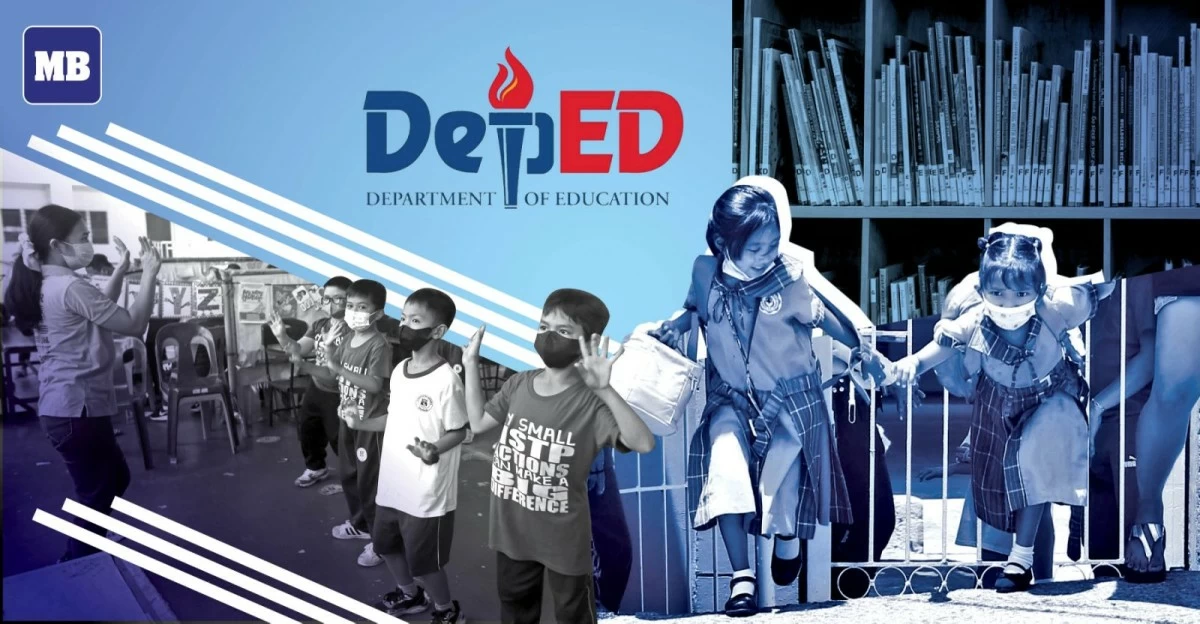
The Department of Education (DepEd) launches rapid recovery efforts after Typhoon Tino damaged over 3,200 classrooms and braces for Typhoon Uwan, mobilizing funds, alternative learning tools, and psychosocial support to ensure education continuity. (DepEd / MB Visual Content Group)
The Department of Education (DepEd) on Friday, November 7, said it has launched urgent rehabilitation and learning recovery efforts after “Tino” left extensive damage to schools across several regions, even as the agency braces for the approaching Typhoon Uwan.
Based on DepEd’s latest situation report, a total of 3,260 classrooms sustained varying degrees of damage, while 3,478 public schools in 22 divisions suspended classes, affecting over 1.9 million learners and around 80,000 teachers and personnel.
DepEd Secretary Sonny Angara said the department has activated its disaster response protocols, directing regional and division engineers to assess structural damage and expedite repairs.
He also assured that learning recovery measures are underway to minimize disruptions to education.
“This is about rebuilding hope and stability for our learners,” Angara said. “Our priority is safety and the quick restoration of learning spaces,” he added.
DepEd said it is tapping the Quick Response Fund (QRF) to fast-track the reconstruction of damaged classrooms and is coordinating with the Department of Public Works and Highways (DPWH) and local government units (LGUs) for joint validation.
The agency has also begun implementing psychosocial support programs for students and teachers affected by Typhoon Tino.
With Typhoon Uwan expected to bring more heavy rains, DepEd said it has intensified its preparedness and learning continuity measures.
DepEd will deploy “EduKahon” kits and other alternative learning modalities to ensure education continues despite disruptions.
Angara also directed the National Educators Academy of the Philippines (NEAP) to remind regional offices to maximize the use of Dynamic Learning Program–Learning Activity Sheets (DLP-LAS) in emergencies.
The move complements DepEd’s recently renewed partnership with the Knowledge Channel Foundation and Solar Pictures to revitalize DepEd TV, expanding access to TV-based learning as part of the agency’s broader learning recovery initiative.
To address the shortage of usable classrooms, DepEd said it will construct upgraded Temporary Learning Spaces (TLS) near affected schools to accommodate displaced students while rehabilitation is ongoing.
According to its Disaster Risk Reduction and Management Service (DRRMS), DepEd said it needs approximately P30.63 million for cleanup and clearing operations across 407 schools, and P1.86 billion for minor classroom repairs, subject to further validation.
Angara emphasized that rehabilitation and recovery efforts will be done in close coordination with LGUs and private sector partners as part of DepEd’s mission to restore normalcy and safeguard the right to education for all learners.
DepEd said that even as it prepares for Typhoon Uwan, the agency is mobilizing every available resource to ensure that learning continues and that schools remain safe havens for children.
Meanwhile, DepEd assured that it will maintain close coordination with the Education Cluster and field offices for continuous monitoring, early action, and emergency response as Typhoon Uwan nears.
“DepEd will continue working with local governments, partners, and communities so that no child is left behind in the aftermath of any disaster,” Angara said. 

Related Tags

DepEd learning recovery TinoPH classroom damage Typhoon Uwan Philippines Sonny Angara DepEd learning continuity
ADVERTISEMENT
.most-popular .layout-ratio{ padding-bottom: 79.13%; } @media (min-width: 768px) and (max-width: 1024px) { .widget-title { font-size: 15px !important; } }

{{ articles_filter_1561_widget.title }}

.most-popular .layout-ratio{ padding-bottom: 79.13%; } @media (min-width: 768px) and (max-width: 1024px) { .widget-title { font-size: 15px !important; } }

{{ articles_filter_1562_widget.title }}

.most-popular .layout-ratio{ padding-bottom: 79.13%; } @media (min-width: 768px) and (max-width: 1024px) { .widget-title { font-size: 15px !important; } }

{{ articles_filter_1563_widget.title }}

{{ articles_filter_1564_widget.title }}

.mb-article-details { position: relative; } .mb-article-details .article-body-preview, .mb-article-details .article-body-summary{ font-size: 17px; line-height: 30px; font-family: "Libre Caslon Text", serif; color: #000; } .mb-article-details .article-body-preview iframe , .mb-article-details .article-body-summary iframe{ width: 100%; margin: auto; } .read-more-background { background: linear-gradient(180deg, color(display-p3 1.000 1.000 1.000 / 0) 13.75%, color(display-p3 1.000 1.000 1.000 / 0.8) 30.79%, color(display-p3 1.000 1.000 1.000) 72.5%); position: absolute; height: 200px; width: 100%; bottom: 0; display: flex; justify-content: center; align-items: center; padding: 0; } .read-more-background a{ color: #000; } .read-more-btn { padding: 17px 45px; font-family: Inter; font-weight: 700; font-size: 18px; line-height: 16px; text-align: center; vertical-align: middle; border: 1px solid black; background-color: white; } .hidden { display: none; }
function initializeAllSwipers() { // Get all hidden inputs with cms_article_id document.querySelectorAll('[id^="cms_article_id_"]').forEach(function (input) { const cmsArticleId = input.value; const articleSelector = '#article-' + cmsArticleId + ' .body_images'; const swiperElement = document.querySelector(articleSelector); if (swiperElement && !swiperElement.classList.contains('swiper-initialized')) { new Swiper(articleSelector, { loop: true, pagination: false, navigation: { nextEl: '#article-' + cmsArticleId + ' .swiper-button-next', prevEl: '#article-' + cmsArticleId + ' .swiper-button-prev', }, }); } }); } setTimeout(initializeAllSwipers, 3000); const intersectionObserver = new IntersectionObserver( (entries) => { entries.forEach((entry) => { if (entry.isIntersecting) { const newUrl = entry.target.getAttribute("data-url"); if (newUrl) { history.pushState(null, null, newUrl); let article = entry.target; // Extract metadata const author = article.querySelector('.author-section').textContent.replace('By', '').trim(); const section = article.querySelector('.section-info ').textContent.replace(' ', ' '); const title = article.querySelector('.article-title h1').textContent; // Parse URL for Chartbeat path format const parsedUrl = new URL(newUrl, window.location.origin); const cleanUrl = parsedUrl.host + parsedUrl.pathname; // Update Chartbeat configuration if (typeof window._sf_async_config !== 'undefined') { window._sf_async_config.path = cleanUrl; window._sf_async_config.sections = section; window._sf_async_config.authors = author; } // Track virtual page view with Chartbeat if (typeof pSUPERFLY !== 'undefined' && typeof pSUPERFLY.virtualPage === 'function') { try { pSUPERFLY.virtualPage({ path: cleanUrl, title: title, sections: section, authors: author }); } catch (error) { console.error('ping error', error); } } // Optional: Update document title if (title && title !== document.title) { document.title = title; } } } }); }, { threshold: 0.1 } ); function showArticleBody(button) { const article = button.closest("article"); const summary = article.querySelector(".article-body-summary"); const body = article.querySelector(".article-body-preview"); const readMoreSection = article.querySelector(".read-more-background"); // Hide summary and read-more section summary.style.display = "none"; readMoreSection.style.display = "none"; // Show the full article body body.classList.remove("hidden"); } document.addEventListener("DOMContentLoaded", () => { let loadCount = 0; // Track how many times articles are loaded const offset = [1, 2, 3, 4, 5, 6, 7, 8, 9, 10]; // Offset values const currentUrl = window.location.pathname.substring(1); let isLoading = false; // Prevent multiple calls if (!currentUrl) { console.log("Current URL is invalid."); return; } const sentinel = document.getElementById("load-more-sentinel"); if (!sentinel) { console.log("Sentinel element not found."); return; } function isSentinelVisible() { const rect = sentinel.getBoundingClientRect(); return ( rect.top < window.innerHeight && rect.bottom >= 0 ); } function onScroll() { if (isLoading) return; if (isSentinelVisible()) { if (loadCount >= offset.length) { console.log("Maximum load attempts reached."); window.removeEventListener("scroll", onScroll); return; } isLoading = true; const currentOffset = offset[loadCount]; window.loadMoreItems().then(() => { let article = document.querySelector('#widget_1690 > div:nth-last-of-type(2) article'); intersectionObserver.observe(article) loadCount++; }).catch(error => { console.error("Error loading more items:", error); }).finally(() => { isLoading = false; }); } } window.addEventListener("scroll", onScroll); });

Sign up by email to receive news.