ADVERTISEMENT

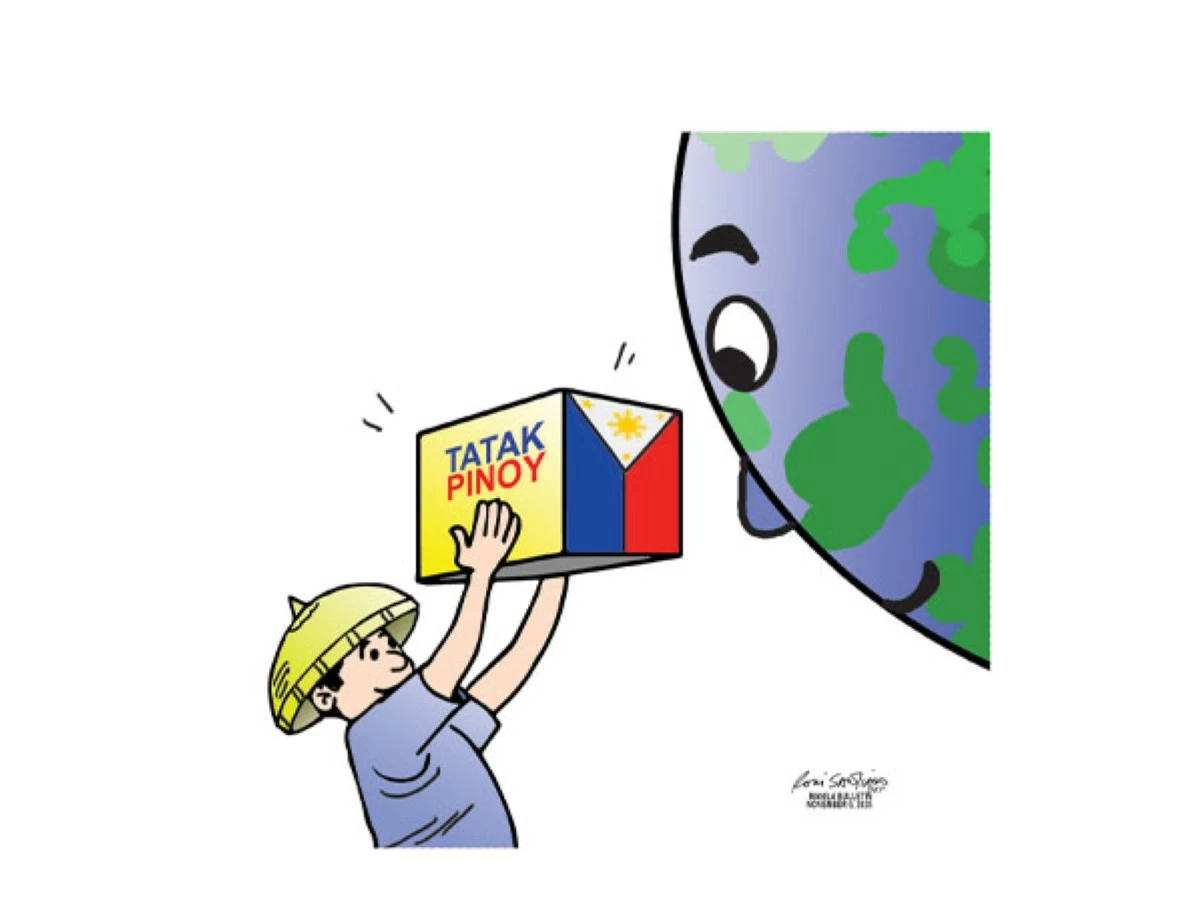
Tatak Pinoy: Building the future on Filipino excellence

Published Nov 6, 2025 12:01 am  |  Updated Nov 5, 2025 05:31 pm
President Ferdinand R. Marcos Jr.’s issuance of Memorandum Circular No. 104 to roll out the Tatak Pinoy Strategy (TPS) signals a decisive push toward transforming the Philippines into a more dynamic, competitive, and innovation-driven economy. The circular operationalizes Republic Act No. 11981, or the Tatak Pinoy Act, which embodies a comprehensive strategy to strengthen the country’s production and export capabilities under five horizontal pillars: human resources, infrastructure, innovation and technology, investments, and sound financial management.
This initiative represents a long-term vision: to make “Made in the Philippines” synonymous with quality, creativity, and global competitiveness. Much like how “Made in Japan” or “Made in Korea” became national brands of excellence, Tatak Pinoy aspires to elevate Filipino products, services, and industries beyond cost competitiveness toward value creation, sustainability, and technological advancement.
The issuance of MC No. 104 by Malacañang provides the necessary executive muscle to ensure that government agencies and local government units align their programs with the Tatak Pinoy framework. This coordination is vital in a country where overlapping mandates and fragmented initiatives have often diluted the impact of well-intentioned reforms. Through this circular, the Department of Trade and Industry (DTI), in partnership with the Department of Economy, Planning, and Development (DEPDev), is empowered to steer the strategy and monitor its progress.
Each of the five pillars of Tatak Pinoy contributes to building a holistic foundation for inclusive growth.
The first, Human Resources, recognizes that people are the ultimate source of competitive advantage. Investing in education, skills upgrading, and digital literacy ensures that Filipino workers can thrive in the fast-changing world of Industry 5.0. The second, Infrastructure, covers both hard and soft infrastructure — from efficient logistics and digital connectivity to modern regulatory systems — all essential to productivity and ease of doing business.
The third pillar, Innovation and Technology, is the heart of long-term competitiveness. Filipino ingenuity has long been evident in startups, design, and creative industries. With proper R&D investment and technology transfer mechanisms, these strengths can be scaled up to global standards. The fourth pillar, Investments, aims to attract both domestic and foreign capital to sectors that can multiply jobs and technological capacity. Finally, Sound Financial Management ensures that resources are mobilized and spent efficiently, with transparency and fiscal prudence underpinning growth.
The Tatak Pinoy initiative also fosters collaboration between the government and private sector, a partnership essential for policy coherence and market responsiveness. Industry associations, business chambers, academic institutions, and local enterprises can all play critical roles in defining what Filipino excellence means in practice.
At its core, Tatak Pinoy is not just an economic program but a nation-building project. It challenges Filipinos to believe in their own capacity to create, compete, and lead. In an era of global uncertainty and technological disruption, it provides a rallying point for unity and pride in purpose — a vision where every Filipino product, service, and innovation carries the mark of integrity, creativity, and quality.
As Malacañang’s Memorandum Circular No. 104 sets the gears in motion, the challenge now is steadfast execution. Success will depend on sustained coordination, measurable targets, and the active participation of all sectors. If pursued with discipline and collective will, Tatak Pinoy could indeed become more than a label. It could become the nation’s enduring identity in the 21st century.
ADVERTISEMENT
.most-popular .layout-ratio{ padding-bottom: 79.13%; } @media (min-width: 768px) and (max-width: 1024px) { .widget-title { font-size: 15px !important; } }

{{ articles_filter_1561_widget.title }}

.most-popular .layout-ratio{ padding-bottom: 79.13%; } @media (min-width: 768px) and (max-width: 1024px) { .widget-title { font-size: 15px !important; } }

{{ articles_filter_1562_widget.title }}

.most-popular .layout-ratio{ padding-bottom: 79.13%; } @media (min-width: 768px) and (max-width: 1024px) { .widget-title { font-size: 15px !important; } }

{{ articles_filter_1563_widget.title }}

{{ articles_filter_1564_widget.title }}

.mb-article-details { position: relative; } .mb-article-details .article-body-preview, .mb-article-details .article-body-summary{ font-size: 17px; line-height: 30px; font-family: "Libre Caslon Text", serif; color: #000; } .mb-article-details .article-body-preview iframe , .mb-article-details .article-body-summary iframe{ width: 100%; margin: auto; } .read-more-background { background: linear-gradient(180deg, color(display-p3 1.000 1.000 1.000 / 0) 13.75%, color(display-p3 1.000 1.000 1.000 / 0.8) 30.79%, color(display-p3 1.000 1.000 1.000) 72.5%); position: absolute; height: 200px; width: 100%; bottom: 0; display: flex; justify-content: center; align-items: center; padding: 0; } .read-more-background a{ color: #000; } .read-more-btn { padding: 17px 45px; font-family: Inter; font-weight: 700; font-size: 18px; line-height: 16px; text-align: center; vertical-align: middle; border: 1px solid black; background-color: white; } .hidden { display: none; }
function initializeAllSwipers() { // Get all hidden inputs with cms_article_id document.querySelectorAll('[id^="cms_article_id_"]').forEach(function (input) { const cmsArticleId = input.value; const articleSelector = '#article-' + cmsArticleId + ' .body_images'; const swiperElement = document.querySelector(articleSelector); if (swiperElement && !swiperElement.classList.contains('swiper-initialized')) { new Swiper(articleSelector, { loop: true, pagination: false, navigation: { nextEl: '#article-' + cmsArticleId + ' .swiper-button-next', prevEl: '#article-' + cmsArticleId + ' .swiper-button-prev', }, }); } }); } setTimeout(initializeAllSwipers, 3000); const intersectionObserver = new IntersectionObserver( (entries) => { entries.forEach((entry) => { if (entry.isIntersecting) { const newUrl = entry.target.getAttribute("data-url"); if (newUrl) { history.pushState(null, null, newUrl); let article = entry.target; // Extract metadata const author = article.querySelector('.author-section').textContent.replace('By', '').trim(); const section = article.querySelector('.section-info ').textContent.replace(' ', ' '); const title = article.querySelector('.article-title h1').textContent; // Parse URL for Chartbeat path format const parsedUrl = new URL(newUrl, window.location.origin); const cleanUrl = parsedUrl.host + parsedUrl.pathname; // Update Chartbeat configuration if (typeof window._sf_async_config !== 'undefined') { window._sf_async_config.path = cleanUrl; window._sf_async_config.sections = section; window._sf_async_config.authors = author; } // Track virtual page view with Chartbeat if (typeof pSUPERFLY !== 'undefined' && typeof pSUPERFLY.virtualPage === 'function') { try { pSUPERFLY.virtualPage({ path: cleanUrl, title: title, sections: section, authors: author }); } catch (error) { console.error('ping error', error); } } // Optional: Update document title if (title && title !== document.title) { document.title = title; } } } }); }, { threshold: 0.1 } ); function showArticleBody(button) { const article = button.closest("article"); const summary = article.querySelector(".article-body-summary"); const body = article.querySelector(".article-body-preview"); const readMoreSection = article.querySelector(".read-more-background"); // Hide summary and read-more section summary.style.display = "none"; readMoreSection.style.display = "none"; // Show the full article body body.classList.remove("hidden"); } document.addEventListener("DOMContentLoaded", () => { let loadCount = 0; // Track how many times articles are loaded const offset = [1, 2, 3, 4, 5, 6, 7, 8, 9, 10]; // Offset values const currentUrl = window.location.pathname.substring(1); let isLoading = false; // Prevent multiple calls if (!currentUrl) { console.log("Current URL is invalid."); return; } const sentinel = document.getElementById("load-more-sentinel"); if (!sentinel) { console.log("Sentinel element not found."); return; } function isSentinelVisible() { const rect = sentinel.getBoundingClientRect(); return ( rect.top < window.innerHeight && rect.bottom >= 0 ); } function onScroll() { if (isLoading) return; if (isSentinelVisible()) { if (loadCount >= offset.length) { console.log("Maximum load attempts reached."); window.removeEventListener("scroll", onScroll); return; } isLoading = true; const currentOffset = offset[loadCount]; window.loadMoreItems().then(() => { let article = document.querySelector('#widget_1690 > div:nth-last-of-type(2) article'); intersectionObserver.observe(article) loadCount++; }).catch(error => { console.error("Error loading more items:", error); }).finally(() => { isLoading = false; }); } } window.addEventListener("scroll", onScroll); });

Sign up by email to receive news.