ADVERTISEMENT

Palace attributes rise in hunger rate to calamities

Published Nov 6, 2025 04:09 pm
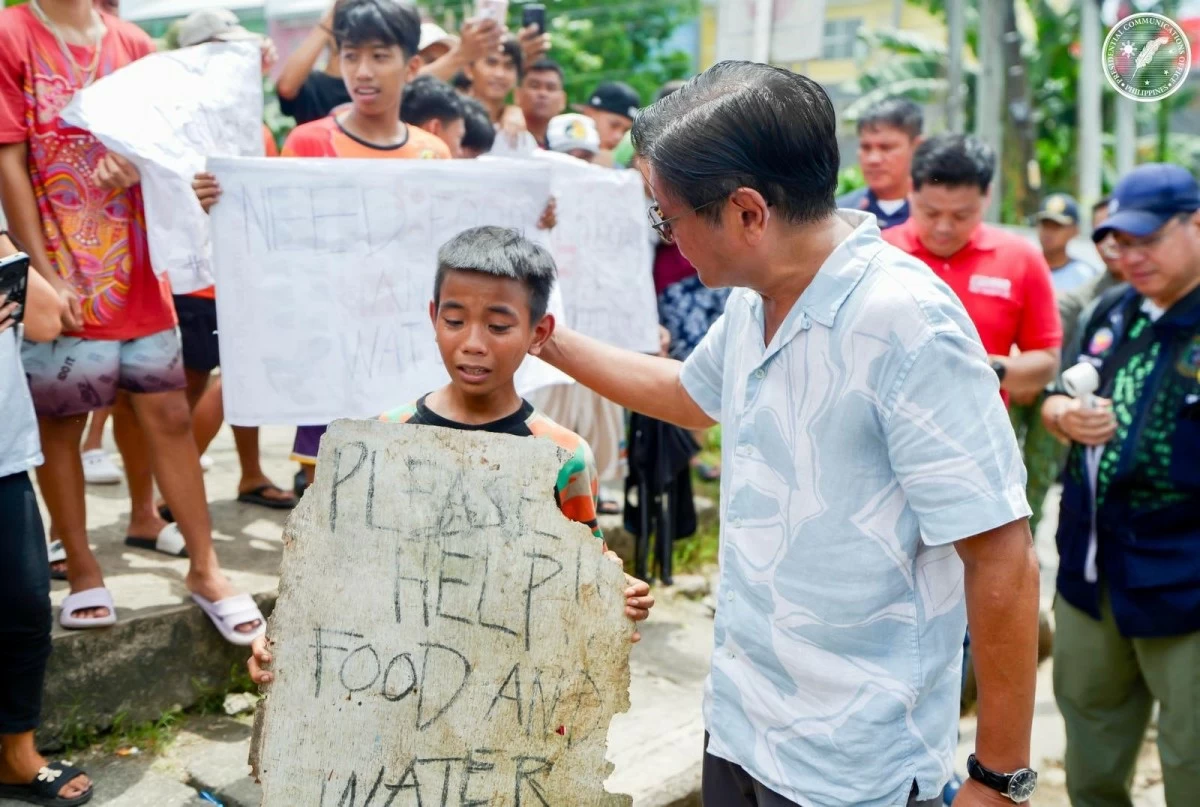
President Ferdinand Marcos Jr. approaches a kid on the street holding a sign requesting food and water in the aftermath of a magnitude 6.9 earthquake in northern Cebu on Oct. 2, 2025. (Presidential Communications Office)
Malacañang has attributed the increasing hunger rate to the series of natural disasters that have hit the country in recent months.
"Huwag po natin kalimutan na sunud-sunod ang kalamidad na naranasan ng mga kababayan po natin – nakaapekto po ito sa patuloy po na pagtatrabaho ng ating pamahalaan lalong-lalo na po ang DSWD (Department of Social Welfare and Development) para po maipababa ang hunger rate ng bansa (Let’s not forget that our fellow Filipinos have recently experienced successive calamities, which have affected the government’s ongoing efforts—especially those of the DSWD—to reduce the country’s hunger rate)," Palace Press Officer and Communications Undersecretary Claire Castro said on Thursday, Nov. 6.
"Kaya po siguro naranasan natin ito because of the calamities na sunod-sunod, hindi po isa eh sunod-sunod po iyong nararanasan natin (That’s probably why we’re seeing these results—because of the series of calamities we’ve been facing one after another)," Castro further said.
Based on the latest Social Weather Stations (SWS) survey results released on Nov. 5, about 22 percent of Filipino families experienced involuntary hunger, going hungry with nothing to eat, at least once in the past three months.
The survey showed an increase of 5.9 points from 16.1 percent in June, interrupting the previous downward trend from 27.2 percent in March to 19.1 percent in mid-April and 20 percent in late April.
Castro stressed that these surveys will still be useful as they will be compared and cross-checked with the data gathered by the government itself.

Unfazed over trust rating decline

The Palace official downplayed the recent decline in President Marcos' trust ratings, saying the President will continue working for the people whether the numbers are low or high.
She also cited that the majority still trusts Marcos.
"Pero nandudoon pa rin po iyong majority po ay nandoon pa rin po iyong kanilang trust sa ating Pangulo. Sabi nga po natin anuman ang numero, mataas, mababa at hangga’t nagtatrabaho ang ating Pangulo at ang gobyerno o para sa taumbayan tuluy-tuloy pa rin po at hindi po tayo maaapektuhan ng anuman pong numero (But the majority still continue to place their trust in the President. As we have said before, regardless of the numbers, whether high or low, as long as the President and the government continue working for the people, their efforts will go on and will not be affected by any figures)," Castro said.
According to OCTA's recent Tugon ng Masa Survey, Marcos' trust ratings posted a 7-point drop, scoring only 57 percent compared to his 64 percent score in July 2025.
His performance ratings also decreased to 54 percent from 62 percent in July.

Related Tags

President Marcos SWS hunger trust rating
ADVERTISEMENT
.most-popular .layout-ratio{ padding-bottom: 79.13%; } @media (min-width: 768px) and (max-width: 1024px) { .widget-title { font-size: 15px !important; } }

{{ articles_filter_1561_widget.title }}

.most-popular .layout-ratio{ padding-bottom: 79.13%; } @media (min-width: 768px) and (max-width: 1024px) { .widget-title { font-size: 15px !important; } }

{{ articles_filter_1562_widget.title }}

.most-popular .layout-ratio{ padding-bottom: 79.13%; } @media (min-width: 768px) and (max-width: 1024px) { .widget-title { font-size: 15px !important; } }

{{ articles_filter_1563_widget.title }}

{{ articles_filter_1564_widget.title }}

.mb-article-details { position: relative; } .mb-article-details .article-body-preview, .mb-article-details .article-body-summary{ font-size: 17px; line-height: 30px; font-family: "Libre Caslon Text", serif; color: #000; } .mb-article-details .article-body-preview iframe , .mb-article-details .article-body-summary iframe{ width: 100%; margin: auto; } .read-more-background { background: linear-gradient(180deg, color(display-p3 1.000 1.000 1.000 / 0) 13.75%, color(display-p3 1.000 1.000 1.000 / 0.8) 30.79%, color(display-p3 1.000 1.000 1.000) 72.5%); position: absolute; height: 200px; width: 100%; bottom: 0; display: flex; justify-content: center; align-items: center; padding: 0; } .read-more-background a{ color: #000; } .read-more-btn { padding: 17px 45px; font-family: Inter; font-weight: 700; font-size: 18px; line-height: 16px; text-align: center; vertical-align: middle; border: 1px solid black; background-color: white; } .hidden { display: none; }
function initializeAllSwipers() { // Get all hidden inputs with cms_article_id document.querySelectorAll('[id^="cms_article_id_"]').forEach(function (input) { const cmsArticleId = input.value; const articleSelector = '#article-' + cmsArticleId + ' .body_images'; const swiperElement = document.querySelector(articleSelector); if (swiperElement && !swiperElement.classList.contains('swiper-initialized')) { new Swiper(articleSelector, { loop: true, pagination: false, navigation: { nextEl: '#article-' + cmsArticleId + ' .swiper-button-next', prevEl: '#article-' + cmsArticleId + ' .swiper-button-prev', }, }); } }); } setTimeout(initializeAllSwipers, 3000); const intersectionObserver = new IntersectionObserver( (entries) => { entries.forEach((entry) => { if (entry.isIntersecting) { const newUrl = entry.target.getAttribute("data-url"); if (newUrl) { history.pushState(null, null, newUrl); let article = entry.target; // Extract metadata const author = article.querySelector('.author-section').textContent.replace('By', '').trim(); const section = article.querySelector('.section-info ').textContent.replace(' ', ' '); const title = article.querySelector('.article-title h1').textContent; // Parse URL for Chartbeat path format const parsedUrl = new URL(newUrl, window.location.origin); const cleanUrl = parsedUrl.host + parsedUrl.pathname; // Update Chartbeat configuration if (typeof window._sf_async_config !== 'undefined') { window._sf_async_config.path = cleanUrl; window._sf_async_config.sections = section; window._sf_async_config.authors = author; } // Track virtual page view with Chartbeat if (typeof pSUPERFLY !== 'undefined' && typeof pSUPERFLY.virtualPage === 'function') { try { pSUPERFLY.virtualPage({ path: cleanUrl, title: title, sections: section, authors: author }); } catch (error) { console.error('ping error', error); } } // Optional: Update document title if (title && title !== document.title) { document.title = title; } } } }); }, { threshold: 0.1 } ); function showArticleBody(button) { const article = button.closest("article"); const summary = article.querySelector(".article-body-summary"); const body = article.querySelector(".article-body-preview"); const readMoreSection = article.querySelector(".read-more-background"); // Hide summary and read-more section summary.style.display = "none"; readMoreSection.style.display = "none"; // Show the full article body body.classList.remove("hidden"); } document.addEventListener("DOMContentLoaded", () => { let loadCount = 0; // Track how many times articles are loaded const offset = [1, 2, 3, 4, 5, 6, 7, 8, 9, 10]; // Offset values const currentUrl = window.location.pathname.substring(1); let isLoading = false; // Prevent multiple calls if (!currentUrl) { console.log("Current URL is invalid."); return; } const sentinel = document.getElementById("load-more-sentinel"); if (!sentinel) { console.log("Sentinel element not found."); return; } function isSentinelVisible() { const rect = sentinel.getBoundingClientRect(); return ( rect.top < window.innerHeight && rect.bottom >= 0 ); } function onScroll() { if (isLoading) return; if (isSentinelVisible()) { if (loadCount >= offset.length) { console.log("Maximum load attempts reached."); window.removeEventListener("scroll", onScroll); return; } isLoading = true; const currentOffset = offset[loadCount]; window.loadMoreItems().then(() => { let article = document.querySelector('#widget_1690 > div:nth-last-of-type(2) article'); intersectionObserver.observe(article) loadCount++; }).catch(error => { console.error("Error loading more items:", error); }).finally(() => { isLoading = false; }); } } window.addEventListener("scroll", onScroll); });

Sign up by email to receive news.