








He might not be a household name, but his two biggest games, “Call of Duty” and “Dead Space” are undisputed worldwide hits, shaping the experiences of millions of gamers and inspiring creators. So when Glen Schofield took the stage at Gamescom Asia x Thailand Game Show to share how he gets ideas, the packed room was listening. Throughout the talk, he emphasized that even as technology develops and evolves, it’s always going to be ideas that drive games that matter to people.

Glen Schofield
Before going to the tips, he said to stay open-minded since, “ideas can come from anywhere.” He said to keep pulling in ideas, but then, “only the best ideas get in the game.” While Schofield’s talk was primarily about games, his approach to idea generation can be applied broadly.
1. Private ideation time
Schofield started by talking about how he likes to ask himself questions. He would expose himself to art, reading, music, TV, whatever media, then he would think and reflect. In a time where we are constantly bombarded with so much, whether it’s media, notifications on our phones, the endless scrolls, we are interacting with things. But we might not be interacting enough with our own minds. This is a call to do that. Ask yourself things. Think deeply about ideas you’re coming across.
2. Personal experience
This might be an interesting one, since Schofield’s biggest games aren’t set in some kind of slice of life, but pretty big, dramatic, pieces in the far future or history. He said, pull from your own, friends, or even stories you’ve heard. But there’s the added piece of filtering those personal experiences into things that can make what you are creating more realistic and meaningful.
3. Research
When talking about research, Schofield mentioned that in the old days, you would have to go to a library. But now there are so many resources that we can draw from to create. His example was in creating a religion for “Dead Space” he wound up bringing together articles he had read about the collision that had killed the dinosaurs and the ways that religions were founded and evolved. By bringing together lots of reading on those ideas, he was able to create his own plausible religion for the game.
4. Brainstorming
While we might imagine creative geniuses working in isolation, Schofield points to the importance of teamwork. He says “there’s nothing like teamwork” in bringing together brilliant ideas so that people can build on and bounce off each other. He does bring up one crucial point about brainstorming. People don’t just show up and magic happens. He points to the importance of research and doing homework before showing up to the brainstorming. The creative leader should assign advanced reading so that people come prepared, otherwise you show up and waste time just getting people on the same page.
5. Visit locations
This is a real luxury, especially for example when Schofield showed photos of a trip to Europe that he and his team took to prepare making “Call of Duty: World War II.” If you can’t afford to go to the exact place, or if that’s impossible, like a space station in a far-off galaxy, then it’s still helpful to get out of where you are and get a feel for different places to spark ideas.
6. Working with experts
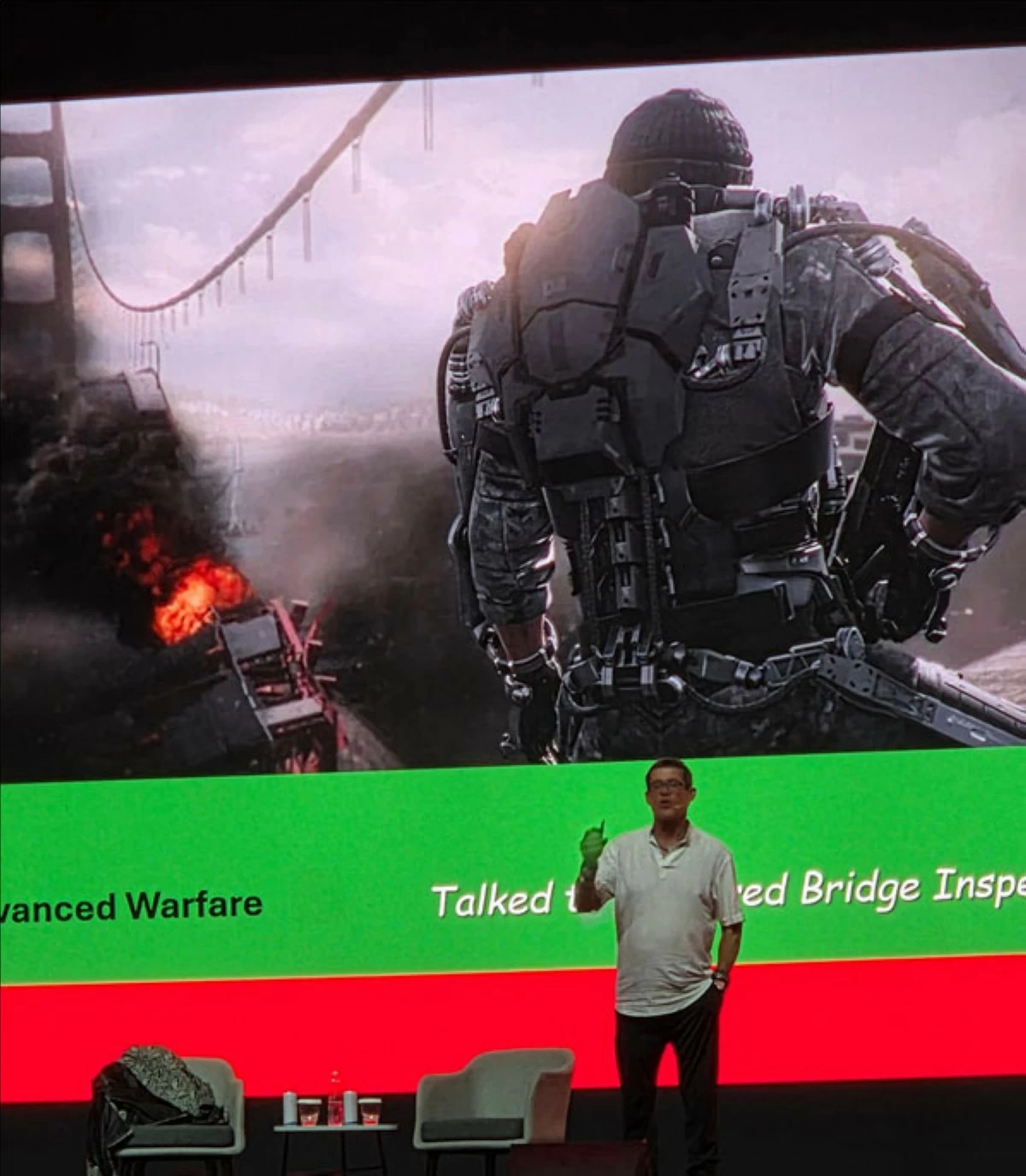
Creative people can’t know everything, and sometimes research isn’t enough. That’s when it’s valuable to consult experts. Schofield’s example was trying to imagine how to blow up a bridge and having the opportunity to ask a demolitions expert. This led to him learning about many technical aspects which he wouldn’t have imagined. We can go to experts to validate or correct our ideas and provide insights from their field.
7. Ripped from the headlines
This one goes without explaining, but basically looking at the news today and seeing where it could inspire stories elsewhere. Schofield clarifies it doesn’t just have to be politics, and in fact he suggests looking at different kinds of news from all over the world, not just what’s immediately around us.
8. Music and sound
When Schofield talked about music and sound, he said, “Keep the ears open.” Our audio environments can influence fresh concepts. Sometimes noise that we tune out can be an inspiration. He showed how the sharp grinding sounds of a train stopping at a station could be transformed into a hellish sound in “Dead Space.”
9. AI
This last one felt a little contentious. But it was something Schofield was passionate about. He advocated that, “AI isn’t here to replace us, it’s here to make us more efficient.” And that it wasn’t just for technical people but, “AI is for everyone …so use it, experiment with it, grow with it.” He said, “ The spark still comes from us. AI is just a tool to help us build faster and dream bigger…Whatever your craft is, learn the AI that will make you faster, better, more independent.” And for those who might be wary he still doubled down on the value of people’s ideas, “Ideas are still the lifeblood of the industry. Those ideas are going to come from you.”