






Manila Bulletin
 Business
The Economy
Philippines still on track for upper-middle-income-country status despite slower Q3 growth—Bernie Villegas
Business
The Economy
Philippines still on track for upper-middle-income-country status despite slower Q3 growth—Bernie Villegas
Business
The Economy
Philippines still on track for upper-middle-income-country status despite slower Q3 growth—Bernie Villegas
Philippines still on track for upper-middle-income-country status despite slower Q3 growth—Bernie Villegas
Published Nov 5, 2025 06:10 pm


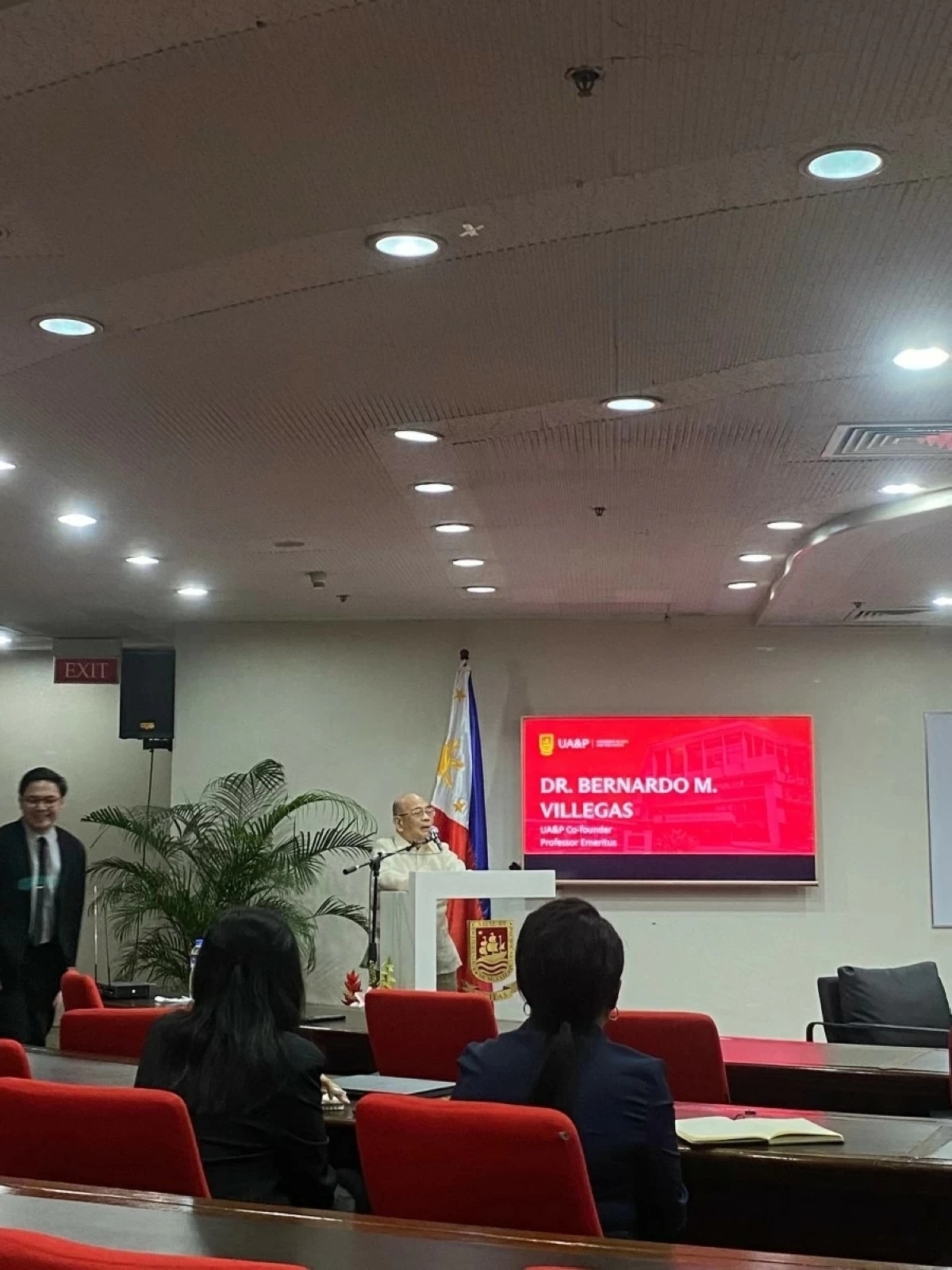
Amid a string of infrastructure controversies and devastating natural disasters, the country’s third-quarter economic growth is projected to slow to 5.3 percent, falling short of the government’s target, according to the University of Asia and the Pacific (UA&P) economist known as the “prophet of boom” in the local business community.
“It was one of the worst years for natural calamities,” said UA&P co-founder and professor emeritus Bernardo M. Villegas on the sidelines of the university’s 2025 economic briefing for diplomats on Wednesday, Oct. 5.
The Philippine government has set a gross domestic product (GDP) growth target of 5.5 to 6.5 percent for 2025, with the economy already hitting the lower end of that range at 5.5 percent in the second quarter.
The Philippine Statistics Authority (PSA) is scheduled to release the country’s third-quarter economic growth data on Friday, Nov. 7.
Villegas noted that while economic growth is expected to ease in the third quarter, activity is likely to rebound in the fourth quarter on the back of increased consumer spending during the Christmas season.
He added that the return of overseas Filipino workers (OFWs) during the holidays is expected to boost household spending, as they bring in remittances and spend more generously with their families, resulting in stronger purchasing power.
Earlier, the country’s chief economist expressed a less optimistic outlook for third-quarter growth, noting that both domestic issues—including the flood control corruption scandal—and external economic conditions may have weighed on performance.
“I am not as optimistic as I used to be, or as I have been,” Department of Economy, Planning, and Development (DEPDev) Secretary Arsenio M. Balisacan said last Monday, Nov. 3.
“Given the data that have been coming out in recent weeks, and particularly the performance of our industry,” Balisacan said, “the industry is probably at its lowest point in recent years.”
“I think that the growth may not be as rosy as we expect, or as we had expected, but we’ll see what comes out on Friday,” he added.
Balisacan noted that apart from the recent scandals and issues in the infrastructure sector, government spending—particularly on construction and fixed capital formation—has also slowed down.
To recall, the latest UA&P economic report indicated that the country’s GDP likely slowed to 5.2 percent in the quarter ending September.
“We expect tepid GDP growth of 5.2 percent in the third quarter after a spate of typhoons and negative sentiments due to the flood control corruption issue,” UA&P senior economist Victor Abola and economist Marco Antonio Agonia said.
However, the UA&P economists still “expect this to speed up to 5.7 percent in the fourth quarter as the economy appears to mend.”
Villegas also expressed confidence that the Philippines is on track to achieve upper-middle-income-country (UMIC) status, citing the country’s consistent average growth rate of around six percent over the past 15 years.
“So there’s no reason why we are afraid that the political problems will stop that. We have had similar political problems for the last 20 years, but we’ve been growing,” he added.
He added that there have been notable improvements in the government’s management of the agriculture sector under President Ferdinand R. Marcos Jr. and Agriculture Secretary Francisco Tiu Laurel Jr., describing it as a positive development for the economy.
Villegas also emphasized that the country is exerting every effort to attract foreign direct investment (FDI).
“Although right now the corruption temporarily makes it difficult—as the President already announced, he sees that as a turning point because they see that we are trying to send those crooks to jail,” he said, emphasizing that sending even a few of them to jail would strengthen foreign investors’ confidence in the government’s reform agenda.
“I trust those people now in the Independent Commission for Infrastructure (ICI),” he said.
Villegas noted that the country is poised to see progress in key areas such as agriculture, anti-corruption efforts, and FDI. He emphasized that these achievements are crucial for the Philippines to reach first-world status by 2040 or 2050.
(Ricardo M. Austria)