






Manila Bulletin
 Philippines
National
Over 20,000 schools affected by class suspensions; 76 damaged by 'Tino' and shearline – DepEd
Philippines
National
Over 20,000 schools affected by class suspensions; 76 damaged by 'Tino' and shearline – DepEd
Philippines
National
Over 20,000 schools affected by class suspensions; 76 damaged by 'Tino' and shearline – DepEd
Over 20,000 schools affected by class suspensions; 76 damaged by 'Tino' and shearline – DepEd
Published Nov 5, 2025 01:43 pm


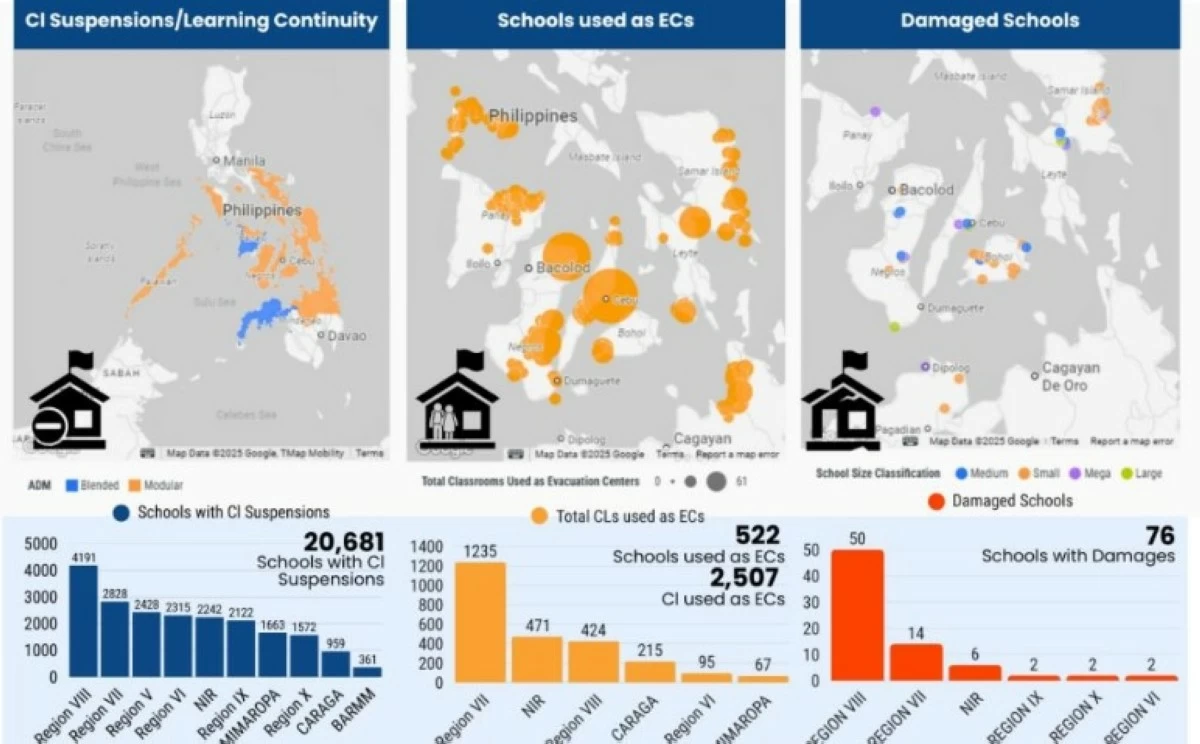
Over 20,000 schools across 10 regions were affected by class suspensions due to Typhoon Tino and the shearline, with 76 schools damaged, according to the Department of Education (DepEd). (Courtesy of DepEd)
The Department of Education (DepEd) on Wednesday, November 5, said that more than 20,000 schools across 10 regions were affected by class suspensions due to the combined effects of Typhoon Tino and the shearline.
Based on DepEd’s latest situation report, 20,681 schools suspended classes at the height of the weather disturbances.
Meanwhile, 522 schools have been converted into evacuation centers, temporarily housing displaced families in affected provinces. A total of 2,507 classrooms are currently being used as temporary shelters.
DepEd said it continues to assess the storm’s impact on education infrastructure and the continuity of learning.
Initial damage assessments from regional offices show that 76 schools sustained varying degrees of structural damage. Of these, 64 classrooms were reported as totally destroyed, 91 classrooms suffered major damage, and 237 sustained partial damage.
To support immediate recovery efforts, DepEd said P2.11 million is needed for clean-up and clearing operations in the 76 affected schools. Additionally, P11.6 million is required for minor repair works, equivalent to around P49,000 per school with minimal damage.
DepEd added that regional and division offices are coordinating closely with local government units (LGUs) and the Department of Public Works and Highways (DPWH) to ensure the safe return of learners to classrooms once weather conditions improve and assessments are completed.
The agency emphasized that the safety of learners, teachers, and education personnel remains its top priority, while efforts are ongoing to resume classes—whether face-to-face or through alternative learning modalities—in areas cleared of hazards.
DepEd said the class suspensions and damages were concentrated in regions heavily affected by the typhoon, particularly in parts of Luzon and the Visayas, where strong winds, heavy rainfall, and flooding disrupted learning delivery.