ADVERTISEMENT

Cyclone outside PAR may become super typhoon before entry this weekend, to be named 'Uwan' — PAGASA

Published Nov 5, 2025 12:57 pm  |  Updated Nov 5, 2025 01:50 pm
PAGASA
PAGASA
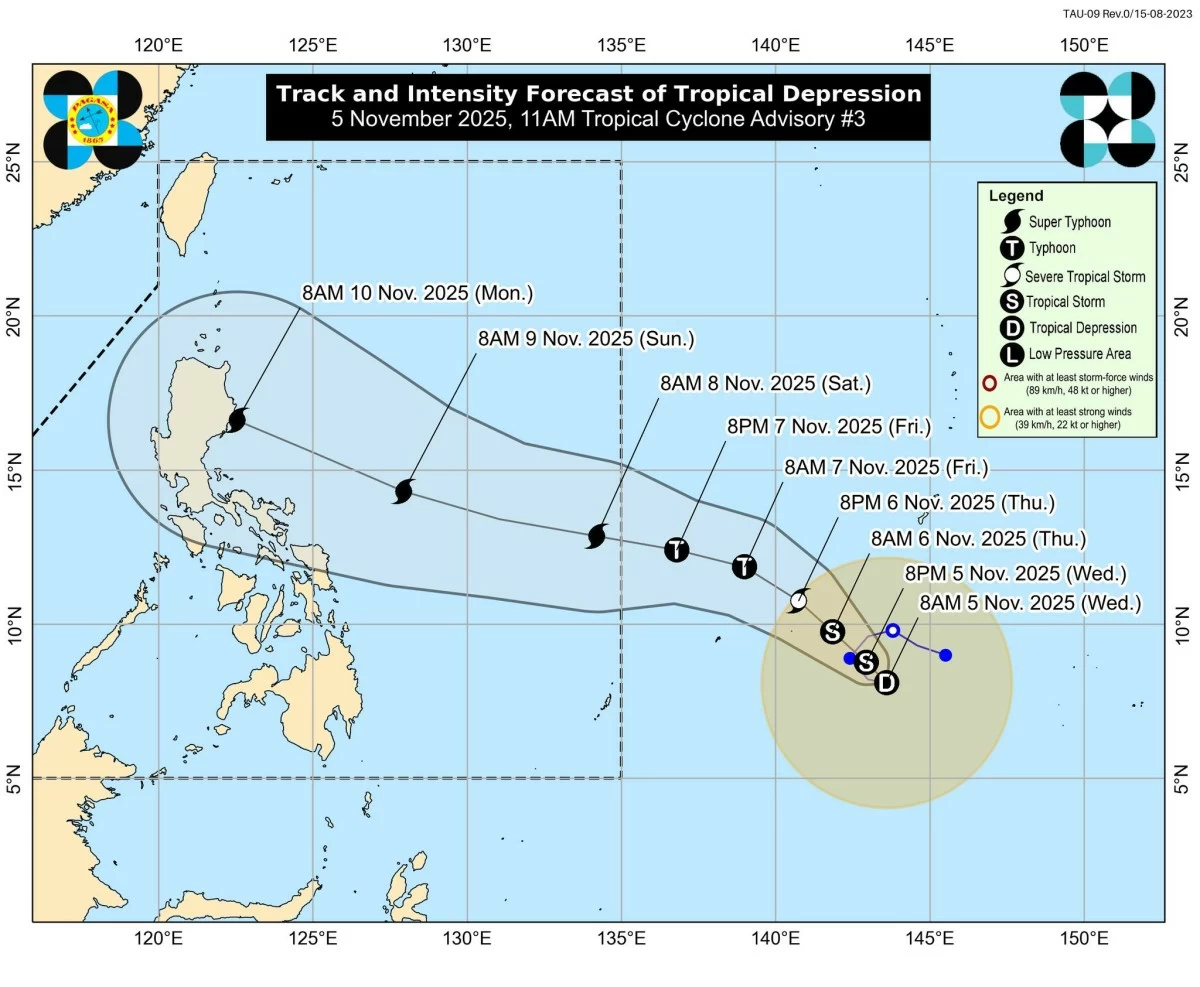
The Philippine Atmospheric, Geophysical and Astronomical Services Administration (PAGASA) warned on Wednesday, Nov. 5, that the tropical depression outside the Philippine Area of Responsibility (PAR) may intensify into a super typhoon before entering the country this weekend.
PAGASA weather specialist Benison Estareja said the tropical depression was located at 10 a.m. about 1,870 kilometers east of northeastern Mindanao, packing maximum sustained winds of 55 kilometers per hour (kph) near the center and gusts of up to 70 kph while moving eastward at 10 kph.
He said the weather disturbance has no direct effect on any part of the country yet, as it remains far from land.
Based on PAGASA’s latest forecast track, the tropical depression is expected to enter the PAR by Saturday morning, Nov. 8.
Since it is still over the warm waters of the Pacific Ocean, Estareja said the cyclone may continue to strengthen and could develop into a typhoon or even a super typhoon upon entry.
Once inside the PAR, the cyclone will be given the local name “Uwan.”
It is forecast to move west-northwestward toward Northern or Central Luzon and may make landfall over mainland Cagayan or Aurora by Monday morning, Nov. 10.
“Dahil aabot sa super typhoon category, around 185 kph to 195 kph yung posible maramdaman ng ating mga kababayan po doon. Mas malakas kumpara sa nagdaang bagyong si Tino (Since it may reach super typhoon category, winds of around 185 to 195 kph could be experienced in those areas. It will be stronger compared to the recent Typhoon Tino),” Estareja said.
He added that there remains some uncertainty in its track, and the cyclone could still shift slightly north toward Batanes or south toward the Bicol Region.
PAGASA said the cyclone’s movement may remain erratic for the next 12 to 24 hours before gradually turning northwestward by Thursday, Nov. 6, and west-northwestward thereafter.
“Habang lumalakas ang bagyo usually lumalawak ang kaulapan at malalakas na hangin. Magiging malawak so maaapektuhan basically ang malaking bahagi ng Luzon at Eastern Visayas habang lumalapit itong si tatawagin nating bagyong Uwan pagsapit ng Sunday, Nov. 9, hanggang Tuesday, Nov. 11 (As the cyclone intensifies, its cloud system and strong winds will expand. It will likely affect much of Luzon and Eastern Visayas as the system—soon to be named ‘Uwan’—approaches between Sunday, Nov. 9, and Tuesday, Nov. 11),” he added.
In anticipation of its approach, tropical cyclone wind signals may be raised over the eastern parts of Luzon and portions of the Samar provinces as early as Friday evening, Nov. 7, or Saturday morning, in anticipation of strong to destructive winds.
The highest possible signal under the current forecast scenario is Signal No. 5.
PAGASA warned that the “deterioration of weather conditions” may begin on Sunday, with “potentially life-threatening stormy conditions” expected over Northern Luzon and parts of Central Luzon on Monday and Tuesday.
“There is also a potential for high storm surge risk and related coastal flooding, especially in Northern Luzon and the east coast of Central Luzon,” the agency said.
It added that “storm surge warnings may be issued as early as Saturday.”
Meanwhile, PAGASA said moderate to rough seas may begin affecting the northern and eastern seaboards of Luzon and the eastern seaboards of Visayas and Mindanao by late Friday or Saturday.
By mid-Saturday or Sunday, moderate to rough seas may also develop along the western and southern seaboards of Luzon.
It added that hazardous sea conditions, reaching very rough to phenomenal seas, may prevail over most of Luzon and the eastern seaboards of Southern Luzon and Visayas starting Sunday.
A gale warning for very rough coastal waters is likely to be issued by Saturday.

Related Tags

SUPER TYPHOON UWAN PAGASA SIGNAL NO. 5 LANDFALL
ADVERTISEMENT
.most-popular .layout-ratio{ padding-bottom: 79.13%; } @media (min-width: 768px) and (max-width: 1024px) { .widget-title { font-size: 15px !important; } }

{{ articles_filter_1561_widget.title }}

.most-popular .layout-ratio{ padding-bottom: 79.13%; } @media (min-width: 768px) and (max-width: 1024px) { .widget-title { font-size: 15px !important; } }

{{ articles_filter_1562_widget.title }}

.most-popular .layout-ratio{ padding-bottom: 79.13%; } @media (min-width: 768px) and (max-width: 1024px) { .widget-title { font-size: 15px !important; } }

{{ articles_filter_1563_widget.title }}

{{ articles_filter_1564_widget.title }}

.mb-article-details { position: relative; } .mb-article-details .article-body-preview, .mb-article-details .article-body-summary{ font-size: 17px; line-height: 30px; font-family: "Libre Caslon Text", serif; color: #000; } .mb-article-details .article-body-preview iframe , .mb-article-details .article-body-summary iframe{ width: 100%; margin: auto; } .read-more-background { background: linear-gradient(180deg, color(display-p3 1.000 1.000 1.000 / 0) 13.75%, color(display-p3 1.000 1.000 1.000 / 0.8) 30.79%, color(display-p3 1.000 1.000 1.000) 72.5%); position: absolute; height: 200px; width: 100%; bottom: 0; display: flex; justify-content: center; align-items: center; padding: 0; } .read-more-background a{ color: #000; } .read-more-btn { padding: 17px 45px; font-family: Inter; font-weight: 700; font-size: 18px; line-height: 16px; text-align: center; vertical-align: middle; border: 1px solid black; background-color: white; } .hidden { display: none; }
function initializeAllSwipers() { // Get all hidden inputs with cms_article_id document.querySelectorAll('[id^="cms_article_id_"]').forEach(function (input) { const cmsArticleId = input.value; const articleSelector = '#article-' + cmsArticleId + ' .body_images'; const swiperElement = document.querySelector(articleSelector); if (swiperElement && !swiperElement.classList.contains('swiper-initialized')) { new Swiper(articleSelector, { loop: true, pagination: false, navigation: { nextEl: '#article-' + cmsArticleId + ' .swiper-button-next', prevEl: '#article-' + cmsArticleId + ' .swiper-button-prev', }, }); } }); } setTimeout(initializeAllSwipers, 3000); const intersectionObserver = new IntersectionObserver( (entries) => { entries.forEach((entry) => { if (entry.isIntersecting) { const newUrl = entry.target.getAttribute("data-url"); if (newUrl) { history.pushState(null, null, newUrl); let article = entry.target; // Extract metadata const author = article.querySelector('.author-section').textContent.replace('By', '').trim(); const section = article.querySelector('.section-info ').textContent.replace(' ', ' '); const title = article.querySelector('.article-title h1').textContent; // Parse URL for Chartbeat path format const parsedUrl = new URL(newUrl, window.location.origin); const cleanUrl = parsedUrl.host + parsedUrl.pathname; // Update Chartbeat configuration if (typeof window._sf_async_config !== 'undefined') { window._sf_async_config.path = cleanUrl; window._sf_async_config.sections = section; window._sf_async_config.authors = author; } // Track virtual page view with Chartbeat if (typeof pSUPERFLY !== 'undefined' && typeof pSUPERFLY.virtualPage === 'function') { try { pSUPERFLY.virtualPage({ path: cleanUrl, title: title, sections: section, authors: author }); } catch (error) { console.error('ping error', error); } } // Optional: Update document title if (title && title !== document.title) { document.title = title; } } } }); }, { threshold: 0.1 } ); function showArticleBody(button) { const article = button.closest("article"); const summary = article.querySelector(".article-body-summary"); const body = article.querySelector(".article-body-preview"); const readMoreSection = article.querySelector(".read-more-background"); // Hide summary and read-more section summary.style.display = "none"; readMoreSection.style.display = "none"; // Show the full article body body.classList.remove("hidden"); } document.addEventListener("DOMContentLoaded", () => { let loadCount = 0; // Track how many times articles are loaded const offset = [1, 2, 3, 4, 5, 6, 7, 8, 9, 10]; // Offset values const currentUrl = window.location.pathname.substring(1); let isLoading = false; // Prevent multiple calls if (!currentUrl) { console.log("Current URL is invalid."); return; } const sentinel = document.getElementById("load-more-sentinel"); if (!sentinel) { console.log("Sentinel element not found."); return; } function isSentinelVisible() { const rect = sentinel.getBoundingClientRect(); return ( rect.top < window.innerHeight && rect.bottom >= 0 ); } function onScroll() { if (isLoading) return; if (isSentinelVisible()) { if (loadCount >= offset.length) { console.log("Maximum load attempts reached."); window.removeEventListener("scroll", onScroll); return; } isLoading = true; const currentOffset = offset[loadCount]; window.loadMoreItems().then(() => { let article = document.querySelector('#widget_1690 > div:nth-last-of-type(2) article'); intersectionObserver.observe(article) loadCount++; }).catch(error => { console.error("Error loading more items:", error); }).finally(() => { isLoading = false; }); } } window.addEventListener("scroll", onScroll); });

Sign up by email to receive news.