ADVERTISEMENT

'Uwan' next?: As 'Tino' lashes Visayas, another cyclone forms outside PAR

Published Nov 4, 2025 12:50 pm  |  Updated Nov 4, 2025 01:14 pm
PAGASA
PAGASA
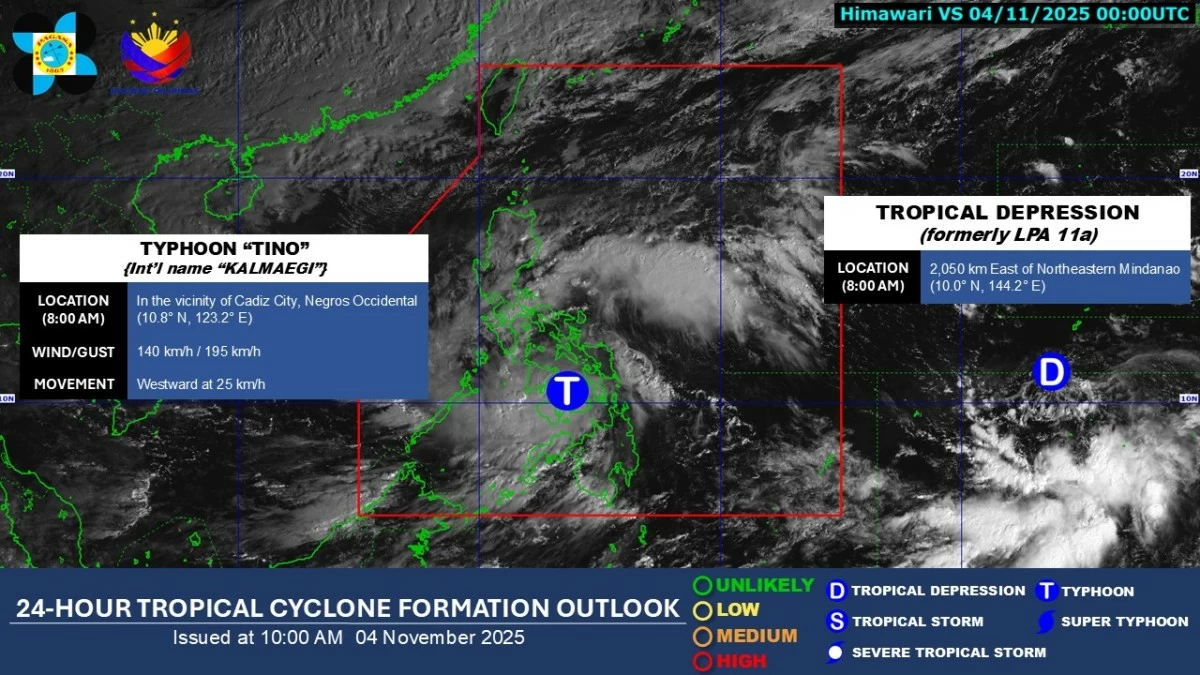
The rains and strong winds have yet to ease from Typhoon Tino’s (Kalmaegi) passage across Visayas, but already, the Philippine Atmospheric, Geophysical and Astronomical Services Administration (PAGASA) is keeping an eye on a new tropical cyclone that could soon make its way into Philippine Area of Responsibility (PAR).
PAGASA weather specialist John Manalo said the low-pressure area (LPA) outside the PAR developed into a tropical depression at 8 a.m. on Tuesday, Nov. 4.
As of 10 a.m., its center was located 1,985 kilometers east of northeastern Mindanao, packing maximum sustained winds of 55 kilometers per hour (kph) near the center and gustiness of up to 70 kph while moving westward at 20 kph.
Once it enters the PAR, the weather disturbance will be given the local name “Uwan.”
Manalo said it may enter between Friday, Nov. 7, and Saturday, Nov. 8, possibly as a typhoon.
“Kaya heads-up po sa ating mga kababayan dahil although medyo may kalayuan pa siya at posible pa magbago ‘yung track nito, gusto po natin i-advance na iinform ang ating mga kababayan patungkol sa tropical depression na ito na muli ay posible makaapekto sa atin lalo na sa darating na weekend (We’re giving an early heads-up to the public because even though it’s still quite far and its track may still change, we want to inform everyone in advance about this tropical depression that could once again affect the country, especially this coming weekend),” Manalo said.
Meanwhile, Typhoon Tino has so far made four landfalls on Tuesday: over Silago, Southern Leyte at 12 a.m.; Borbon, Cebu at 5:10 a.m.; Sagay City, Negros Occidental at 6:40 a.m.; and San Lorenzo, Guimaras at 11:10 a.m.
Manalo said another landfall remains possible over Panay Island before the typhoon moves into the Sulu Sea on its way to northern Palawan by Wednesday morning, Nov. 5.
It may exit the PAR by Thursday, Nov. 6, while continuing to move west-northwestward at 25 kph.
As of 10 a.m. Tuesday, the center of the eye of Typhoon Tino was located in the vicinity of Bacolod City, Negros Occidental.
After crossing the landmass, the typhoon slightly weakened but remained a strong cyclone, with maximum sustained winds of 140 kph near the center and gustiness of up to 195 kph.

Related Tags

PAGASA TINO UWAN TYPHOON TINO LPA
ADVERTISEMENT
.most-popular .layout-ratio{ padding-bottom: 79.13%; } @media (min-width: 768px) and (max-width: 1024px) { .widget-title { font-size: 15px !important; } }

{{ articles_filter_1561_widget.title }}

.most-popular .layout-ratio{ padding-bottom: 79.13%; } @media (min-width: 768px) and (max-width: 1024px) { .widget-title { font-size: 15px !important; } }

{{ articles_filter_1562_widget.title }}

.most-popular .layout-ratio{ padding-bottom: 79.13%; } @media (min-width: 768px) and (max-width: 1024px) { .widget-title { font-size: 15px !important; } }

{{ articles_filter_1563_widget.title }}

{{ articles_filter_1564_widget.title }}

.mb-article-details { position: relative; } .mb-article-details .article-body-preview, .mb-article-details .article-body-summary{ font-size: 17px; line-height: 30px; font-family: "Libre Caslon Text", serif; color: #000; } .mb-article-details .article-body-preview iframe , .mb-article-details .article-body-summary iframe{ width: 100%; margin: auto; } .read-more-background { background: linear-gradient(180deg, color(display-p3 1.000 1.000 1.000 / 0) 13.75%, color(display-p3 1.000 1.000 1.000 / 0.8) 30.79%, color(display-p3 1.000 1.000 1.000) 72.5%); position: absolute; height: 200px; width: 100%; bottom: 0; display: flex; justify-content: center; align-items: center; padding: 0; } .read-more-background a{ color: #000; } .read-more-btn { padding: 17px 45px; font-family: Inter; font-weight: 700; font-size: 18px; line-height: 16px; text-align: center; vertical-align: middle; border: 1px solid black; background-color: white; } .hidden { display: none; }
function initializeAllSwipers() { // Get all hidden inputs with cms_article_id document.querySelectorAll('[id^="cms_article_id_"]').forEach(function (input) { const cmsArticleId = input.value; const articleSelector = '#article-' + cmsArticleId + ' .body_images'; const swiperElement = document.querySelector(articleSelector); if (swiperElement && !swiperElement.classList.contains('swiper-initialized')) { new Swiper(articleSelector, { loop: true, pagination: false, navigation: { nextEl: '#article-' + cmsArticleId + ' .swiper-button-next', prevEl: '#article-' + cmsArticleId + ' .swiper-button-prev', }, }); } }); } setTimeout(initializeAllSwipers, 3000); const intersectionObserver = new IntersectionObserver( (entries) => { entries.forEach((entry) => { if (entry.isIntersecting) { const newUrl = entry.target.getAttribute("data-url"); if (newUrl) { history.pushState(null, null, newUrl); let article = entry.target; // Extract metadata const author = article.querySelector('.author-section').textContent.replace('By', '').trim(); const section = article.querySelector('.section-info ').textContent.replace(' ', ' '); const title = article.querySelector('.article-title h1').textContent; // Parse URL for Chartbeat path format const parsedUrl = new URL(newUrl, window.location.origin); const cleanUrl = parsedUrl.host + parsedUrl.pathname; // Update Chartbeat configuration if (typeof window._sf_async_config !== 'undefined') { window._sf_async_config.path = cleanUrl; window._sf_async_config.sections = section; window._sf_async_config.authors = author; } // Track virtual page view with Chartbeat if (typeof pSUPERFLY !== 'undefined' && typeof pSUPERFLY.virtualPage === 'function') { try { pSUPERFLY.virtualPage({ path: cleanUrl, title: title, sections: section, authors: author }); } catch (error) { console.error('ping error', error); } } // Optional: Update document title if (title && title !== document.title) { document.title = title; } } } }); }, { threshold: 0.1 } ); function showArticleBody(button) { const article = button.closest("article"); const summary = article.querySelector(".article-body-summary"); const body = article.querySelector(".article-body-preview"); const readMoreSection = article.querySelector(".read-more-background"); // Hide summary and read-more section summary.style.display = "none"; readMoreSection.style.display = "none"; // Show the full article body body.classList.remove("hidden"); } document.addEventListener("DOMContentLoaded", () => { let loadCount = 0; // Track how many times articles are loaded const offset = [1, 2, 3, 4, 5, 6, 7, 8, 9, 10]; // Offset values const currentUrl = window.location.pathname.substring(1); let isLoading = false; // Prevent multiple calls if (!currentUrl) { console.log("Current URL is invalid."); return; } const sentinel = document.getElementById("load-more-sentinel"); if (!sentinel) { console.log("Sentinel element not found."); return; } function isSentinelVisible() { const rect = sentinel.getBoundingClientRect(); return ( rect.top < window.innerHeight && rect.bottom >= 0 ); } function onScroll() { if (isLoading) return; if (isSentinelVisible()) { if (loadCount >= offset.length) { console.log("Maximum load attempts reached."); window.removeEventListener("scroll", onScroll); return; } isLoading = true; const currentOffset = offset[loadCount]; window.loadMoreItems().then(() => { let article = document.querySelector('#widget_1690 > div:nth-last-of-type(2) article'); intersectionObserver.observe(article) loadCount++; }).catch(error => { console.error("Error loading more items:", error); }).finally(() => { isLoading = false; }); } } window.addEventListener("scroll", onScroll); });

Sign up by email to receive news.