ADVERTISEMENT

Brawner: AFP must be ready to fight alone in first 30 days of possible conflict

Published Nov 4, 2025 03:34 pm
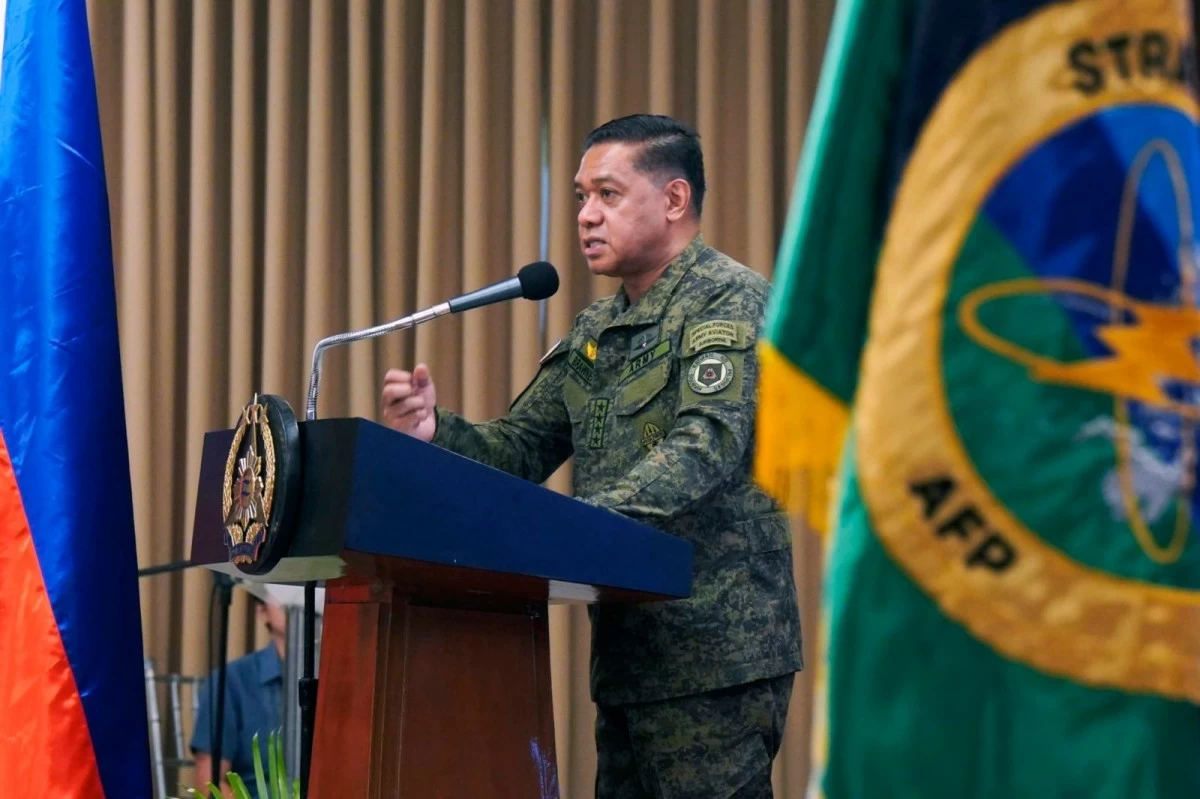
Armed Forces of the Philippines (AFP) Chief, General Romeo Brawner Jr. (Photo: AFP)
Armed Forces of the Philippines (AFP) Chief of Staff, General Romeo Brawner Jr. underscored the need for the military to be capable of defending the country on its own in the opening stages of any potential conflict even as the nation continues to modernize and strengthen defense cooperation with allies.
Speaking at the opening of the ninth iteration of the AFP’s Joint Exercise (AJEX) DAGIT-PA (Dagat, Langit, Lupa) at Camp Aguinaldo in Quezon City on Tuesday, Nov. 4, Brawner said President Marcos Jr. has directed the military to ensure it can “fight and preserve its forces for at least 20 to 30 days” before allied support arrives under various defense treaties and agreements, such as the Mutual Defense Treaty (MDT), which requires the Philippines and United States to help each other in case of a third party armed attack.
“We have to rely on ourselves first. Tayo muna ang lalaban (We’ll have to fight on our own). We must be able to weather the initial attack and hold the line until reinforcements arrive,” he said, although he did not specify which country the Philippines might find itself in conflict with in the future.
The annual exercise, which integrates land, air, and maritime operations through the Philippine Army (PA), Philippine Air Force (PAF), and Philippine Navy (PN), now includes new domains of warfare such as cyber, electromagnetic, information, cognitive, and even space operations.
For the first time, it will also involve the newly activated AFP Strategic Command as the main training audience instead of the General Headquarters (GHQ) Battle Staff. The Strategic Command will expose gaps in people, logistics, and systems so they can be fixed, he explained.
Brawner said the shift recognizes that the AFP GHQ cannot “transform overnight into a full-blown battle staff” during wartime, emphasizing the need for a dedicated command capable of managing large-scale operations.
The AFP chief also confirmed that part of this year’s AJEX DAGIT-PA will include simulated attacks at the Malampaya gas platform off Palawan, and drills near Pag-asa Island in the West Philippine Sea (WPS), where conflict with China continues to escalate due to the latter's aggressive actions such as dangerous maneuvers, deliberate ramming, use of water cannon, and others.
Brawner said the updated defense plan expands the country’s defensive posture beyond the mainland to its exclusive economic zone (EEZ) and outermost islands, in a move aligned with the military’s Comprehensive Archipelagic Defense Concept (CADC).
“We are now extending this to our EEZ and to the other features that we are occupying, specifically Pag-asa Island. That is the farthest island where Filipinos live, and we have to defend it,” he said.
He said the exercises will involve a “complete package” of maritime, air, and land components, though operational specifics remain confidential.
Drone, information warfare
Due to the evolving security landscape, Brawner warned that modern warfare is changing rapidly, citing lessons from the conflict in Ukraine. He said the AFP must adapt to drone warfare, where “being seen could mean being destroyed,” and focus on counter-drone capabilities.
“The future of warfare is in drones. Each infantryman may one day carry not just a rifle but also two drones, one for reconnaissance and one as a munition,” he said.
He added that the AJEX DAGIT-PA will also test the AFP’s new unilateral defense plan drafted by the J5 office, designed to ensure the Philippines can fight independently in the early stages of a conflict.
Strengthening inter-agency and reserve force roles
Meanwhile, Brawner commended the participation of the Philippine Coast Guard (PCG), Philippine National Police (PNP), and military reservists in this year’s drills, stressing that national defense “extends beyond those in uniform.”
He said the integration of reservists, particularly those skilled in drone operations, will strengthen the country’s overall defense readiness.
“Preparedness is our greatest peacekeeper, and unity is our strongest weapon. We will adapt, we will anticipate, and we will act decisively to defend our country and our people,” he noted.
AJEX DAGIT-PA 09-2025 will run for two weeks this November.

Related Tags

AJEX DAGIT-PA Romeo Brawner Jr. AFP West Philippine Sea
ADVERTISEMENT
.most-popular .layout-ratio{ padding-bottom: 79.13%; } @media (min-width: 768px) and (max-width: 1024px) { .widget-title { font-size: 15px !important; } }

{{ articles_filter_1561_widget.title }}

.most-popular .layout-ratio{ padding-bottom: 79.13%; } @media (min-width: 768px) and (max-width: 1024px) { .widget-title { font-size: 15px !important; } }

{{ articles_filter_1562_widget.title }}

.most-popular .layout-ratio{ padding-bottom: 79.13%; } @media (min-width: 768px) and (max-width: 1024px) { .widget-title { font-size: 15px !important; } }

{{ articles_filter_1563_widget.title }}

{{ articles_filter_1564_widget.title }}

.mb-article-details { position: relative; } .mb-article-details .article-body-preview, .mb-article-details .article-body-summary{ font-size: 17px; line-height: 30px; font-family: "Libre Caslon Text", serif; color: #000; } .mb-article-details .article-body-preview iframe , .mb-article-details .article-body-summary iframe{ width: 100%; margin: auto; } .read-more-background { background: linear-gradient(180deg, color(display-p3 1.000 1.000 1.000 / 0) 13.75%, color(display-p3 1.000 1.000 1.000 / 0.8) 30.79%, color(display-p3 1.000 1.000 1.000) 72.5%); position: absolute; height: 200px; width: 100%; bottom: 0; display: flex; justify-content: center; align-items: center; padding: 0; } .read-more-background a{ color: #000; } .read-more-btn { padding: 17px 45px; font-family: Inter; font-weight: 700; font-size: 18px; line-height: 16px; text-align: center; vertical-align: middle; border: 1px solid black; background-color: white; } .hidden { display: none; }
function initializeAllSwipers() { // Get all hidden inputs with cms_article_id document.querySelectorAll('[id^="cms_article_id_"]').forEach(function (input) { const cmsArticleId = input.value; const articleSelector = '#article-' + cmsArticleId + ' .body_images'; const swiperElement = document.querySelector(articleSelector); if (swiperElement && !swiperElement.classList.contains('swiper-initialized')) { new Swiper(articleSelector, { loop: true, pagination: false, navigation: { nextEl: '#article-' + cmsArticleId + ' .swiper-button-next', prevEl: '#article-' + cmsArticleId + ' .swiper-button-prev', }, }); } }); } setTimeout(initializeAllSwipers, 3000); const intersectionObserver = new IntersectionObserver( (entries) => { entries.forEach((entry) => { if (entry.isIntersecting) { const newUrl = entry.target.getAttribute("data-url"); if (newUrl) { history.pushState(null, null, newUrl); let article = entry.target; // Extract metadata const author = article.querySelector('.author-section').textContent.replace('By', '').trim(); const section = article.querySelector('.section-info ').textContent.replace(' ', ' '); const title = article.querySelector('.article-title h1').textContent; // Parse URL for Chartbeat path format const parsedUrl = new URL(newUrl, window.location.origin); const cleanUrl = parsedUrl.host + parsedUrl.pathname; // Update Chartbeat configuration if (typeof window._sf_async_config !== 'undefined') { window._sf_async_config.path = cleanUrl; window._sf_async_config.sections = section; window._sf_async_config.authors = author; } // Track virtual page view with Chartbeat if (typeof pSUPERFLY !== 'undefined' && typeof pSUPERFLY.virtualPage === 'function') { try { pSUPERFLY.virtualPage({ path: cleanUrl, title: title, sections: section, authors: author }); } catch (error) { console.error('ping error', error); } } // Optional: Update document title if (title && title !== document.title) { document.title = title; } } } }); }, { threshold: 0.1 } ); function showArticleBody(button) { const article = button.closest("article"); const summary = article.querySelector(".article-body-summary"); const body = article.querySelector(".article-body-preview"); const readMoreSection = article.querySelector(".read-more-background"); // Hide summary and read-more section summary.style.display = "none"; readMoreSection.style.display = "none"; // Show the full article body body.classList.remove("hidden"); } document.addEventListener("DOMContentLoaded", () => { let loadCount = 0; // Track how many times articles are loaded const offset = [1, 2, 3, 4, 5, 6, 7, 8, 9, 10]; // Offset values const currentUrl = window.location.pathname.substring(1); let isLoading = false; // Prevent multiple calls if (!currentUrl) { console.log("Current URL is invalid."); return; } const sentinel = document.getElementById("load-more-sentinel"); if (!sentinel) { console.log("Sentinel element not found."); return; } function isSentinelVisible() { const rect = sentinel.getBoundingClientRect(); return ( rect.top < window.innerHeight && rect.bottom >= 0 ); } function onScroll() { if (isLoading) return; if (isSentinelVisible()) { if (loadCount >= offset.length) { console.log("Maximum load attempts reached."); window.removeEventListener("scroll", onScroll); return; } isLoading = true; const currentOffset = offset[loadCount]; window.loadMoreItems().then(() => { let article = document.querySelector('#widget_1690 > div:nth-last-of-type(2) article'); intersectionObserver.observe(article) loadCount++; }).catch(error => { console.error("Error loading more items:", error); }).finally(() => { isLoading = false; }); } } window.addEventListener("scroll", onScroll); });

Sign up by email to receive news.