






Manila Bulletin
 Philippines
National
DND: Visiting forces deal with Canada reflects strategic push for peace, stability, resilience
Philippines
National
DND: Visiting forces deal with Canada reflects strategic push for peace, stability, resilience
Philippines
National
DND: Visiting forces deal with Canada reflects strategic push for peace, stability, resilience
DND: Visiting forces deal with Canada reflects strategic push for peace, stability, resilience
Published Nov 3, 2025 09:29 am


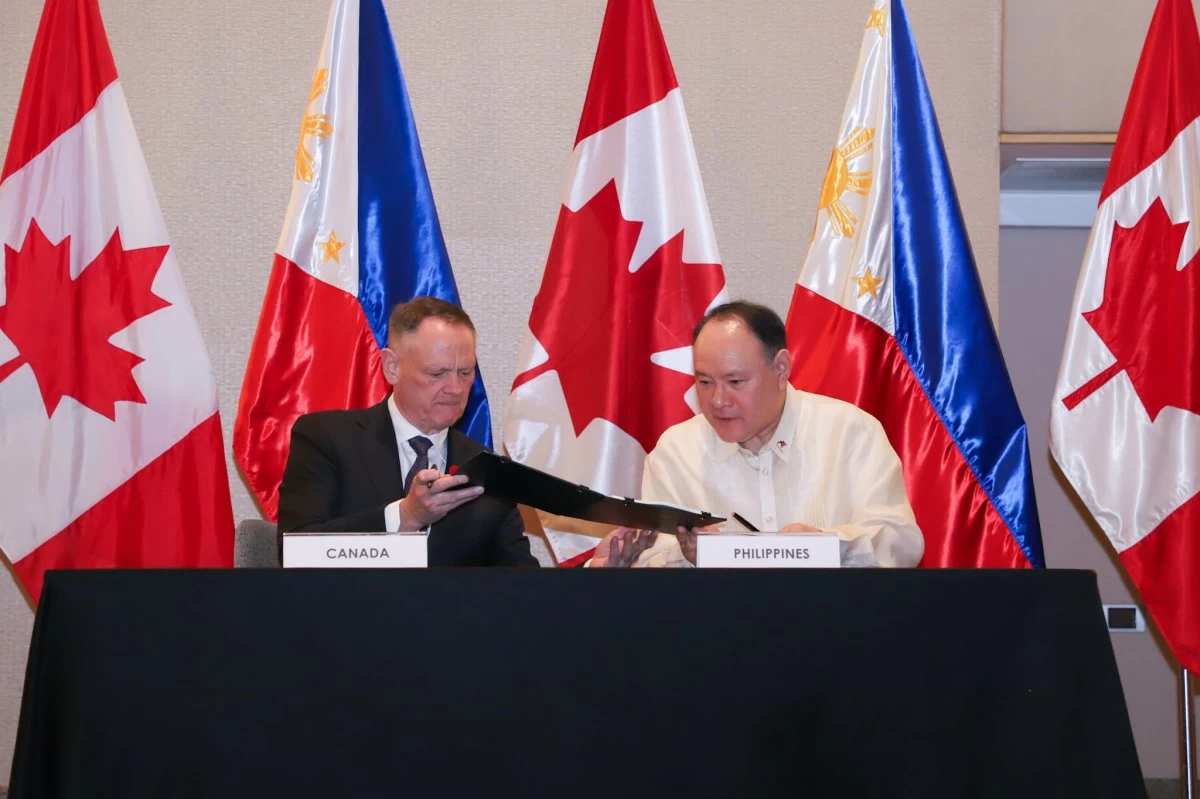
(L-R) Canadian Minister of National Defence David McGuinty and Department of National Defense (DND) Secretary Gilberto C. Teodoro Jr. sign a Status of Visiting Forces Agreement (SOVFA) in Makati City on Nov. 2, 2025 to deepen their security ties in pursuit of peace, stability, and national resilience. (Photo: DND)
The Department of National Defense (DND) signed a Status of Visiting Forces Agreement (SOVFA) with Canada on Sunday, Nov. 2, a landmark deal that underscored its strategic push to deepen security ties with like-minded nations in pursuit of peace, stability, and national resilience.
The SOVFA, signed by DND Secretary Gilberto C. Teodoro Jr. and Canadian Minister of National Defence David McGuinty in Makati City, establishes the legal framework for visiting forces from both countries during joint training and military exercises.
The agreement between Manila and Ottawa came amid increasing tension in the West Philippine Sea (WPS) due to China’s aggressive actions and expansionist claims.
The DND said that the Philippines is Canada’s first SOVFA partner in the Indo-Pacific region, “marking a significant milestone in the two nations’ growing defense partnership and shared commitment to promoting regional peace and stability.”
Teodoro emphasized that Manila’s deepening defense ties with Ottawa “reflect the country’s strategic approach to strengthening cooperation with like-minded nations in pursuit of peace, stability, and national resilience.”
“[The SOVFA] strengthens interoperability and logistics cooperation between the Armed Forces of the Philippines (AFP) and the Canadian Armed Forces (CAF), paving the way for deeper defense engagement and capacity-building efforts,” Teodoro said.
Teodoro and McGuinty held a bilateral meeting after the signing where they underscored their shared commitment to strengthening defense cooperation anchored on mutual respect, strategic trust, and support for a rules-based international order.
McGuinty, on his first official visit to Manila and the first for a Canadian defense minister, reaffirmed Canada’s readiness to work closely with the Philippines “through sustained dialogue and joint defense initiatives to uphold a secure and stable Indo-Pacific.”
Canada became the fifth country with a VFA deal with the Philippines. Others are the US, Australia, Japan, and New Zealand.
After the signing, the SOVFA will have to be ratified by President Marcos Jr. and ratified by the Senate. A similar domestic process will be followed by Canada for the treaty, before it takes effect.
‘Resisting China’s aggression’
The signing came a day after Teodoro met with his defense counterparts from Australia, Japan, and the United States in Kuala Lumpur, Malaysia where the four nations reaffirmed their shared vision for a free and open Indo-Pacific.
In a joint statement, Teodoro, Australian Deputy Prime Minister and Minister for Defence Richard Marles, Japanese Minister of Defense Koizumi Shinjiro, and US Secretary of War Pete Hegseth expressed concern over China’s actions in the East and South China Seas, and reiterated their opposition to any unilateral attempts to change the status quo by force or coercion.
They also backed the creation of an Indo-Pacific Chiefs of Defense Cooperation Council to enhance coordination and confirmed plans for all four nations to participate in the Balikatan Exercises 2026, to be hosted by the Philippines, as part of efforts to strengthen joint readiness and regional deterrence.
Teodoro said the signing of the SOVFA with Canada supports the establishment of "Task Force Philippines," recently announced by Hegseth, aimed at supporting the Philippines' deterrence efforts in the WPS.
"It is an operational arrangement between U.S. INDOPACOM and the Armed Forces of the Philippines as the Task Force to converge all our bilateral activities," Teodoro said.
"[The] Task Force has a specific mission and that mission role is to converge with our resilience both internally and externally. And it is, shall we say, an efficiency mechanism to funnel all the activities. So, we do not only converge in deterrence but we also converge because of the frequency of natural calamities that have beset us. This Task Force will put more regularity into an immediate and quick response to the natural calamities that we are facing," he added.