






Manila Bulletin
 Philippines
National
EcoWaste seeks law vs single-use plastics to curb 'Undas' waste problem
Philippines
National
EcoWaste seeks law vs single-use plastics to curb 'Undas' waste problem
Philippines
National
EcoWaste seeks law vs single-use plastics to curb 'Undas' waste problem
EcoWaste seeks law vs single-use plastics to curb 'Undas' waste problem
By Jel Santos
Published Nov 2, 2025 04:39 pm


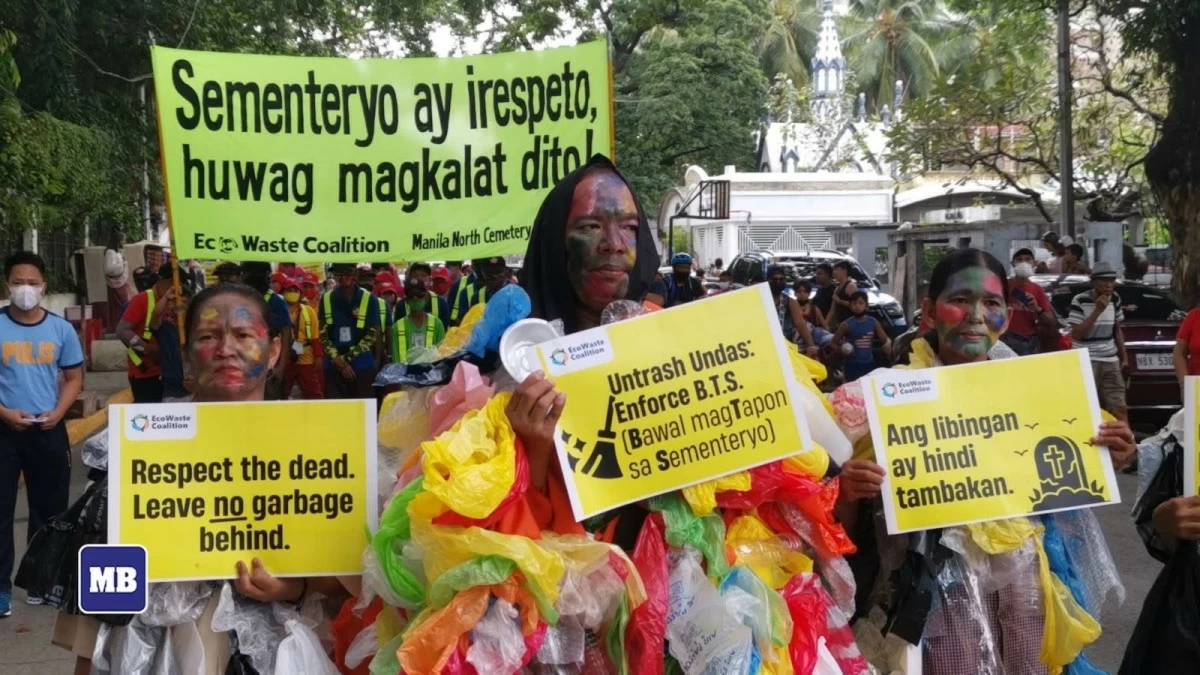
(MB FILE PHOTO)
Toxics watchdog EcoWaste Coalition has called on Congress to enact a nationwide ban on single-use plastics (SUPs), citing the large volume of plastic waste produced in cemeteries during “Undas.”
This call came after the group conducted a post-Undas monitoring from Oct. 31 to Nov. 2 in 25 cemeteries across Bataan, Bulacan, Pampanga, Cavite, Laguna, Rizal, and Metro Manila, including the Manila North and South Cemeteries.
EcoWaste said disposable plastics such as bags, bottles, cups, straws, and food containers were among the most littered items.
“We urge our lawmakers to prioritize the enactment of a law that will phase out and eventually ban the production and consumption of SUPs,” Ochie Tolentino, EcoWaste campaigner, said in a statement.
“This long-overdue pollution prevention legislation will surely help in reducing the volume, as well as toxicity, of what we throw every day and, most especially, during Undas and other popular cultural celebrations,” she added.
EcoWaste explained that single-use plastics, largely produced from fossil fuels, are intended for brief use but persist in the environment, where they are rarely recycled and cause widespread ecological harm, including to wildlife.
“Unknown to many, SUPs contribute to the interconnected planetary crisis of climate emergency, pervasive pollution and biodiversity loss,” said Tolentino.
The watchdog stressed that cleaner and more sustainable “Undas” can be achieved if single-use plastics are eliminated, local governments uphold plastic ban ordinances, and proper waste management systems compliant with RA 9003 are observed in cemeteries and memorial areas.
RA 9003, or the Ecological Solid Waste Management Act, seeks to protect public health and the environment through eco-friendly waste prevention and reduction practices, including source reduction, reusing, recycling, composting, and disposal.
Tolentino underscored that providing bags or bins for mixed waste disposal throughout the cemetery is not enough without proper waste segregation and management practices.
“In line with RA 9003, the different waste types should be properly separated to make their reuse and recycling easier, prevent cross-contamination, and cut the amount of residual waste going to the landfills,” she stated.