






Manila Bulletin
 Philippines
National
Too many interagency roles 'divert' DepEd's attention from basic education
Philippines
National
Too many interagency roles 'divert' DepEd's attention from basic education
Philippines
National
Too many interagency roles 'divert' DepEd's attention from basic education
Too many interagency roles 'divert' DepEd's attention from basic education
EDCOM 2 flags DepEd's participation in over 261 interagency bodies as a hindrance to education focus
Published Oct 30, 2025 08:48 pm



EDCOM 2 flags DepEd’s 261 interagency roles as a strain on its focus on basic education, teacher support, and funding reforms. (Manila Bulletin / File photo)
The Department of Education (DepEd) is currently involved in 261 interagency bodies, a number that Education Secretary Sonny Angara described as “coordination spread thin” during a recent hearing with the Second Congressional Commission on Education (EDCOM 2).
Angara said DepEd chairs at least 20 of these bodies, while 21 others are jointly handled with the Commission on Higher Education (CHED) and the Technical Education and Skills Development Authority (TESDA).
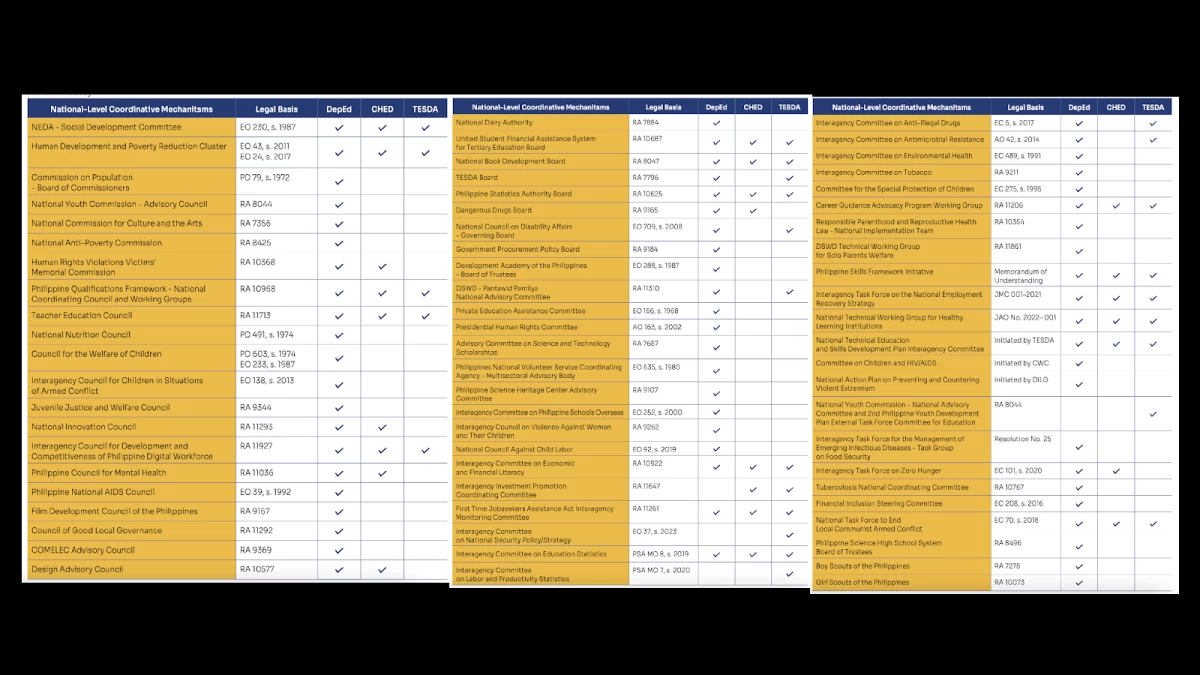
(Courtesy of EDCOM 2)
This figure marks a significant increase from the 63 interagency bodies initially reported in EDCOM 2’s Year One Report, “Miseducation: The Failed System of Philippine Education.”
DepEd’s expanding mandate limits focus on basic education
During the hearing on DepEd’s charter and mandates, EDCOM 2 emphasized that the 1994 trifocalization of the former Department of Education, Culture, and Sports (DECS)—into DepEd, CHED, and TESDA—was designed to allow DepEd to focus solely on basic education and improve students’ functional literacy.
However, despite this reform, the number of functionally illiterate Filipinos has nearly doubled over the past 30 years—from 14.5 million in the 1990s to 24.8 million today, based on the 2024 Functional Literacy, Education, and Mass Media Survey (FLEMMS).
While DepEd was meant to focus on basic education, EDCOM 2 noted that the agency continues to be burdened by overlapping mandates from more than 150 new laws and executive issuances passed since 2001.
Teachers overwhelmed by non-teaching tasks
EDCOM 2 Executive Director Karol Mark Yee emphasized that these added responsibilities extend beyond the central office to schools and teachers.
Teachers are now handling vision screening under RA 11358, fulfilling Pantawid Pamilyang Pilipino Program (4Ps) requirements under RA 11310, coordinating school feeding programs, managing canteens, leading Disaster Risk Reduction and Management (DRRM) initiatives, and implementing the National Drug Education Program (NDEP).
“We note also that these added responsibilities have impacted both the agency and schools, with teachers taking on additional roles—including the implementation of vision screening under RA 11358 and coordination of 4Ps requirements under RA 11310, among others,” Yee said in a statement released by EDCOM 2 on Thursday, October 30.
These non-teaching tasks consume valuable time that should be devoted to instruction, worsening the shortage of support staff and negatively impacting learning outcomes, EDCOM 2 noted in its report.
DepEd streamlines interagency work, plans to hire more support staff
To address the “coordination overload,” DepEd is streamlining participation in interagency councils by limiting involvement to “high-impact, mission-aligned” bodies under an Education Cluster in the Office of the President.
Angara said DepEd has also assigned members of its Executive Committee to represent the Department in key interagency groups to ensure more strategic engagement.
Another proposed measure is the hiring of Administrative Officers (AOs) to relieve teachers of clerical and coordination duties.
During the hearing, Angara remarked that DepEd aims to ensure that “every public school will have at least one admin officer” by 2026.
Unfunded education laws hamper implementation
DepEd also faces challenges implementing its numerous mandates due to unfunded or partially funded laws.
Since 1982, the Department’s mandates have expanded to cover curriculum, health and safety, culture, and civics, along with hundreds of laws establishing or converting schools.
Among the underfunded programs are the Academic Recovery and Accessible Learning (ARAL) Program under RA 12028, the Alternative Learning System (ALS) under RA 11510, and Mental Health and Well-Being Promotion under RA 12080.
Angara revealed that fully funding all education-related laws would require over P1 trillion.
“We tried to calculate and do a rough estimate—if we were to fully fund all the laws on education, it would cost over a trillion pesos,” Angara said. “So we’re trying to have a plan for that going forward,” he added.
EDCOM 2 Standing Committee member Fr. Lawrence Llona and Senator Loren Legarda echoed these concerns, citing the large funding gap for the ALS program.
Legarda noted that while the law mandates P30.5 billion for ALS implementation, only P78.4 million is currently allocated. She committed to champion increased funding for Indigenous Peoples’ Education (IPED) and ALS, urging DepEd to submit formal recommendations to the Senate Finance Committee.
EDCOM 2, established under Republic Act 11899, is mandated to assess the Philippine education system and recommend reforms and legislation to address the nation’s education crisis.