







Philippine exports hit record despite US tariffs
Published Oct 30, 2025 04:32 pm


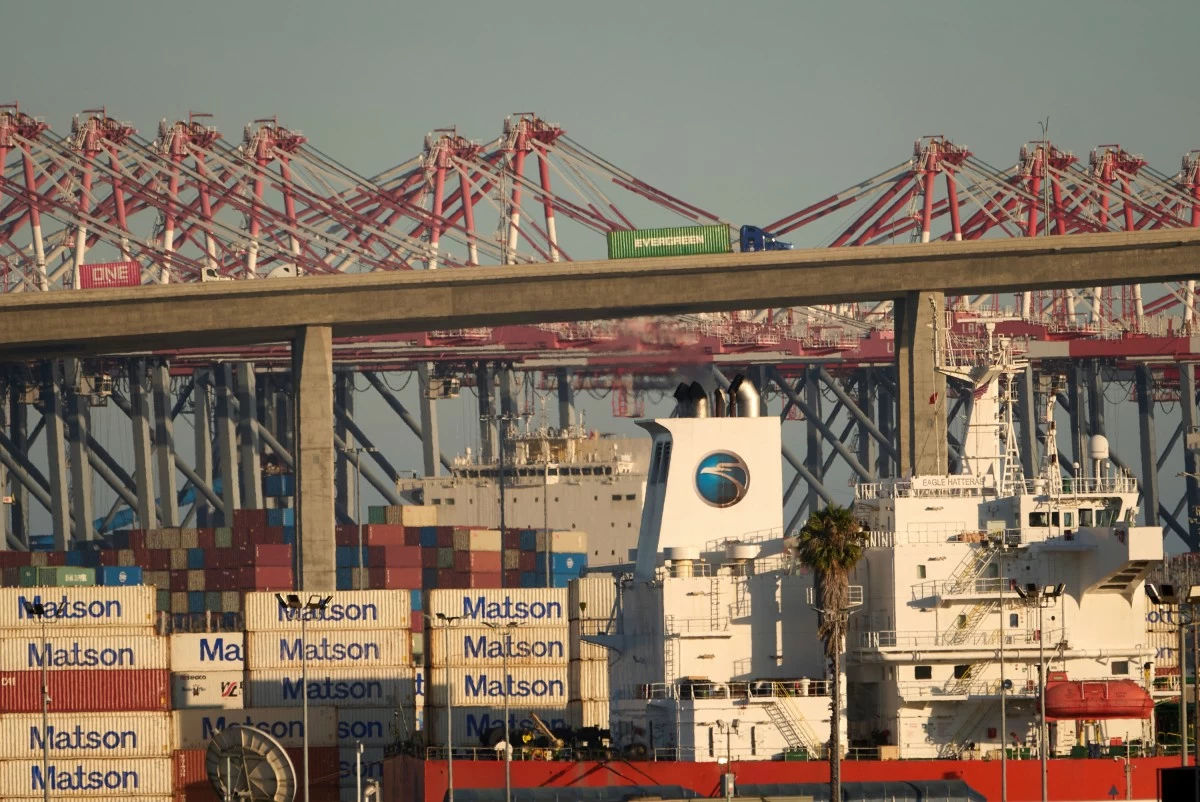
Shipping containers are stacked at the Matson terminal in the Port of Long Beach, Calif.,Thursday, July 31, 2025. (AP Photo/Damian Dovarganes)
Despite global trade uncertainties stemming from United States (US) tariffs, the Philippines’ goods exports during the first nine months of 2025 reached a record high, with the US remaining the top market.
The latest preliminary Philippine Statistics Authority (PSA) data on Thursday, Oct. 30, showed that the country’s merchandise exports at end-September totaled $63.02 billion, while imports reached $100.2 billion.
National Statistician Claire Dennis S. Mapa told Manila Bulletin that goods exports in the first nine months of the year reached the highest end-September level on record since 1991.
Mapa added that imports from January to September 2025 posted the highest nine-month value since 2022.
PSA data showed that the country’s merchandise exports in September reached $7.25 billion, marking a 15.9-percent increase from $6.26 billion in September 2024. This growth followed a 5.5-percent annual rise in August and contrasted with a 7.6-percent decline in September 2024.
PSA data revealed that the US was the Philippines’ top export market in September, with shipments valued at $1.11 billion, accounting for 15.3 percent of the country’s total exports that month.
Other leading September export destinations included Hong Kong ($1.1 billion, 15.1 percent of total), China ($959.19 million, 13.2 percent), Japan ($883.33 million, 12.2 percent), and the Netherlands ($325.78 million, 4.5 percent).
As for imports, PSA data showed that the Philippines’ total imports in September reached $11.6 billion, marking a 2.1-percent increase from $11.36 billion in September 2024. This followed a 0.3-percent annual decline in August and contrasted with a 10.1-percent rise in September 2024.
In terms of source countries, PSA data revealed that China remained the Philippines’ largest supplier of imports in September, with goods valued at $3.29 billion, accounting for 28.4 percent of total imports.
Other top import sources that month included South Korea ($1.06 billion, 9.1 percent of total), Japan ($935.07 million, 8.1 percent), Indonesia ($821.42 million, 7.1 percent), and the US ($728.88 million, 6.3 percent).
PSA data also showed that the Philippines’ total external trade in goods in September reached $18.86 billion, a seven-percent increase from $17.62 billion in the same month last year.
“Despite the tariffs, the US remains our top export market because American firms still demand high-value Philippine goods, especially electronics and services,” explained Jonathan Ravelas, senior adviser at Reyes Tacandong & Co.
“Tariffs have not stopped trade where quality and reliability matter,” he added.
Ravelas noted that China dominates Philippine imports because it supplies everything from raw materials to consumer goods at scale and at low cost, adding that the lesson is for the Philippines to diversify its markets and upgrade local industries to reduce dependency and strengthen resilience.
Robert Dan Roces, group economist at the Sy-led conglomerate SM Investments Corp. (SMIC), said that the US remains the Philippines’ top export market due to strong demand for high-value products, particularly semiconductors and electronics, which face low tariffs and are in demand within US tech supply chains.
Roces added that China continues to lead as the Philippines’ main source of imports, supplying most of the country’s intermediate goods, machinery, and consumer products at competitive prices and with the advantage of proximity.
“In short, the US buys our chips, while China sells us the parts to make them,” he said.
John Paolo Rivera, senior research fellow at state think tank Philippine Institute for Development Studies (PIDS), said that the Philippines maintains a strong electronics and semiconductors export base with minimal direct exposure to US tariffs, and US demand remains robust, allowing shipments to continue under existing contracts and supply chain obligations despite higher tariffs.
“China’s dominance as the Philippines’ largest source of imports is driven by its role as the critical upstream supplier of electronics components, intermediate goods, capital equipment, and raw materials,” Rivera said.
He added that the Philippines’ exports are largely directed to the US market, while imports come mainly from China, reflecting the country’s manufacturing supply-chain structure.
“The key risk now is if US tariffs rise further and cost pressures from Chinese imports increase, which could squeeze margins on both sides of the trade ledger,” Rivera added.
Meanwhile, Michael Ricafort, chief economist at Rizal Commercial Banking Corp. (RCBC), noted that the month-on-month decline in Philippine exports to the US over the past two months reflected the end of front-loading ahead of the 19-percent tariffs, which took effect on Aug. 7.
“Imports picked up in view of the seasonal increase in Philippine importation in the third quarter to prepare for the seasonal demand in the fourth quarter in the local and exports markets, especially during the Christmas holiday season,” Ricafort said.
According to Oxford Economics senior economist Sheana Yue, Asian goods export volumes reached a new peak in September.
In an Oct. 29 report, Oxford Economics said that this may reflect export price cuts, delays in US tariff implementation, and continued strong demand for electronics.
“This resilience is likely to ease, but risks are leaning toward [the] upside,” the think tank said.
“Admittedly, higher sectoral tariffs still cloud Asia’s export outlook. But carve-outs may ease the effective tariff burden. Furthermore, the web of supply chain linkages complicates US disentanglement from Asian exports, especially in electronics,” it added.
(Ricardo M. Austria)