ADVERTISEMENT

PH, EU renew push for human rights, due process in Brussels meet

Published Oct 30, 2025 09:20 am
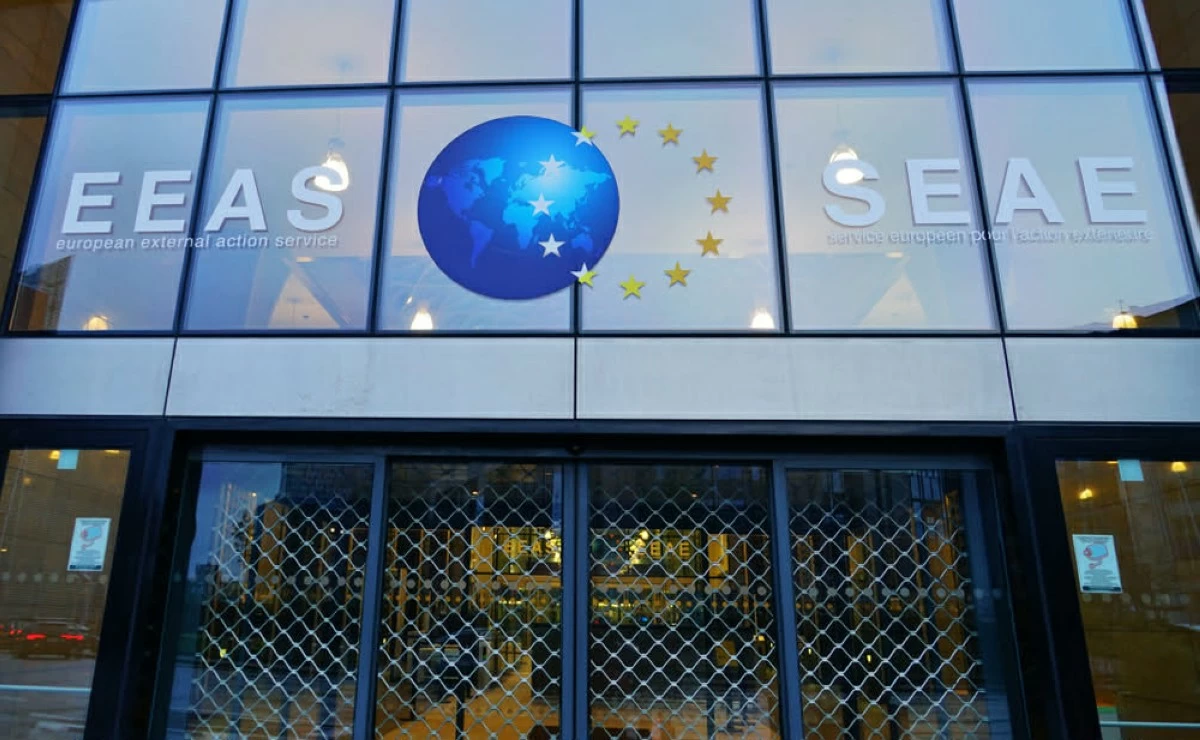
External view of the European Union’s diplomatic service building in Brussels, Belgium. (Shutterstock/EQRoy)
The Philippines and the European Union (EU) have reaffirmed their commitment to human rights, due process, and the rule of law, agreeing to work together to uphold and promote the principles of the United Nations (UN) Charter amid rising geopolitical tensions.
“The Philippines underscored its continued adherence to international human rights standards and its openness to constructive engagements with international bodies of the UN,” a statement from the EU said after the Fifth Subcommittee Meeting on Good Governance, Rule of Law, and Human Rights under the EU-Philippines Partnership and Cooperation Agreement (PCA).
With the Philippines’ chairship of the Association of Southeast Asian Nations (ASEAN) Summit next year, both parties restated their mutual commitments to strengthen cooperation between EU and the ASEAN Inter-Governmental Commission on Human Rights (AICHR).
The EU also showed its support for the Philippines 4th National Action Plan on Human Rights and the activities by the Committee on Human Rights Coordination (SCHRC) to sustain the gains from the United Nations Joint Programme for Human Rights (UNJP).
Both sides highlighted the importance of getting the Commission on Human Rights (CHR) and other non-government organizations and civil society groups involved in implementing the said action plan and the committee’s work.
“The EU and the Philippines underscored their strong condemnation of alleged extra-judicial killings and underscored the need to provide remedies for victims, fight impunity and hold perpetrators accountable,” the statement read.
In this regard, the Philippines also said it has made progress in the ongoing police and justice reforms, jail decongestion, and the establishment of an independent National Forensic Institute to make autopsies mandatory for cases involving death under suspicious circumstances.
“The EU and the Philippines committed to protect human rights defenders against violence, harassment, and red-tagging, and to provide an enabling environment for civil society,” the statement said.
“They agreed that anti-terrorism legislation should not be used to restrict legitimate activities of civil society, human rights defenders and journalists, and must ensure justice and protection for victims of terrorism,” it added.
The EU also recognized the decline of alleged cases of enforced disappearances in the Philippines, with the latter continuing to implement a rapid intervention mechanism with the training and deployment of prosecutors nationwide and acknowledging the regional bloc’s recommendation “to sign, ratify and implement even with reservations” the International Convention for the Protection of All Persons from Enforced Disappearances.
Both parties also recognized the importance of freedom of opinion and expression, media and information pluralism, and digital rights.
“The EU and the Philippines committed to taking steps to respect, protect and promote these rights, ensuring that media practitioners can operate in a safe and supportive environment,” the statement said, adding that the Philippines explained its efforts to review and adapt libel and cyber-libel laws.
“The EU and the Philippines deplored the killings of journalists,” it added, noting discussions on the reported deaths of Erwin "Boy Pana” Segovia, Juan “Johnny” Dayang, and Ali Macalintal.
Amid the country’s problem with illegal drugs, both sides affirmed that a human rights-based approach must be used to fight drug use.
“Both sides agreed on the need to regularly review the effectiveness of drug policies and ensure their alignment with international human rights standards,” the statement read.
“The Philippines shared information about work to adopt a policy on a public health and human rights based approach to addressing the drug issue.”
With their commitment to cooperating on ensuring human rights, EU and the Philippines underscored the role of international partners and civil society organizations in promoting good governance and rule of law, and sought their continued cooperative interventions.
The Subcommittee Meeting happened last Oct. 6 in Brussels, Belgium. It was co-chaired by Department of Foreign Affairs (DFA) Assistant Secretary for European Affairs of the Philippines Deena Joy Amatong and Acting Managing Director for Asia and the Pacific Paola Pampaloni of the European External Action Service (EEAS).
EU member-states and Philippine government agencies attended the meeting.

Related Tags

Human Rights European Union PH-EU UN Charter
ADVERTISEMENT
.most-popular .layout-ratio{ padding-bottom: 79.13%; } @media (min-width: 768px) and (max-width: 1024px) { .widget-title { font-size: 15px !important; } }

{{ articles_filter_1561_widget.title }}

.most-popular .layout-ratio{ padding-bottom: 79.13%; } @media (min-width: 768px) and (max-width: 1024px) { .widget-title { font-size: 15px !important; } }

{{ articles_filter_1562_widget.title }}

.most-popular .layout-ratio{ padding-bottom: 79.13%; } @media (min-width: 768px) and (max-width: 1024px) { .widget-title { font-size: 15px !important; } }

{{ articles_filter_1563_widget.title }}

{{ articles_filter_1564_widget.title }}

.mb-article-details { position: relative; } .mb-article-details .article-body-preview, .mb-article-details .article-body-summary{ font-size: 17px; line-height: 30px; font-family: "Libre Caslon Text", serif; color: #000; } .mb-article-details .article-body-preview iframe , .mb-article-details .article-body-summary iframe{ width: 100%; margin: auto; } .read-more-background { background: linear-gradient(180deg, color(display-p3 1.000 1.000 1.000 / 0) 13.75%, color(display-p3 1.000 1.000 1.000 / 0.8) 30.79%, color(display-p3 1.000 1.000 1.000) 72.5%); position: absolute; height: 200px; width: 100%; bottom: 0; display: flex; justify-content: center; align-items: center; padding: 0; } .read-more-background a{ color: #000; } .read-more-btn { padding: 17px 45px; font-family: Inter; font-weight: 700; font-size: 18px; line-height: 16px; text-align: center; vertical-align: middle; border: 1px solid black; background-color: white; } .hidden { display: none; }
function initializeAllSwipers() { // Get all hidden inputs with cms_article_id document.querySelectorAll('[id^="cms_article_id_"]').forEach(function (input) { const cmsArticleId = input.value; const articleSelector = '#article-' + cmsArticleId + ' .body_images'; const swiperElement = document.querySelector(articleSelector); if (swiperElement && !swiperElement.classList.contains('swiper-initialized')) { new Swiper(articleSelector, { loop: true, pagination: false, navigation: { nextEl: '#article-' + cmsArticleId + ' .swiper-button-next', prevEl: '#article-' + cmsArticleId + ' .swiper-button-prev', }, }); } }); } setTimeout(initializeAllSwipers, 3000); const intersectionObserver = new IntersectionObserver( (entries) => { entries.forEach((entry) => { if (entry.isIntersecting) { const newUrl = entry.target.getAttribute("data-url"); if (newUrl) { history.pushState(null, null, newUrl); let article = entry.target; // Extract metadata const author = article.querySelector('.author-section').textContent.replace('By', '').trim(); const section = article.querySelector('.section-info ').textContent.replace(' ', ' '); const title = article.querySelector('.article-title h1').textContent; // Parse URL for Chartbeat path format const parsedUrl = new URL(newUrl, window.location.origin); const cleanUrl = parsedUrl.host + parsedUrl.pathname; // Update Chartbeat configuration if (typeof window._sf_async_config !== 'undefined') { window._sf_async_config.path = cleanUrl; window._sf_async_config.sections = section; window._sf_async_config.authors = author; } // Track virtual page view with Chartbeat if (typeof pSUPERFLY !== 'undefined' && typeof pSUPERFLY.virtualPage === 'function') { try { pSUPERFLY.virtualPage({ path: cleanUrl, title: title, sections: section, authors: author }); } catch (error) { console.error('ping error', error); } } // Optional: Update document title if (title && title !== document.title) { document.title = title; } } } }); }, { threshold: 0.1 } ); function showArticleBody(button) { const article = button.closest("article"); const summary = article.querySelector(".article-body-summary"); const body = article.querySelector(".article-body-preview"); const readMoreSection = article.querySelector(".read-more-background"); // Hide summary and read-more section summary.style.display = "none"; readMoreSection.style.display = "none"; // Show the full article body body.classList.remove("hidden"); } document.addEventListener("DOMContentLoaded", () => { let loadCount = 0; // Track how many times articles are loaded const offset = [1, 2, 3, 4, 5, 6, 7, 8, 9, 10]; // Offset values const currentUrl = window.location.pathname.substring(1); let isLoading = false; // Prevent multiple calls if (!currentUrl) { console.log("Current URL is invalid."); return; } const sentinel = document.getElementById("load-more-sentinel"); if (!sentinel) { console.log("Sentinel element not found."); return; } function isSentinelVisible() { const rect = sentinel.getBoundingClientRect(); return ( rect.top < window.innerHeight && rect.bottom >= 0 ); } function onScroll() { if (isLoading) return; if (isSentinelVisible()) { if (loadCount >= offset.length) { console.log("Maximum load attempts reached."); window.removeEventListener("scroll", onScroll); return; } isLoading = true; const currentOffset = offset[loadCount]; window.loadMoreItems().then(() => { let article = document.querySelector('#widget_1690 > div:nth-last-of-type(2) article'); intersectionObserver.observe(article) loadCount++; }).catch(error => { console.error("Error loading more items:", error); }).finally(() => { isLoading = false; }); } } window.addEventListener("scroll", onScroll); });

Sign up by email to receive news.