ADVERTISEMENT

DepEd urged to review policy on school division offices amid 'inequitable' distribution

EDCOM 2 cites the need to amend Republic Act 9155 to address disparities in school divisions nationwide

Published Oct 29, 2025 02:45 pm
EDCOM 2 called on the Department of Education (DepEd) to amend Republic Act 9155 to address disparities in school division offices and ensure equitable support for teachers and students nationwide. (Manila Bulletin / file photo)
To ensure a more equitable distribution of school division offices (SDOs) across the country, the Department of Education (DepEd) has been urged to review—and possibly amend—Republic Act No. 9155, or the Governance of Basic Education Act of 2001.
In a hearing on DepEd’s mandates and charter earlier this week, the Second Congressional Commission on Education (EDCOM 2) revealed significant disparities in the number of schools and students supervised by each division.
These disparities, the Commission said in a statement issued on Wednesday, October 29, have led to unequal access to resources, personnel, and support systems nationwide.
Uneven workload across school divisions
According to EDCOM 2’s findings, the more than 200 SDOs under DepEd vary widely in the number of schools they manage—even among those classified under the same size category.
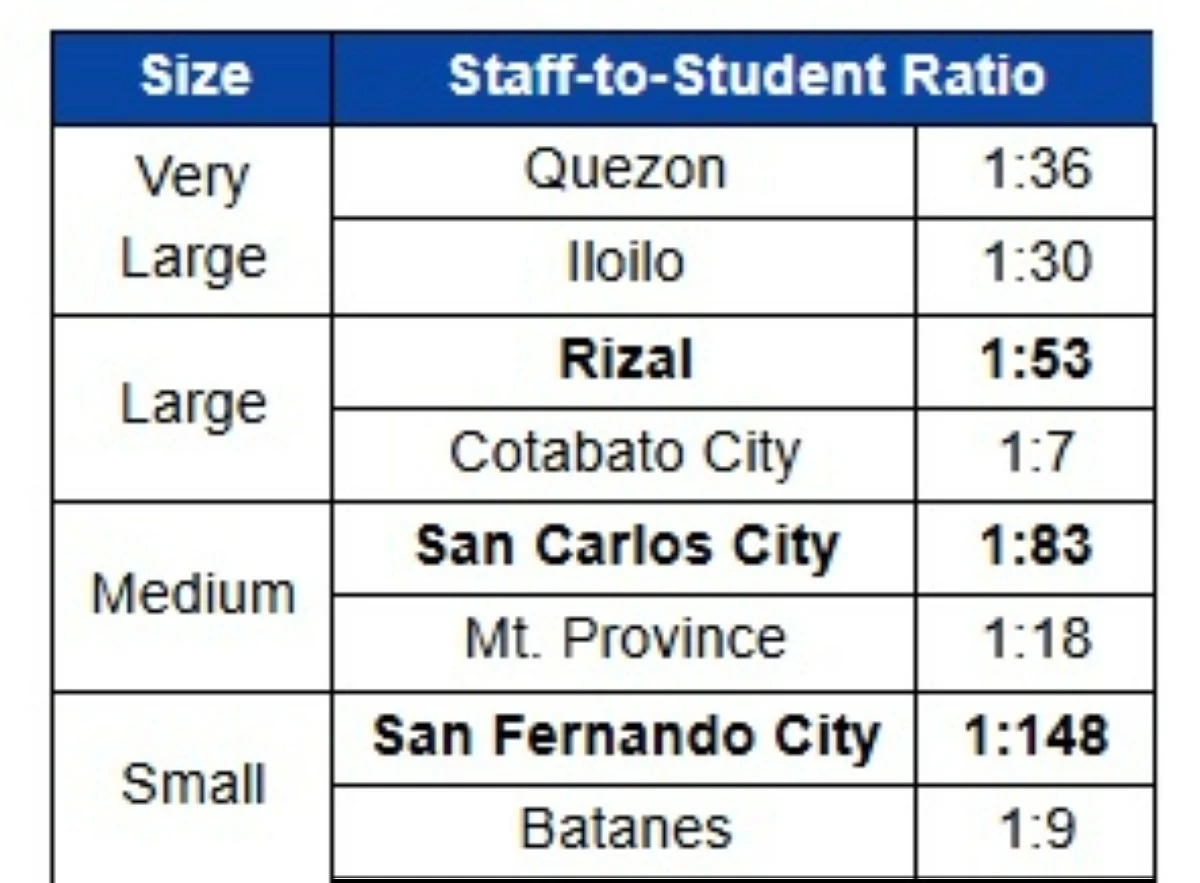
EDCOM 2 highlights disparity in critical personnel to support the schools, teachers and students. (EDCOM 2)
For instance, the Division of Leyte supervises 1,363 schools, while Caloocan City—also categorized as a large division—oversees only 319 schools. Similarly, Cebu, the country’s largest division, manages 1,346 schools, compared to Batanes, which has only 28.
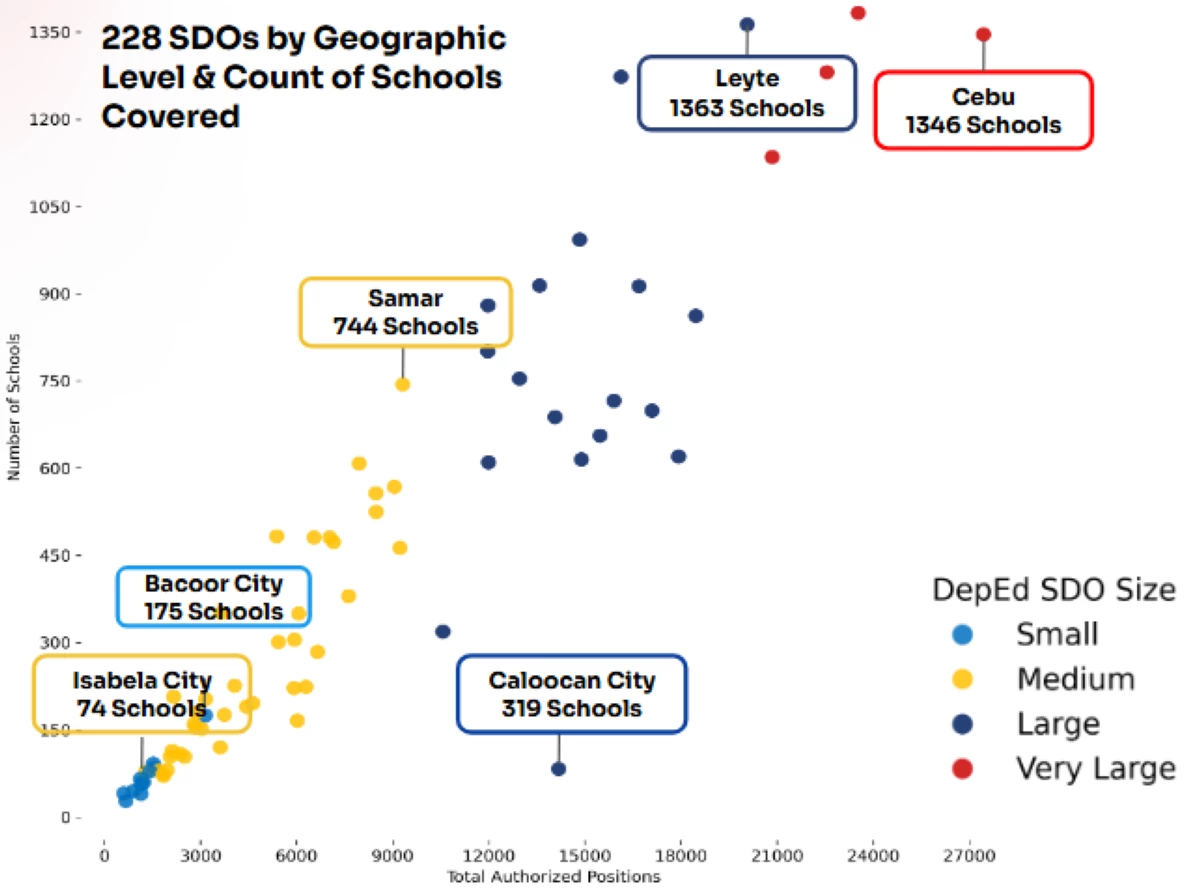
(Courtesy of EDCOM 2)
EDCOM 2 also found major differences in staff-to-student ratios among divisions. These disparities, the Commission noted, reflect inequities in critical support for teachers and students across regions.
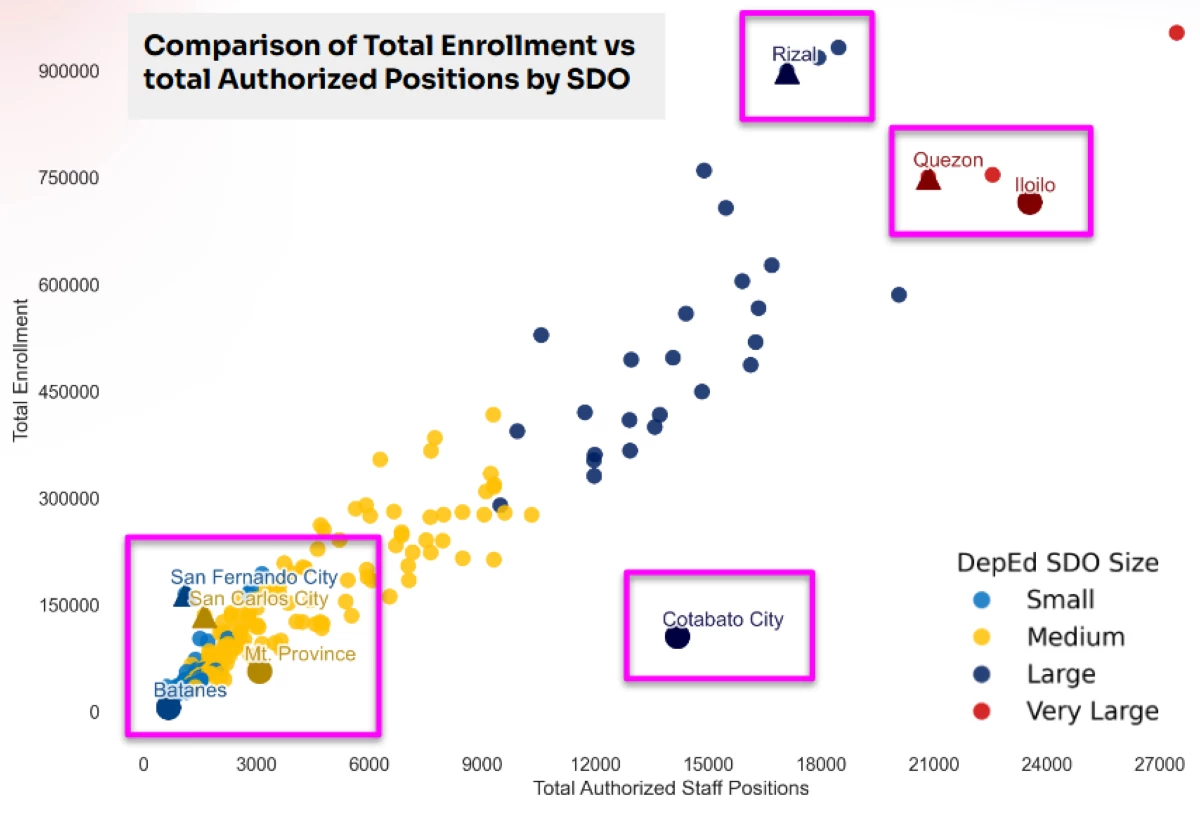
(Courtesy of EDCOM 2)
Legal limitations under RA 9155
DepEd Undersecretary for Legal and Legislative Affairs Filemon Javier explained that the law’s provision—stating that “a division shall consist of a province or a city”—effectively restricts the Department from creating new divisions within the same province or city, even when student populations or the number of schools have significantly increased.
This limitation, Javier said, has made it difficult for DepEd to address administrative overloads and ensure fair allocation of personnel.
“Because the provision explicitly says that a division shall consist of a province or a city, it implies that there’s only one division in a province or a city,” Javier explained, suggesting that amending the law to allow multiple divisions “within” provinces or cities would give DepEd more flexibility to improve management and supervision.
Lawmakers push for amendments
EDCOM 2 Co-Chairperson Rep. Roman Romulo urged DepEd to submit its recommendations on how to amend RA 9155, including proposed staffing ratios and budgetary requirements.
“Do you need a law to create a new school division, or can DepEd do that on its own? What is the ideal ratio, and what steps are being taken to address this?” Romulo asked during the hearing.
DepEd Secretary Sonny Angara agreed that the current structure needs to be reviewed. “I think the opinion is that 1,300 schools is too much for one official to oversee—that’s the crux of it,” he said.
EDCOM 2 Co-Chair Senator Loren Legarda emphasized the need to coordinate with the Department of Budget and Management (DBM) before proposing new divisions. “Along with the recommendation for the proposed measure, let’s also determine how many plantilla positions and the corresponding budget are needed,” she added.
Towards a more responsive education governance
RA 9155 was enacted in 2001 following the recommendations of the first EDCOM to decentralize DepEd’s functions and empower local divisions and schools.
However, EDCOM 2 noted that the evolving education landscape—marked by population growth and the expansion of the K–12 system—requires revisiting this framework.
Established under RA 11899, EDCOM 2 is mandated to conduct a comprehensive assessment of the Philippine education system and recommend reforms to address the ongoing education crisis. 

Related Tags

DepEd EDCOM 2 school division offices Republic Act 9155 education reform Philippines Sonny Angara governance of basic education
ADVERTISEMENT
.most-popular .layout-ratio{ padding-bottom: 79.13%; } @media (min-width: 768px) and (max-width: 1024px) { .widget-title { font-size: 15px !important; } }

{{ articles_filter_1561_widget.title }}

.most-popular .layout-ratio{ padding-bottom: 79.13%; } @media (min-width: 768px) and (max-width: 1024px) { .widget-title { font-size: 15px !important; } }

{{ articles_filter_1562_widget.title }}

.most-popular .layout-ratio{ padding-bottom: 79.13%; } @media (min-width: 768px) and (max-width: 1024px) { .widget-title { font-size: 15px !important; } }

{{ articles_filter_1563_widget.title }}

{{ articles_filter_1564_widget.title }}

.mb-article-details { position: relative; } .mb-article-details .article-body-preview, .mb-article-details .article-body-summary{ font-size: 17px; line-height: 30px; font-family: "Libre Caslon Text", serif; color: #000; } .mb-article-details .article-body-preview iframe , .mb-article-details .article-body-summary iframe{ width: 100%; margin: auto; } .read-more-background { background: linear-gradient(180deg, color(display-p3 1.000 1.000 1.000 / 0) 13.75%, color(display-p3 1.000 1.000 1.000 / 0.8) 30.79%, color(display-p3 1.000 1.000 1.000) 72.5%); position: absolute; height: 200px; width: 100%; bottom: 0; display: flex; justify-content: center; align-items: center; padding: 0; } .read-more-background a{ color: #000; } .read-more-btn { padding: 17px 45px; font-family: Inter; font-weight: 700; font-size: 18px; line-height: 16px; text-align: center; vertical-align: middle; border: 1px solid black; background-color: white; } .hidden { display: none; }
function initializeAllSwipers() { // Get all hidden inputs with cms_article_id document.querySelectorAll('[id^="cms_article_id_"]').forEach(function (input) { const cmsArticleId = input.value; const articleSelector = '#article-' + cmsArticleId + ' .body_images'; const swiperElement = document.querySelector(articleSelector); if (swiperElement && !swiperElement.classList.contains('swiper-initialized')) { new Swiper(articleSelector, { loop: true, pagination: false, navigation: { nextEl: '#article-' + cmsArticleId + ' .swiper-button-next', prevEl: '#article-' + cmsArticleId + ' .swiper-button-prev', }, }); } }); } setTimeout(initializeAllSwipers, 3000); const intersectionObserver = new IntersectionObserver( (entries) => { entries.forEach((entry) => { if (entry.isIntersecting) { const newUrl = entry.target.getAttribute("data-url"); if (newUrl) { history.pushState(null, null, newUrl); let article = entry.target; // Extract metadata const author = article.querySelector('.author-section').textContent.replace('By', '').trim(); const section = article.querySelector('.section-info ').textContent.replace(' ', ' '); const title = article.querySelector('.article-title h1').textContent; // Parse URL for Chartbeat path format const parsedUrl = new URL(newUrl, window.location.origin); const cleanUrl = parsedUrl.host + parsedUrl.pathname; // Update Chartbeat configuration if (typeof window._sf_async_config !== 'undefined') { window._sf_async_config.path = cleanUrl; window._sf_async_config.sections = section; window._sf_async_config.authors = author; } // Track virtual page view with Chartbeat if (typeof pSUPERFLY !== 'undefined' && typeof pSUPERFLY.virtualPage === 'function') { try { pSUPERFLY.virtualPage({ path: cleanUrl, title: title, sections: section, authors: author }); } catch (error) { console.error('ping error', error); } } // Optional: Update document title if (title && title !== document.title) { document.title = title; } } } }); }, { threshold: 0.1 } ); function showArticleBody(button) { const article = button.closest("article"); const summary = article.querySelector(".article-body-summary"); const body = article.querySelector(".article-body-preview"); const readMoreSection = article.querySelector(".read-more-background"); // Hide summary and read-more section summary.style.display = "none"; readMoreSection.style.display = "none"; // Show the full article body body.classList.remove("hidden"); } document.addEventListener("DOMContentLoaded", () => { let loadCount = 0; // Track how many times articles are loaded const offset = [1, 2, 3, 4, 5, 6, 7, 8, 9, 10]; // Offset values const currentUrl = window.location.pathname.substring(1); let isLoading = false; // Prevent multiple calls if (!currentUrl) { console.log("Current URL is invalid."); return; } const sentinel = document.getElementById("load-more-sentinel"); if (!sentinel) { console.log("Sentinel element not found."); return; } function isSentinelVisible() { const rect = sentinel.getBoundingClientRect(); return ( rect.top < window.innerHeight && rect.bottom >= 0 ); } function onScroll() { if (isLoading) return; if (isSentinelVisible()) { if (loadCount >= offset.length) { console.log("Maximum load attempts reached."); window.removeEventListener("scroll", onScroll); return; } isLoading = true; const currentOffset = offset[loadCount]; window.loadMoreItems().then(() => { let article = document.querySelector('#widget_1690 > div:nth-last-of-type(2) article'); intersectionObserver.observe(article) loadCount++; }).catch(error => { console.error("Error loading more items:", error); }).finally(() => { isLoading = false; }); } } window.addEventListener("scroll", onScroll); });

Sign up by email to receive news.