ADVERTISEMENT

Marcos on calling out establishment of 'nature reserve' in Bajo de Masinloc: I just laid out facts

Published Oct 28, 2025 08:50 pm
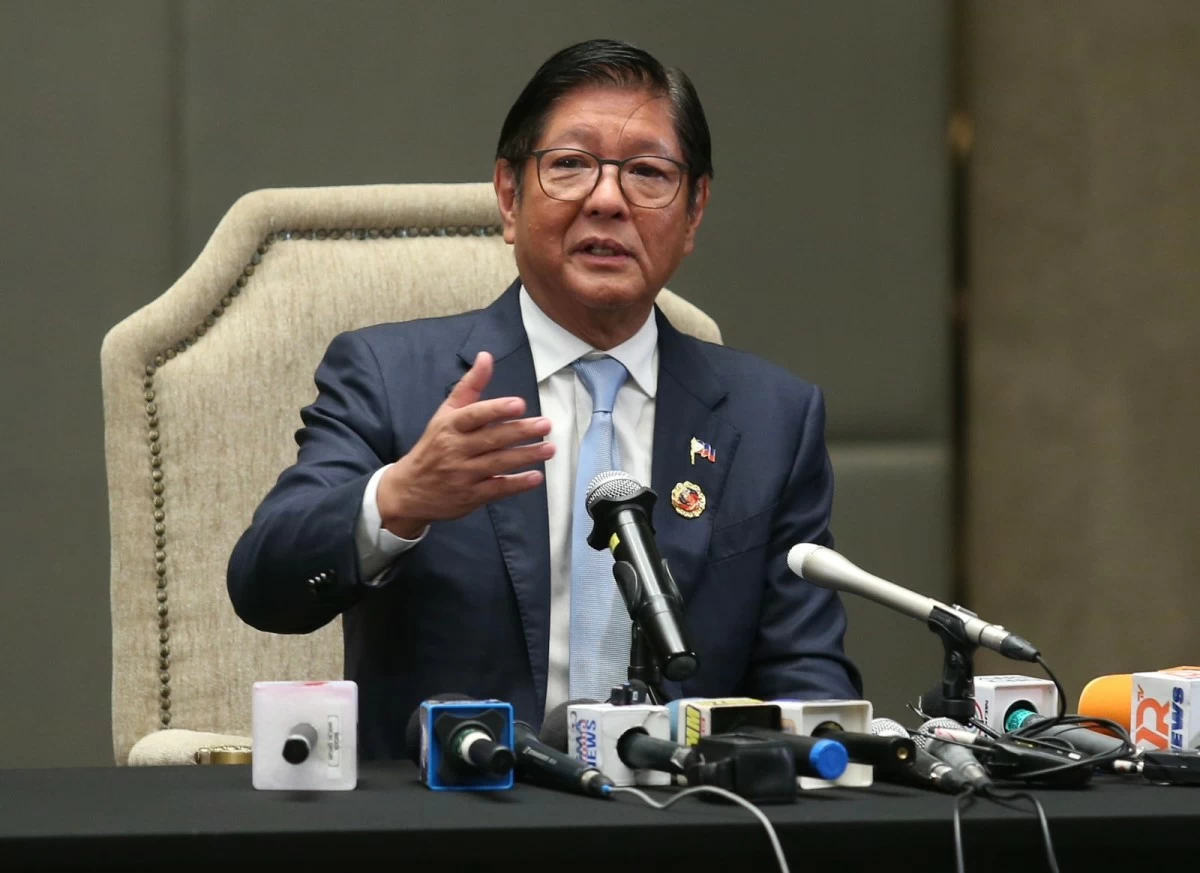
President Ferdinand R. Marcos Jr. holds a post-ASEAN Summit press briefing in Kuala Lumpur, Malaysia on Oct. 28, 2025. (Mark Balmores)
KUALA LUMPUR, Malaysia—President Marcos said repeatedly lamenting the establishment of a nature reserve in Bajo de Masinloc was not intended as a strong statement.
Marcos said he was only stating facts during his interventions in several engagements—one of them was with China— during the Association of Southeast Asian Nations (ASEAN) Summit.
In an ASEAN Summit-post press briefing on Tuesday night, Oct. 28, the President explained that he mentioned China's nature reserve project in the country's waters with an intention to inform the regional bloc and its partners of the country's situation.
"I would disagree. I did not make a strong statement," Marcos said.
"I just laid out the facts. And that is what we do. We – I try always to just explain to everyone what is happening and that this is the situation in the Philippines. Never mind anyone else. This is the situation the Philippines finds itself in," Marcos added.
He said it was also his way of asking for their help.
"Ito yung nangyayari sa amin. Kaya sana matulungan ninyo kami (This is what's happening to us. So we hope you can help us)," Marcos said.
The President disclosed that Chinese Premier Li Qiang stated during the summit that the nature reserve was within their local law and international law, to which Marcos disputed.
"Well, the Premier just – during his time to speak, just said that this is – as far as China is concerned, is within their local law and international law. Of course, we dispute that, but that's essentially how that diplomatic process works," he said.

We continue to find ways

The Chief Executive further bared that after speaking about the nature reserve in Bajo de Masinloc, which he said makes the situation in the South China Sea "even more complicated," he also spoke about the possibilities and possible ways to resolve such issues.
"And I continue to find ways to redefine our relationship with China. I really believe that the way forward is to change. Because when you talk about China and the Philippines, all you talk about are the territorial disputes. Well, anybody, I'm not saying the media, everybody that think – the territorial disputes," he said.
"And I think, you know there is a huge possibility for trade, for exchanges, for all kinds of discussions and engagements between China and I that do not include these territorial disputes," he added.
He further said that would be something he will try to achieve during his ASEAN chairship.
Marcos also said he agrees with what Malaysian Prime Minister Anwar Ibrahim said that all other issues, including the South China Sea, should be resolved within the ASEAN and with its ASEAN partners in the region, considering that outside interference could just make things more tense.
"I fully agree with Prime Minister Anwar. The lead agency should be ASEAN," Marcos said.
"Now, of course, it is a bilateral issue between the Philippines and the People's Republic. But still, that does not preclude the involvement of ASEAN. And considering that ASEAN has as its members many, many countries that are involved in trade with China that are politically aligned even with China… So, that makes it a stronger base because you're not just depending on a single ideology or argument or principle," Marcos said.
"And we can hear from all the other countries. And that makes it different. That makes it stronger. And that makes it more likely for us to be able to find a way forward so that we can hopefully resolve the issues," he added.
READ MORE: Marcos: Cooperation cannot exist alongside coercion

Related Tags

President Marcos ASEAN Summit Bajo de Masinloc nature reserve
ADVERTISEMENT
.most-popular .layout-ratio{ padding-bottom: 79.13%; } @media (min-width: 768px) and (max-width: 1024px) { .widget-title { font-size: 15px !important; } }

{{ articles_filter_1561_widget.title }}

.most-popular .layout-ratio{ padding-bottom: 79.13%; } @media (min-width: 768px) and (max-width: 1024px) { .widget-title { font-size: 15px !important; } }

{{ articles_filter_1562_widget.title }}

.most-popular .layout-ratio{ padding-bottom: 79.13%; } @media (min-width: 768px) and (max-width: 1024px) { .widget-title { font-size: 15px !important; } }

{{ articles_filter_1563_widget.title }}

{{ articles_filter_1564_widget.title }}

.mb-article-details { position: relative; } .mb-article-details .article-body-preview, .mb-article-details .article-body-summary{ font-size: 17px; line-height: 30px; font-family: "Libre Caslon Text", serif; color: #000; } .mb-article-details .article-body-preview iframe , .mb-article-details .article-body-summary iframe{ width: 100%; margin: auto; } .read-more-background { background: linear-gradient(180deg, color(display-p3 1.000 1.000 1.000 / 0) 13.75%, color(display-p3 1.000 1.000 1.000 / 0.8) 30.79%, color(display-p3 1.000 1.000 1.000) 72.5%); position: absolute; height: 200px; width: 100%; bottom: 0; display: flex; justify-content: center; align-items: center; padding: 0; } .read-more-background a{ color: #000; } .read-more-btn { padding: 17px 45px; font-family: Inter; font-weight: 700; font-size: 18px; line-height: 16px; text-align: center; vertical-align: middle; border: 1px solid black; background-color: white; } .hidden { display: none; }
function initializeAllSwipers() { // Get all hidden inputs with cms_article_id document.querySelectorAll('[id^="cms_article_id_"]').forEach(function (input) { const cmsArticleId = input.value; const articleSelector = '#article-' + cmsArticleId + ' .body_images'; const swiperElement = document.querySelector(articleSelector); if (swiperElement && !swiperElement.classList.contains('swiper-initialized')) { new Swiper(articleSelector, { loop: true, pagination: false, navigation: { nextEl: '#article-' + cmsArticleId + ' .swiper-button-next', prevEl: '#article-' + cmsArticleId + ' .swiper-button-prev', }, }); } }); } setTimeout(initializeAllSwipers, 3000); const intersectionObserver = new IntersectionObserver( (entries) => { entries.forEach((entry) => { if (entry.isIntersecting) { const newUrl = entry.target.getAttribute("data-url"); if (newUrl) { history.pushState(null, null, newUrl); let article = entry.target; // Extract metadata const author = article.querySelector('.author-section').textContent.replace('By', '').trim(); const section = article.querySelector('.section-info ').textContent.replace(' ', ' '); const title = article.querySelector('.article-title h1').textContent; // Parse URL for Chartbeat path format const parsedUrl = new URL(newUrl, window.location.origin); const cleanUrl = parsedUrl.host + parsedUrl.pathname; // Update Chartbeat configuration if (typeof window._sf_async_config !== 'undefined') { window._sf_async_config.path = cleanUrl; window._sf_async_config.sections = section; window._sf_async_config.authors = author; } // Track virtual page view with Chartbeat if (typeof pSUPERFLY !== 'undefined' && typeof pSUPERFLY.virtualPage === 'function') { try { pSUPERFLY.virtualPage({ path: cleanUrl, title: title, sections: section, authors: author }); } catch (error) { console.error('ping error', error); } } // Optional: Update document title if (title && title !== document.title) { document.title = title; } } } }); }, { threshold: 0.1 } ); function showArticleBody(button) { const article = button.closest("article"); const summary = article.querySelector(".article-body-summary"); const body = article.querySelector(".article-body-preview"); const readMoreSection = article.querySelector(".read-more-background"); // Hide summary and read-more section summary.style.display = "none"; readMoreSection.style.display = "none"; // Show the full article body body.classList.remove("hidden"); } document.addEventListener("DOMContentLoaded", () => { let loadCount = 0; // Track how many times articles are loaded const offset = [1, 2, 3, 4, 5, 6, 7, 8, 9, 10]; // Offset values const currentUrl = window.location.pathname.substring(1); let isLoading = false; // Prevent multiple calls if (!currentUrl) { console.log("Current URL is invalid."); return; } const sentinel = document.getElementById("load-more-sentinel"); if (!sentinel) { console.log("Sentinel element not found."); return; } function isSentinelVisible() { const rect = sentinel.getBoundingClientRect(); return ( rect.top < window.innerHeight && rect.bottom >= 0 ); } function onScroll() { if (isLoading) return; if (isSentinelVisible()) { if (loadCount >= offset.length) { console.log("Maximum load attempts reached."); window.removeEventListener("scroll", onScroll); return; } isLoading = true; const currentOffset = offset[loadCount]; window.loadMoreItems().then(() => { let article = document.querySelector('#widget_1690 > div:nth-last-of-type(2) article'); intersectionObserver.observe(article) loadCount++; }).catch(error => { console.error("Error loading more items:", error); }).finally(() => { isLoading = false; }); } } window.addEventListener("scroll", onScroll); });

Sign up by email to receive news.