






Manila Bulletin
 Philippines
National
Taal Volcano still under Alert Level 1 after weekend minor eruptions – Phivolcs
Philippines
National
Taal Volcano still under Alert Level 1 after weekend minor eruptions – Phivolcs
Philippines
National
Taal Volcano still under Alert Level 1 after weekend minor eruptions – Phivolcs
Taal Volcano still under Alert Level 1 after weekend minor eruptions – Phivolcs
Published Oct 27, 2025 11:18 am


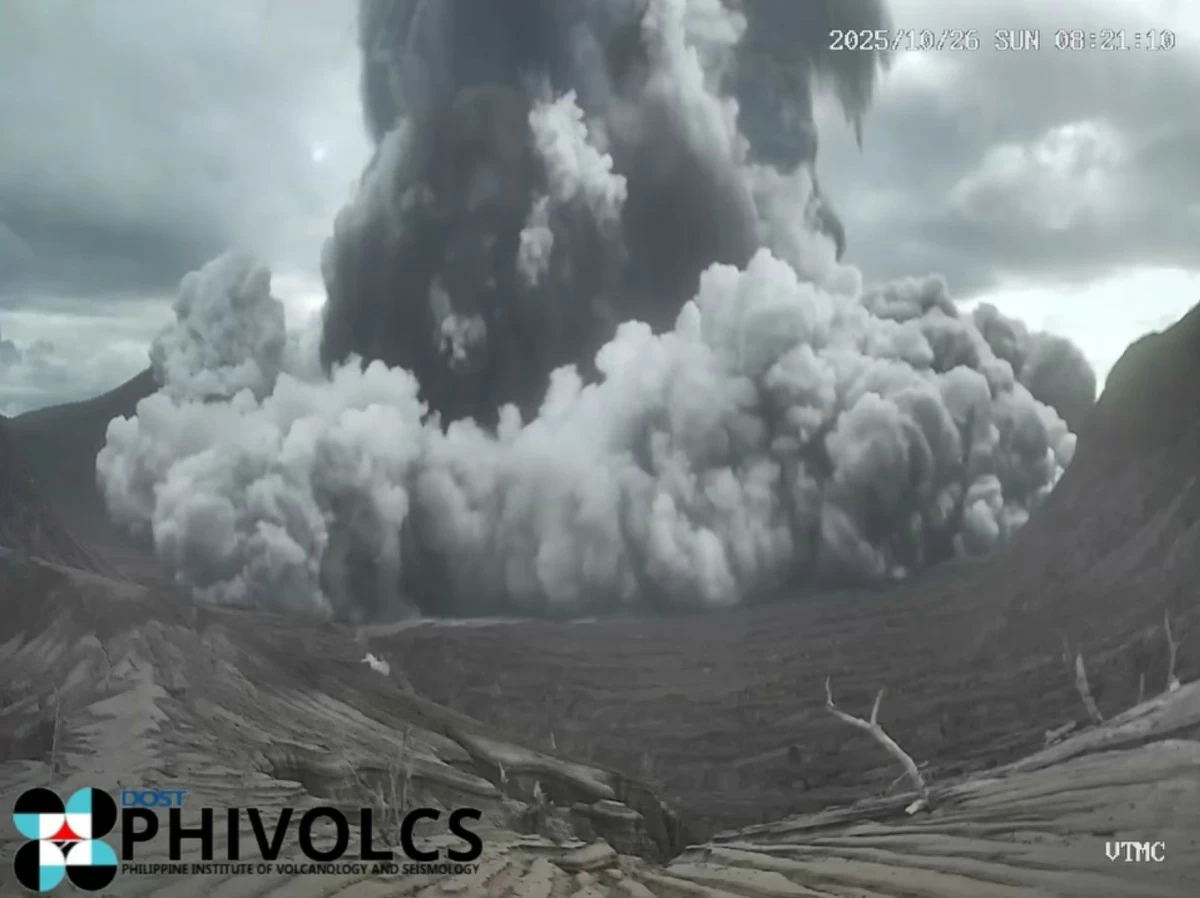
Plumes rise from the Main Crater of Taal Volcano during a series of minor eruptions on Sunday, October 26, 2025. The Philippine Institute of Volcanology and Seismology (Phivolcs) recorded one phreatic and two phreatomagmatic explosions that produced plumes reaching up to 2,100 meters high. (Screen grab from Phivolcs Facebook page)
The Philippine Institute of Volcanology and Seismology (Phivolcs) said it has maintained Alert Level 1 (low-level unrest) over Taal Volcano even after a series of short-lived eruptions were recorded over the weekend.
Four minor eruptions, which include three phreatomagmatic bursts and one phreatic event, at the northeastern portion of the Taal Main Crater were recorded from Saturday afternoon, Oct. 25, to early Sunday morning, Oct. 26.
The events, which lasted between two and four minutes, generated dense plumes that rose 1,200 to 2,100 meters above the vent before drifting southwest.
A phreatic eruption occurs when water comes into contact with hot volcanic materials such as rocks or gases. No magma is involved in this type of eruption, which produces only a steam plume.
Meanwhile, a phreatomagmatic eruption happens when magma interacts with water, generating steam, ash, and occasionally fragmented volcanic materials.
Phivolcs said ashfall and sulfurous fumes were reported in several barangays of Laurel and Agoncillo, Batangas, including Banyaga, Buso-buso, Gulod, Bugaan West, and San Gregorio.
These were mostly brought down by rain, while minor pyroclastic density currents, or ground-hugging mixtures of ash, gas, and rock fragments, were observed within the main crater based on camera recordings.
Despite the activity, Phivolcs said no significant increase in volcanic earthquakes, ground deformation, or sulfur dioxide (SO₂) emission was observed after the eruptions.
The number of volcanic earthquakes recorded remained close to the average of eight per day for October, while sulfur dioxide output on Oct. 25 averaged 436 tons per day, which is far lower than the long-term average of nearly 4,800 tons per day recorded since 2021.
“These parameters are consistent with open-system degassing of magma in shallow storage beneath the Taal Main Crater, generating minor phreatic and phreatomagmatic eruptions,” Phivolcs said.
It added that “no pronounced increases in volcanic earthquake and ground deformation parameters have followed the eruption as of this report. Alert Level 1 is therefore maintained over Taal Volcano.”
Phivolcs reminded the public that “Alert Level 1 means that Taal is still at unrest and that sudden steam-driven or phreatic or minor phreatomagmatic eruptions can occur at any time.”
It warned that these events “can generate life-threatening hazards of pyroclastic density currents, ballistic projectiles, volcanic gas, hot ashfall and others that can impact TVI and cause injury and fatal harm.”
The agency recommended that entry into Volcano Island and the surrounding permanent danger zone, particularly near the Main Crater and the Daang Kastila fissure, remain strictly prohibited.
Local government units were advised to continuously prepare for potential impacts of ashfall and volcanic gas such as SO₂ on their communities, giving special attention to the elderly, those who have diseases, expecting mothers and young children.
Phivolcs also urged civil aviation authorities to advise pilots to avoid flying above TVI as ash and ballistic fragments from any sudden eruption can be hazardous to aircraft.
Taal Volcano, one of the most active in the Philippines, last experienced a major eruption in January 2020 that displaced thousands of residents in Batangas and nearby provinces.
Since then, the volcano has recorded intermittent bursts of minor unrest, but Phivolcs has kept it under Alert Level 1 since July 2024.