







₱3.6-billion Clark food hub development now underway
Published Oct 27, 2025 03:14 pm


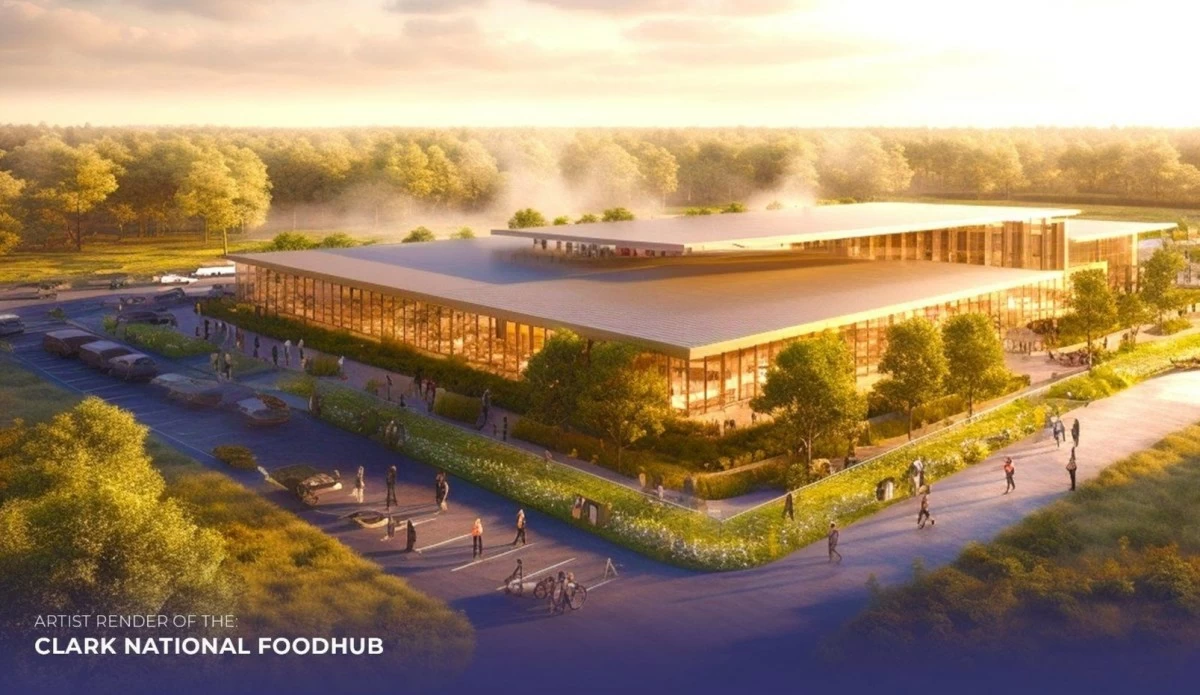
(CIAC photo)
The government is taking a major step toward strengthening the country’s food security as it is now ready to begin the development of the ₱3.6-billion large-scale food hub complex that will rise in Clark, Pampanga.
Both state-run Food Terminal Inc. (FTI) and Clark International Airport Corp. (CIAC) signed on Monday, Oct. 27, a memorandum of agreement (MOA) to kickstart the project’s development.
Under a 25-year lease agreement with CIAC, FTI seeks to develop a 46-hectare (ha) property that would serve as the primary agricultural trading center for northern Luzon.
As envisioned, Clark food hub will combine trading, food storage, processing, logistics, and agri-tourism facilities all under one roof.
The facility will also feature a Halal-certified zone and dedicated spaces for businesses under the government’s One Town, One Product (OTOP) program, which promotes local livelihoods, innovation, and sustainable growth.
FTI, a state-run firm under the Department of Agriculture (DA), plans to start construction work for a 10-ha section of the project starting early next year.
Under the proposed ₱6.793-trillion 2026 national budget, the government has earmarked ₱2.1 billion for the project next year.
FTI President and Chief Executive Officer (CEO) Joseph Lo said the massive project is seen as a revival of FTI’s original mission of connecting farmers straight to consumers.
“The hub will encourage producers and entrepreneurs, ensure fair farm-gate prices, lower food costs, reduce post-harvest losses, create jobs, and stabilize supply,” said Lo.
Inspired by the current administration’s naming scheme, patterned after President Ferdinand “Bongbong” R. Marcos Jr.’s initials, the project will be officially recognized as “Bagsakan ng Bayan Mega Food Hub”—or BBM Food Hub in short.
Beyond the food hub’s construction, the partnership between FTI and CIAC also involves the project’s operations and maintenance (O&M).
CIAC President and CEO Joseph Alcazar said this is seen as a response to Marcos’ directive to prioritize agricultural development while advancing the country’s logistics value chain.
Alcazar said these improvements will be immediately apparent within Clark Freeport Zone, New Clark City, Metro Manila, and the regions of northern, central, and southern Luzon.
CIAC, the aviation and land-development arm of state-run Bases Conversion and Development Authority (BCDA), considers Clark food hub as one of its flagship projects to transform prime government land surrounding Clark International Airport into a major logistics hub.
Agriculture Secretary Francisco Tiu Laurel, who witnessed the signing ceremony, said the project would be modeled after successful initiatives in countries like Thailand, where food hubs have been a key driver of agricultural progress.
To ensure that the Philippines would follow suit, Tiu Laurel said Clark food hub is just one of several mega food hubs the DA will develop to ensure long-term food security.
The DA is planning to build a 40-ha hub in Bukidnon province to service the island of Mindanao, while a 30-ha hub is planned in Quezon province to serve produce from southern Luzon and Bicol regions.
In a recent market intelligence report by the United States (US) Department of Commerce’s International Trade Administration (ITA), Clark food hub was cited as a prominent project that could entice American investments.
ITA, in particular, said the facility presents investment opportunities for agribusiness and logistics firms looking to expand their presence in the Philippines.
ITA added that investors could harness the food hub to “expand market presence, modernize infrastructure, and introduce global best practices in food handling, processing, and supply-chain management.”