ADVERTISEMENT

World Bank urges Philippines to accelerate RE deployment amid rising emissions

Published Oct 24, 2025 03:31 pm
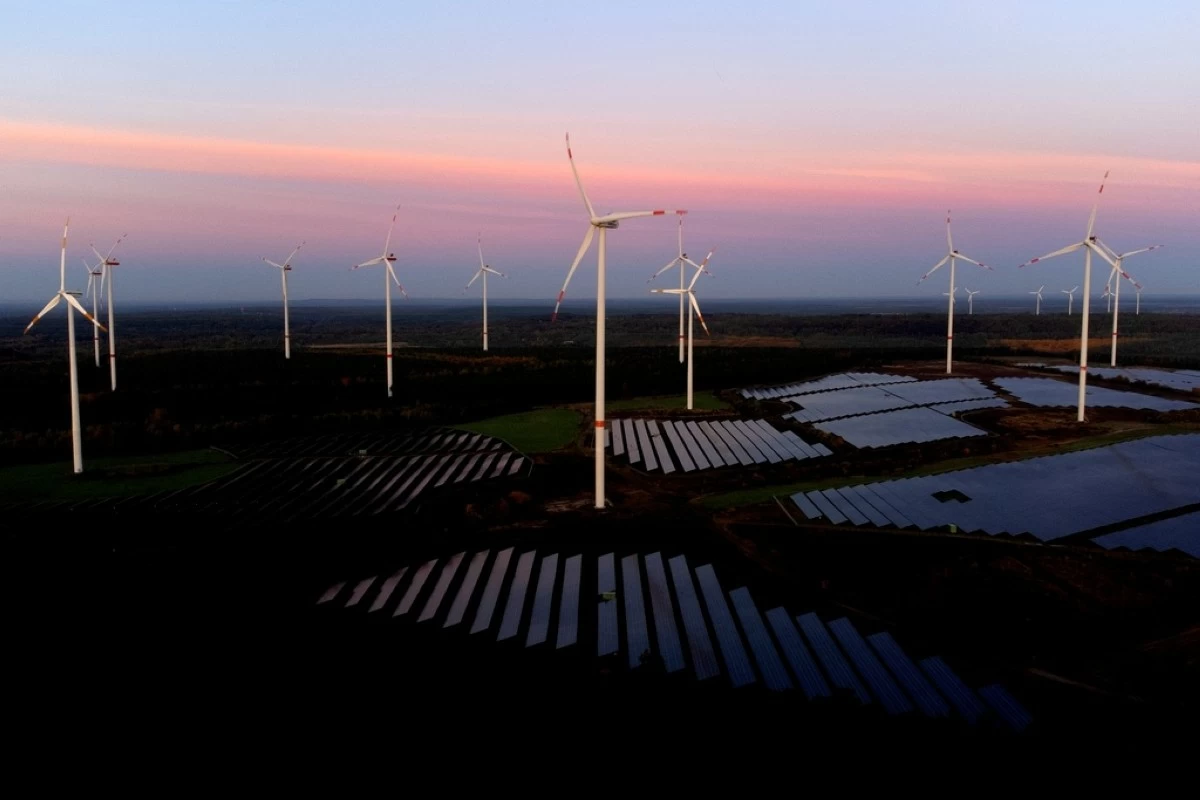
FILE - Wind turbines operate as the sun rises at the Klettwitz Nord solar energy park near Klettwitz, Germany, Oct. 16, 2024. (AP Photo/Matthias Schrader, File)
The Philippine government must address barriers to scaling up variable renewable energy (VRE), particularly in areas such as grid infrastructure, permitting, auction design, and market competition, according to the World Bank (WB).
In a report titled “Decarbonizing the Power Sector in East Asia: Unlocking Investment to Empower Low-Carbon Growth and Competitiveness,” the WB recommended accelerating the deployment of VRE in the country, referring to power from intermittent sources like solar and wind, whose output depends on environmental conditions.
The WB highlighted that energy-related greenhouse gas (GHG) emissions are rising in the Philippines and other East Asia and Pacific (EAP) countries, including China, Indonesia, and Vietnam.
“This rise in energy-related emissions is mainly due to the power and industrial sectors,” the WB noted in the report published on Oct. 22.
The WB stressed the importance of adopting an integrated energy-planning framework that aligns national renewable energy (RE) targets with overall system development.
It emphasized that power sector plans should correspond with the country’s nationally determined contributions (NDCs) and broader climate goals to clearly define the sector’s role in reducing emissions.
Despite the push for RE, the Philippines’ energy sector posted a decline in 2024, with revenues from coal, oil, natural gas, and condensate falling 13.2 percent to ₱285.73 billion from ₱329.27 billion in 2023, according to the Philippine Statistics Authority (PSA).
The WB underscored that achieving net-zero targets requires accelerating RE deployment. The Philippines aims to expand its capacity from two gigawatts (GW) in 2023 to 350 GW by 2025, with the majority expected to come from VRE sources.
To achieve these targets, the WB said, “Governments should establish interministerial coordination platforms and shared datasets to enable coherent implementation and avoid contradictions across documents.”
The WB emphasized that the Philippines needs to optimize the roles of the public and private sectors in transmission and grid infrastructure upgrades and address a key bottleneck by resolving right-of-way (ROW) issues, including revising compensation schemes.
The WB added that the Energy Regulatory Commission (ERC) should proactively expedite pending National Grid Corp. of the Philippines (NGCP) transmission applications.
It also cited the need to prioritize National Transmission Corp. (TransCo)-led public-private partnerships (PPPs) for grid upgrades beyond the transmission development plan to enhance support for VRE.
“With the executive order (EO) enabling TransCo to step up its role in constructing grid infrastructure still pending,” the WB stressed, “the Office of the President (OP) must expedite its issuance.”
“The Philippines must balance public and private sector investments for timely network upgrades and streamline issues such as ROW, which have delayed upgrades in the past,” the WB added.
The WB also emphasized that the Philippines must broaden the scope of the Department of Energy’s (DOE) Energy Virtual One-Stop Shop (EVOSS), launched in 2019, transforming it into a single permitting hub that coordinates with local government units (LGUs) and agencies such as the Department of Agrarian Reform (DAR) to facilitate land acquisition, reduce costs, improve coordination, and expedite project timelines.
“Global experience shows coordinated licensing and permitting improve developer execution and support sector success,” the WB added.
The WB also underscored the need to refine RE auction designs and requirements, such as performance bonds.
Finally, the WB recommended promoting a fully competitive retail market by fully implementing the Retail Competition and Open Access (RCOA) framework and expanding access to direct RE procurement.
The WB added that, as the Philippines—together with Vietnam—advances compliance frameworks, private actors pursuing net-zero and carbon neutrality are increasingly using voluntary carbon markets (VCMs), which can improve project financials for VRE developers.
(Ricardo M. Austria)
ADVERTISEMENT
.most-popular .layout-ratio{ padding-bottom: 79.13%; } @media (min-width: 768px) and (max-width: 1024px) { .widget-title { font-size: 15px !important; } }

{{ articles_filter_1561_widget.title }}

.most-popular .layout-ratio{ padding-bottom: 79.13%; } @media (min-width: 768px) and (max-width: 1024px) { .widget-title { font-size: 15px !important; } }

{{ articles_filter_1562_widget.title }}

.most-popular .layout-ratio{ padding-bottom: 79.13%; } @media (min-width: 768px) and (max-width: 1024px) { .widget-title { font-size: 15px !important; } }

{{ articles_filter_1563_widget.title }}

{{ articles_filter_1564_widget.title }}

.mb-article-details { position: relative; } .mb-article-details .article-body-preview, .mb-article-details .article-body-summary{ font-size: 17px; line-height: 30px; font-family: "Libre Caslon Text", serif; color: #000; } .mb-article-details .article-body-preview iframe , .mb-article-details .article-body-summary iframe{ width: 100%; margin: auto; } .read-more-background { background: linear-gradient(180deg, color(display-p3 1.000 1.000 1.000 / 0) 13.75%, color(display-p3 1.000 1.000 1.000 / 0.8) 30.79%, color(display-p3 1.000 1.000 1.000) 72.5%); position: absolute; height: 200px; width: 100%; bottom: 0; display: flex; justify-content: center; align-items: center; padding: 0; } .read-more-background a{ color: #000; } .read-more-btn { padding: 17px 45px; font-family: Inter; font-weight: 700; font-size: 18px; line-height: 16px; text-align: center; vertical-align: middle; border: 1px solid black; background-color: white; } .hidden { display: none; }
function initializeAllSwipers() { // Get all hidden inputs with cms_article_id document.querySelectorAll('[id^="cms_article_id_"]').forEach(function (input) { const cmsArticleId = input.value; const articleSelector = '#article-' + cmsArticleId + ' .body_images'; const swiperElement = document.querySelector(articleSelector); if (swiperElement && !swiperElement.classList.contains('swiper-initialized')) { new Swiper(articleSelector, { loop: true, pagination: false, navigation: { nextEl: '#article-' + cmsArticleId + ' .swiper-button-next', prevEl: '#article-' + cmsArticleId + ' .swiper-button-prev', }, }); } }); } setTimeout(initializeAllSwipers, 3000); const intersectionObserver = new IntersectionObserver( (entries) => { entries.forEach((entry) => { if (entry.isIntersecting) { const newUrl = entry.target.getAttribute("data-url"); if (newUrl) { history.pushState(null, null, newUrl); let article = entry.target; // Extract metadata const author = article.querySelector('.author-section').textContent.replace('By', '').trim(); const section = article.querySelector('.section-info ').textContent.replace(' ', ' '); const title = article.querySelector('.article-title h1').textContent; // Parse URL for Chartbeat path format const parsedUrl = new URL(newUrl, window.location.origin); const cleanUrl = parsedUrl.host + parsedUrl.pathname; // Update Chartbeat configuration if (typeof window._sf_async_config !== 'undefined') { window._sf_async_config.path = cleanUrl; window._sf_async_config.sections = section; window._sf_async_config.authors = author; } // Track virtual page view with Chartbeat if (typeof pSUPERFLY !== 'undefined' && typeof pSUPERFLY.virtualPage === 'function') { try { pSUPERFLY.virtualPage({ path: cleanUrl, title: title, sections: section, authors: author }); } catch (error) { console.error('ping error', error); } } // Optional: Update document title if (title && title !== document.title) { document.title = title; } } } }); }, { threshold: 0.1 } ); function showArticleBody(button) { const article = button.closest("article"); const summary = article.querySelector(".article-body-summary"); const body = article.querySelector(".article-body-preview"); const readMoreSection = article.querySelector(".read-more-background"); // Hide summary and read-more section summary.style.display = "none"; readMoreSection.style.display = "none"; // Show the full article body body.classList.remove("hidden"); } document.addEventListener("DOMContentLoaded", () => { let loadCount = 0; // Track how many times articles are loaded const offset = [1, 2, 3, 4, 5, 6, 7, 8, 9, 10]; // Offset values const currentUrl = window.location.pathname.substring(1); let isLoading = false; // Prevent multiple calls if (!currentUrl) { console.log("Current URL is invalid."); return; } const sentinel = document.getElementById("load-more-sentinel"); if (!sentinel) { console.log("Sentinel element not found."); return; } function isSentinelVisible() { const rect = sentinel.getBoundingClientRect(); return ( rect.top < window.innerHeight && rect.bottom >= 0 ); } function onScroll() { if (isLoading) return; if (isSentinelVisible()) { if (loadCount >= offset.length) { console.log("Maximum load attempts reached."); window.removeEventListener("scroll", onScroll); return; } isLoading = true; const currentOffset = offset[loadCount]; window.loadMoreItems().then(() => { let article = document.querySelector('#widget_1690 > div:nth-last-of-type(2) article'); intersectionObserver.observe(article) loadCount++; }).catch(error => { console.error("Error loading more items:", error); }).finally(() => { isLoading = false; }); } } window.addEventListener("scroll", onScroll); });

Sign up by email to receive news.