







Phivolcs records brief explosive eruption at Kanlaon Volcano
Published Oct 24, 2025 08:59 pm


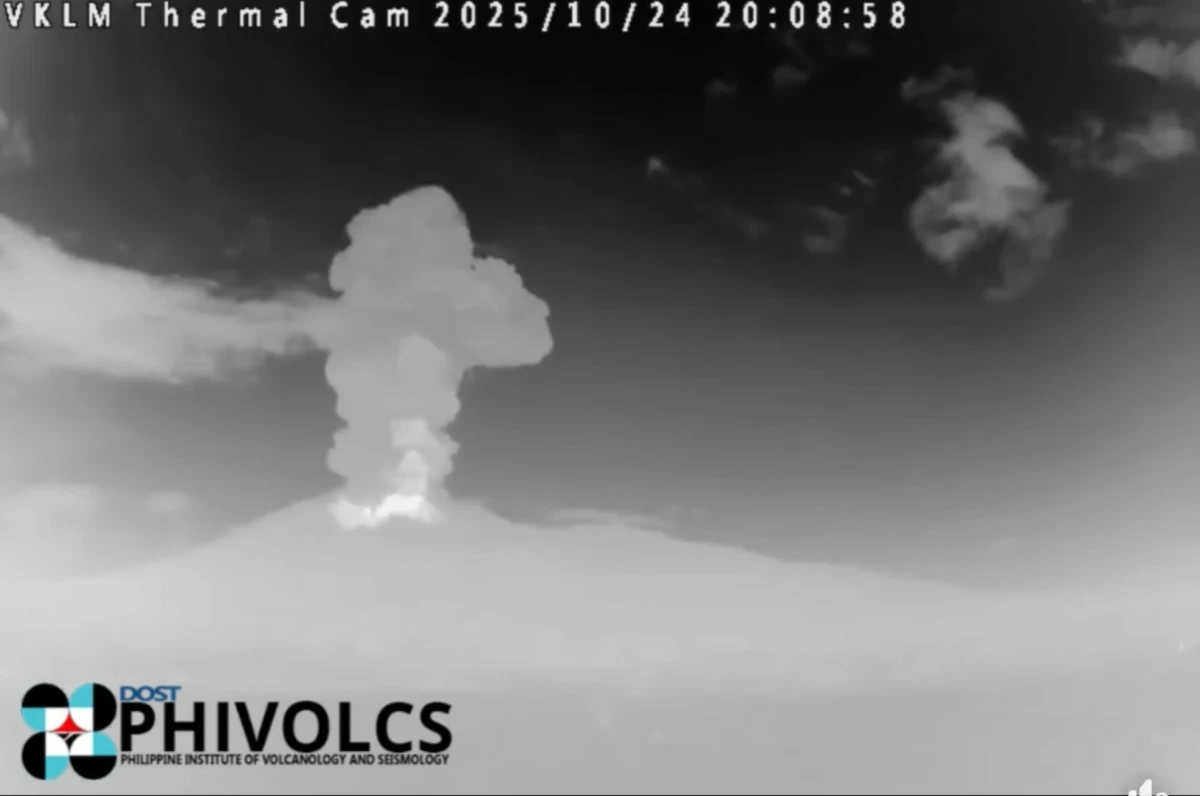
Screen grab from the Philippine Institute of Volcanology and Seismology’s (Phivolcs) time-lapse footage shows the minor explosive eruption of Kanlaon Volcano on Friday evening, Oct. 24, 2025. The eruption plume rose about 2,000 meters above the crater before drifting northeast, as recorded by the IP camera at the Lower Masulog, Canlaon City observation station. (Phivolcs’ Facebook page)
The Philippine Institute of Volcanology and Seismology (Phivolcs) recorded a minor explosive eruption at the summit crater of Kanlaon Volcano on Friday evening, Oct. 24.
Based on a time-lapse footage from 8:05 p.m. to 8:08 p.m., the eruption produced a plume that rose about 2,000 meters above the crater before drifting northeast, Phivolcs said.
The event was captured by the IP camera at the Lower Masulog, Canlaon City observation station.
Pyroclastic density currents were also observed descending the southern upper slopes within one kilometer of the summit crater.
Phivolcs reminded the public that Alert Level 2 remains in effect, meaning the volcano is still under a state of moderate unrest and that sudden steam-driven or phreatic eruptions could occur.
Residents and visitors are advised to stay outside the four-kilometer permanent danger zone due to the risk of sudden explosions, pyroclastic density currents, rockfalls, and exposure to harmful volcanic gases.
Local government units were urged to maintain preparedness for possible evacuation scenarios, while civil aviation authorities were advised to avoid flying close to the volcano’s summit due to potential ash that could endanger aircraft.
Phivolcs also warned that heavy rainfall could generate lahars or sediment-laden streamflows in rivers and drainages surrounding the volcano.
Kanlaon Volcano, one of the most active in the Philippines, straddles the provinces of Negros Occidental and Negros Oriental on Negros Island.