






Manila Bulletin
 Philippines
National
'Magnakaw, gusto? Magtayo ng klasrum, ayaw?': Group hits DPWH's classroom failure
Philippines
National
'Magnakaw, gusto? Magtayo ng klasrum, ayaw?': Group hits DPWH's classroom failure
Philippines
National
'Magnakaw, gusto? Magtayo ng klasrum, ayaw?': Group hits DPWH's classroom failure
'Magnakaw, gusto? Magtayo ng klasrum, ayaw?': Group hits DPWH's classroom failure
ACT Philippines urges Marcos admin to act on education crisis
Published Oct 22, 2025 04:08 pm


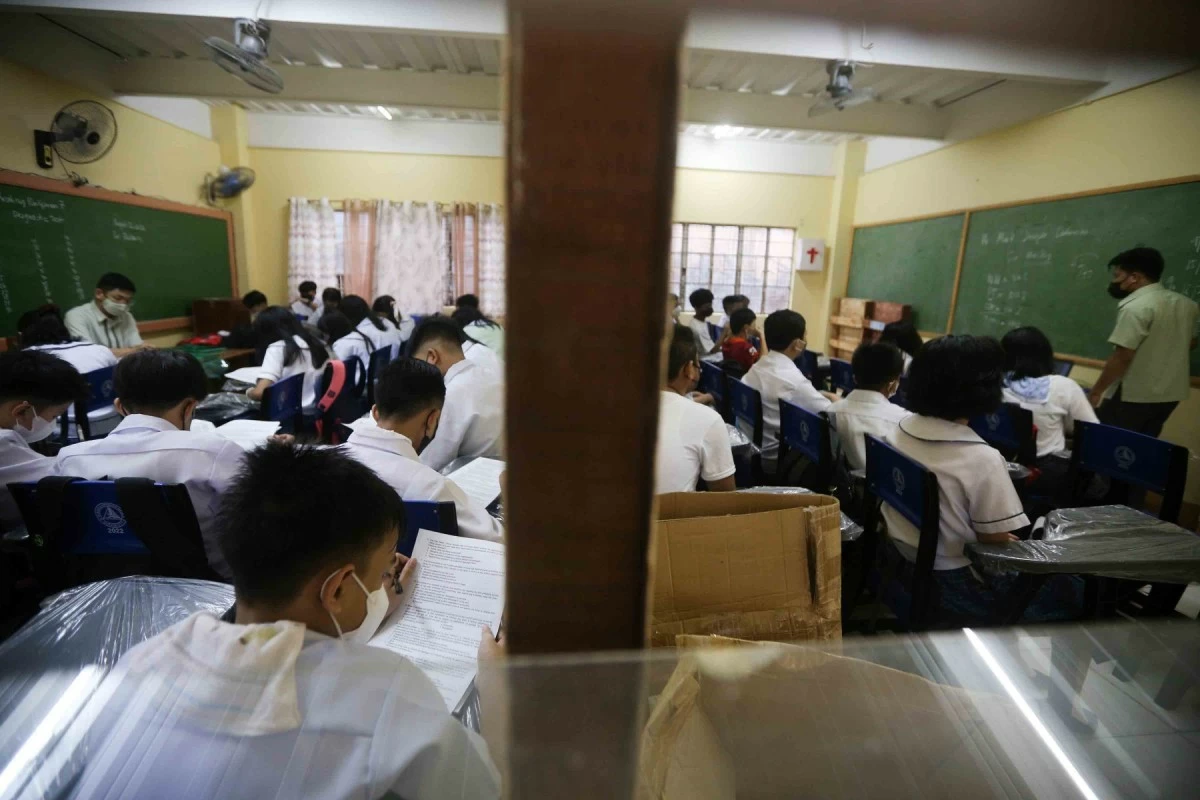
A file photo shows a classroom divided into two to accommodate students. The Alliance of Concerned Teachers (ACT) criticized the Department of Public Works and Highways (DPWH) for completing only 22 of its 1,700 target classrooms for 2025, calling it a sign of government neglect and urging the Marcos administration to prioritize education infrastructure and increase the budget. (Manila Bulletin)
A teachers’ group on Wednesday, October 22, slammed the Department of Public Works and Highways (DPWH) for its failure to meet classroom construction targets, urging the Marcos administration to intervene and address what it called a worsening education infrastructure crisis.
The Alliance of Concerned Teachers (ACT) denounced what it described as the DPWH’s “dismal” record in classroom construction, saying the government’s failure to deliver exposes its “lip service” to education reform.
Citing official data, ACT revealed that as of October 2025, the DPWH had completed only 22 classrooms out of its 1,700 target for the year, with more than 800 projects yet to begin.
“Magnakaw, gusto? Magtayo ng klasrum, ayaw? (Stealing? They’re eager. But building classrooms? They refuse?),” ACT Chairperson Ruby Bernardo said as the group expressed outrage over the government’s failure to address the severe classroom shortage in the country.
Bernardo pointed out that the goal of constructing only 1,700 classrooms is already grossly inadequate to meet the staggering deficit of 165,000—and yet, only a small fraction of that target has been completed this year.
Worse, she noted, over 800 classrooms have not even been started.
Bernardo emphasized the dire conditions faced by teachers and students, with thousands of learners crammed into hot, noisy classrooms—some even divided in half—or forced to hold classes in covered courts and makeshift structures.
“Malinaw na matinding pagpapabaya ito ng estado sa sektor ng edukasyon at sa karapatan ng kabataan sa de-kalidad na edukasyon (This is clearly a severe neglect by the state of the education sector and of the youth’s right to quality education),” Bernardo said.
ACT said the extremely low completion rate underscores misplaced government priorities, noting that while the DPWH funneled billions of pesos into flood control projects—some now under investigation for alleged corruption—education infrastructure was left to deteriorate.
“Children’s right to safe and adequate learning spaces was completely abandoned,” ACT said, calling the situation “not mere incompetence but criminal neglect.”
Skepticism over the proposed CBAP
Meanwhile, the group expressed doubts over the proposed Classroom-Building Acceleration Program (CBAP), which involves local government units (LGUs) and private contractors in school-building projects.
“While presented as a solution to the worsening backlog, CBAP effectively shifts the national government’s constitutional duty to provide free, quality education onto local governments and the private sector,” Bernardo said.
READ:
Instead of outsourcing its responsibility, ACT said the Marcos administration and the Department of Education (DepEd) must “fix and streamline the classroom construction process, hold erring officials accountable for anomalies and corruption in school-building projects, and ensure that agencies mandated to deliver these services are competent, transparent, and credible.”
ACT further lamented that billions are lost to corruption while public schools continue to suffer from shortages of teachers, textbooks, and basic facilities.
“This is nothing less than a grave injustice to teachers, learners, and the Filipino people,” Bernardo added.
The teachers’ group urged the Marcos administration to take “decisive action” on the worsening classroom crisis and called for a higher education budget equivalent to six percent of GDP, which it said is necessary to address infrastructure gaps, improve learning recovery, and uplift the conditions of teachers and education support personnel.
RELATED STORY: